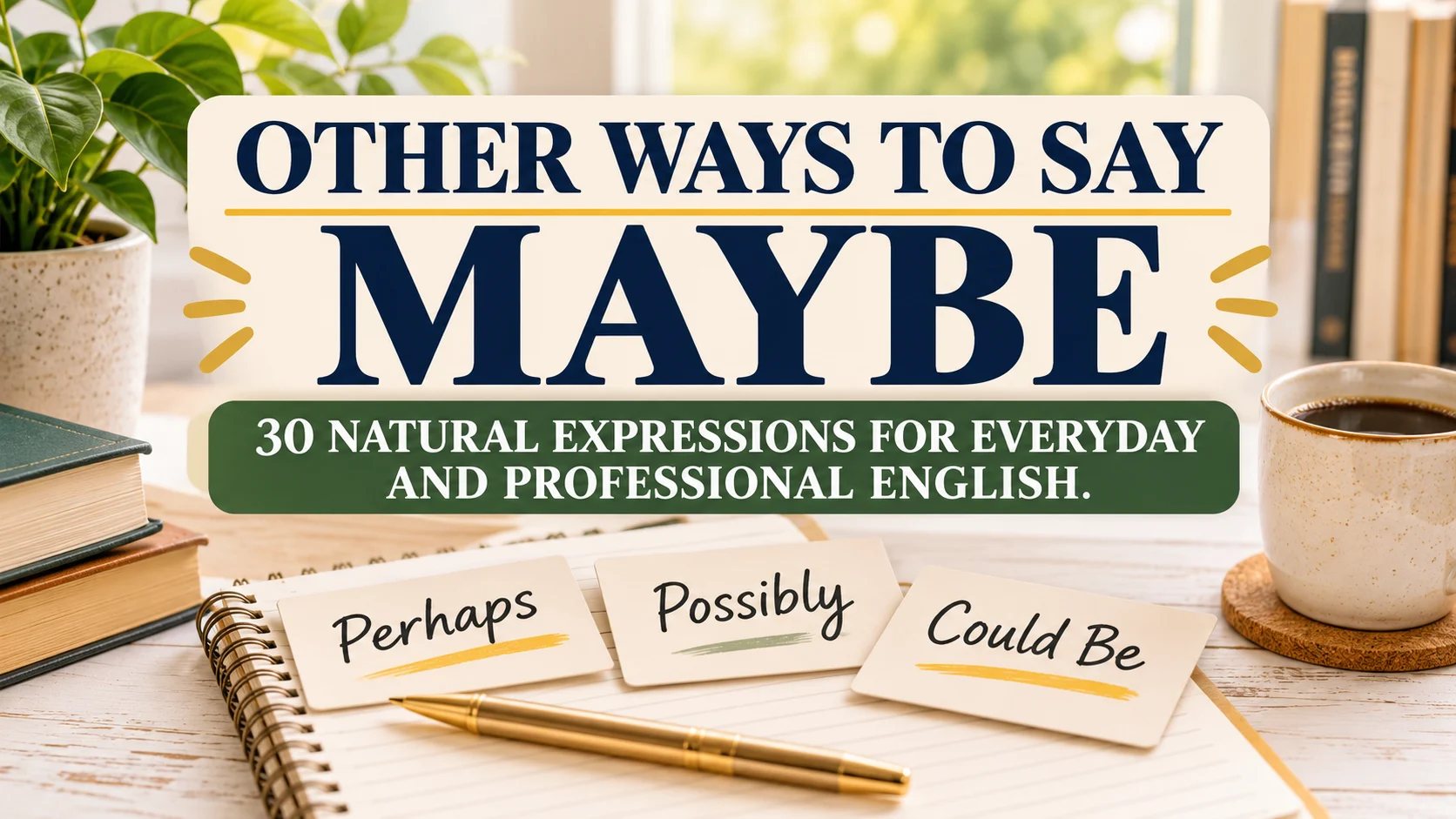
The best alternatives to maybe include perhaps, possibly, potentially, it is likely, there is a chance, and I suppose. These expressions help you communicate uncertainty, possibility, and hesitation naturally while adapting your language to formal, casual, and professional situations.
Introduction
The word “maybe” is one of the most common expressions in everyday English. People use it when they are unsure about something, want to suggest a possibility, or prefer not to give a definite answer. Whether you are talking with friends, responding to a colleague, or writing a professional email, this simple word helps communicate uncertainty without making a firm commitment.
However, repeating the same expression can make your communication sound predictable. Learning alternatives to maybe allows you to express different levels of certainty, sound more fluent, and choose language that suits your audience. For example, “perhaps” sounds slightly more polished, while “there is a possibility” works well in professional discussions.
Understanding how to express excitement in English is useful, but knowing how to communicate uncertainty is equally important. The right expression can make your conversations more natural, your emails more professional, and your responses more precise.
In this guide, you will discover 30 useful expressions, complete with meanings, explanations, natural examples, and practical usage tips.
Formal Alternatives to “Maybe”
When writing academic papers, formal emails, business proposals, or professional documents, choosing polished expressions can make your English sound more confident and precise.
Here are four formal options:
- Perhaps: A polite way to suggest something without expressing complete certainty.
- Possibly: Indicates that something could happen or be true.
- Potentially: Describes something that may happen under certain circumstances.
- It is conceivable that: Introduces an idea or situation that is possible to imagine.
Pro Tip
Use “perhaps” in formal conversations and “it is conceivable that” when discussing theoretical possibilities. Avoid unnecessarily complicated expressions when a simple word communicates your meaning.
Casual Alternatives to “Maybe”
Casual expressions are useful when chatting with friends, discussing plans, or responding naturally in everyday conversations.
- I guess: Expresses an uncertain opinion or assumption.
- I suppose: Suggests something is probably true, although you are not completely certain.
- Could be: Indicates that something is possible.
- Might be: Expresses a possibility without making a definite statement.
Pro Tip
Use “could be” and “might be” when you want to sound relaxed without appearing dismissive. “I suppose” is useful when you want to communicate mild hesitation.
Professional Alternatives to “Maybe”
In workplace communication, your choice of words can influence how confident, thoughtful, and cooperative you sound.
Consider these professional reaction phrases:
- There is a possibility: Communicates that something may happen.
- It is a possibility: Acknowledges an option without confirming it.
- That could be an option: Politely introduces a potential solution.
- Subject to confirmation: Indicates that something depends on further verification.
Pro Tip
In business emails, explain what the possibility depends on. For example, “We could proceed, subject to management approval” sounds clearer than simply saying “Maybe.”
Informal Expressions
Informal expressions in English are particularly useful for texting, friendly conversations, and relaxed discussions.
- Who knows?: Suggests that something is uncertain or unpredictable.
- You never know: Indicates that something unexpected could happen.
- It might happen: Expresses that an event is possible.
- We’ll see: Suggests that a decision or outcome will become clear later.
Pro Tip
These expressions work best when speaking with friends or familiar colleagues. Avoid using overly casual responses in formal business correspondence.
“Fluent English is not about using complicated words. It is about choosing the right words for the right situation.”
Common Mistakes People Make When Using “Maybe”
Although “maybe” is simple, learners sometimes use it in ways that make their communication unclear or grammatically incorrect.
Here are five mistakes to avoid.
1. Using “Maybe” When a Definite Answer Is Required
Sometimes people use “maybe” even when they already know their decision.
Incorrect: “Maybe I will submit the report today.”
Better: “I will submit the report today.”
2. Confusing “Maybe” With “May Be”
“Maybe” is an adverb, while “may be” is a verb phrase.
Incorrect: “She maybe available tomorrow.”
Correct: “She may be available tomorrow.”
3. Using Too Many Uncertainty Expressions Together
Combining several expressions can make your sentence unnecessarily hesitant.
Incorrect: “Maybe perhaps we could possibly meet.”
Better: “Perhaps we could meet.”
4. Using Casual Expressions in Formal Emails
Expressions such as “I guess” may sound too relaxed in formal correspondence.
Less professional: “I guess we can approve the proposal.”
Better: “We may be able to approve the proposal.”
5. Using “Maybe” Without Explaining Important Conditions
When discussing business decisions, uncertainty should be explained clearly.
Unclear: “Maybe we can finish the project.”
Better: “We may finish the project if the required resources are available.”
What Does “Maybe” Mean?
“Maybe” means that something is possible but not certain. It communicates uncertainty, hesitation, or the possibility that an event or situation could happen.
It is commonly used when someone does not know the answer, has not made a decision, or wants to avoid giving a definite commitment.
Grammar Explanation
“Maybe” is an adverb. It modifies a sentence or statement to indicate possibility or uncertainty.
It is commonly placed:
- At the beginning: Maybe she will join us.
- Before the main idea: We maybe need more time. (Less natural in many contexts; “We may need more time” is preferable.)
- As a standalone response: “Are you coming?” “Maybe.”
Example:
“Maybe we can arrange another meeting next week.”
In this sentence, the speaker suggests a possible meeting without confirming the arrangement.
When to Use “Maybe”
The word “maybe” is appropriate in several everyday and professional situations.
Common contexts include:
- Making suggestions: When proposing an idea without insisting on it.
- Discussing future plans: When you are uncertain about your availability.
- Answering questions: When you do not know something for certain.
- Expressing hesitation: When you need more time to decide.
- Discussing possibilities: When an outcome is possible but not guaranteed.
- Avoiding firm commitments: When you cannot confidently promise something.
Spoken vs. Written Usage
| Situation | Recommended Expression |
|---|---|
| Everyday conversation | Maybe |
| Friendly text messages | I guess |
| Formal writing | Perhaps |
| Business emails | There is a possibility |
| Academic writing | Potentially |
| Professional meetings | That could be an option |
Formal vs. Informal Usage
Formal communication generally benefits from expressions such as “perhaps,” “possibly,” and “it is conceivable that.”
Informal communication allows more relaxed expressions, including “I guess,” “could be,” and “we’ll see.”
The important thing is to match your language to your audience.
Is It Professional or Polite to Say “Maybe”?
Yes, “maybe” is generally polite because it allows you to communicate uncertainty without directly rejecting an idea.
However, it is not always the most professional choice. In business communication, it can sometimes make you sound indecisive, especially when someone expects a clear response.
Business-style example:
Instead of:
“Maybe we can complete the project by Friday.”
Write:
“We may be able to complete the project by Friday, depending on the availability of the required resources.”
Politeness:
Yes
Professionalism:
Not always
“Maybe” is acceptable in relaxed workplace conversations, but more specific expressions are usually preferable in formal emails, proposals, and important business discussions.
Pros and Cons of Using “Maybe”
Understanding the strengths and limitations of this expression can help you decide when to use it.
Pros
- Simple and natural: Easy to understand and use in everyday communication.
- Friendly tone: Helps conversations feel relaxed and approachable.
- Common usage: Widely understood by native and non-native English speakers.
- Easy to understand: Communicates uncertainty without requiring complicated explanations.
Cons
- Too informal for work: May not communicate sufficient professionalism in important business situations.
- Overused: Repeating it can make your vocabulary sound limited.
- Limited emotional range: Does not always communicate the exact degree of uncertainty.
- Not suitable for formal writing: More precise alternatives are often better for academic and professional documents.
“The difference between sounding uncertain and sounding thoughtful often comes down to one carefully chosen expression.”
Other Ways to Say Maybe (With Examples)
These 30 alternatives will help you sound more fluent, confident, and natural in different situations.
Use them according to tone, context, and audience to communicate uncertainty, possibility, or hesitation accurately.
1. Perhaps
Meaning: Something is possible, although it is not certain.
Explanation: A polished alternative that works in formal and everyday communication.
Example Sentence: Perhaps we should discuss the proposal before making a final decision.
Best Use: Formal discussions
Worst Use: Definite answers
Tone: Polite, neutral, thoughtful
Context Variability:
- Casual: Perhaps we can meet later.
- Professional: Perhaps we should review the figures.
- Spoken: Perhaps you’re right.
2. Possibly
Meaning: Something could happen or be true.
Explanation: Useful when discussing uncertain situations or potential outcomes.
Example Sentence: We could possibly finish the assignment by Thursday.
Best Use: Formal writing
Worst Use: Firm commitments
Tone: Neutral, cautious, professional
Context Variability:
- Casual: Could you possibly help me?
- Professional: We may possibly extend the deadline.
- Spoken: It could possibly happen.
3. Potentially
Meaning: Something may happen or develop under certain conditions.
Explanation: Commonly used in professional, academic, and analytical discussions.
Example Sentence: This strategy could potentially improve our overall performance.
Best Use: Business discussions
Worst Use: Simple greetings
Tone: Analytical, professional, neutral
Context Variability:
- Casual: That could potentially work.
- Professional: This change could potentially reduce costs.
- Spoken: It is potentially a good idea.
4. I Guess
Meaning: Expresses an uncertain opinion or personal assumption.
Explanation: A relaxed phrase used when you are not entirely convinced.
Example Sentence: I guess we could try a different approach.
Best Use: Friendly conversations
Worst Use: Formal emails
Tone: Casual, hesitant, relaxed
Context Variability:
- Casual: I guess I’ll stay home.
- Professional: I guess we could reconsider. (Better replaced in formal meetings.)
- Spoken: I guess you’re right.
5. I Suppose
Meaning: Indicates that something seems reasonable or possible.
Explanation: Often communicates mild uncertainty or reluctant agreement.
Example Sentence: I suppose we can schedule the meeting for Monday.
Best Use: Casual discussions
Worst Use: Urgent decisions
Tone: Thoughtful, hesitant, neutral
Context Variability:
- Casual: I suppose that’s fine.
- Professional: I suppose we could consider that option.
- Spoken: I suppose you’re correct.
6. Could Be
Meaning: Something is possible but not confirmed.
Explanation: A short, natural expression for responding to uncertain situations.
Example Sentence: That could be the reason the system stopped working.
Best Use: Everyday conversation
Worst Use: Formal reports
Tone: Neutral, relaxed, tentative
Context Variability:
- Casual: Could be!
- Professional: That could be a workable solution.
- Spoken: It could be true.
7. Might Be
Meaning: Indicates that something may be true or may happen.
Explanation: Useful for discussing possibilities without making definite claims.
Example Sentence: She might be interested in joining the project.
Best Use: Everyday discussions
Worst Use: Confirmed facts
Tone: Neutral, cautious, natural
Context Variability:
- Casual: It might be fun.
- Professional: This might be worth reviewing.
- Spoken: He might be available.
8. There Is a Possibility
Meaning: Something may happen or exist.
Explanation: A clear expression that communicates uncertainty in a professional manner.
Example Sentence: There is a possibility that the delivery will arrive tomorrow.
Best Use: Business communication
Worst Use: Quick replies
Tone: Professional, neutral, cautious
Context Variability:
- Casual: There’s a possibility we can go.
- Professional: There is a possibility of extending the agreement.
- Spoken: There is a possibility it will rain.
9. It Is a Possibility
Meaning: A particular outcome or suggestion could be realistic.
Explanation: Useful when acknowledging an idea without confirming it.
Example Sentence: Working remotely next week is a possibility.
Best Use: Workplace discussions
Worst Use: Definite decisions
Tone: Professional, measured, neutral
Context Variability:
- Casual: It’s a possibility.
- Professional: A revised schedule is a possibility.
- Spoken: Yes, it is a possibility.
10. That Could Be an Option
Meaning: A particular suggestion may be worth considering.
Explanation: A diplomatic way to respond to proposed solutions.
Example Sentence: Moving the meeting online could be an option.
Best Use: Team discussions
Worst Use: Final approvals
Tone: Cooperative, professional, diplomatic
Context Variability:
- Casual: That could be an option.
- Professional: An alternative supplier could be an option.
- Spoken: That could work as an option.
11. Subject to Confirmation
Meaning: Something is possible but requires verification or approval.
Explanation: Commonly used in professional communication when details are not finalized.
Example Sentence: The booking is available for Friday, subject to confirmation.
Best Use: Business emails
Worst Use: Casual chats
Tone: Formal, precise, professional
Context Variability:
- Casual: We can go, subject to confirmation. (Unusually formal.)
- Professional: The proposed date is subject to confirmation.
- Spoken: The arrangement is subject to confirmation.
12. It Is Conceivable That
Meaning: Something is possible to imagine or consider.
Explanation: A formal expression used when discussing theoretical possibilities.
Example Sentence: It is conceivable that the company may introduce a new policy.
Best Use: Academic writing
Worst Use: Casual texting
Tone: Formal, analytical, sophisticated
Context Variability:
- Casual: It’s conceivable that it could happen.
- Professional: It is conceivable that demand will increase.
- Spoken: It is conceivable that we may succeed.
13. There Is a Chance
Meaning: Something has some possibility of happening.
Explanation: A natural expression for discussing uncertain outcomes.
Example Sentence: There is a chance that we will finish ahead of schedule.
Best Use: Everyday discussions
Worst Use: Guaranteed outcomes
Tone: Neutral, conversational, hopeful
Context Variability:
- Casual: There’s a chance I’ll come.
- Professional: There is a chance of completing the project early.
- Spoken: There’s a chance it might work.
14. You Never Know
Meaning: Something unexpected could happen.
Explanation: Used when an outcome is uncertain and several possibilities remain open.
Example Sentence: Keep applying for opportunities; you never know what might happen.
Best Use: Friendly advice
Worst Use: Formal proposals
Tone: Encouraging, casual, optimistic
Context Variability:
- Casual: You never know!
- Professional: You never know which opportunity may arise. (Better suited to informal workplace conversation.)
- Spoken: You never know what could happen.
15. Who Knows?
Meaning: Indicates that nobody can be certain about something.
Explanation: A conversational expression used when the outcome is unpredictable.
Example Sentence: Who knows? We might discover a better solution.
Best Use: Friendly conversations
Worst Use: Formal reports
Tone: Casual, curious, relaxed
Context Variability:
- Casual: Who knows? Maybe tomorrow.
- Professional: Who knows what the next quarter will bring? (Informal meeting tone.)
- Spoken: Who knows? Anything is possible.
16. We’ll See
Meaning: A decision or outcome will become clear later.
Explanation: Useful when you do not want to make an immediate commitment.
Example Sentence: We’ll see whether we can arrange another meeting next week.
Best Use: Future plans
Worst Use: Urgent confirmations
Tone: Neutral, reserved, conversational
Context Variability:
- Casual: We’ll see!
- Professional: We’ll see what the revised schedule allows.
- Spoken: Let’s wait and see.
17. It Might Happen
Meaning: An event or situation is possible.
Explanation: A straightforward alternative for discussing uncertain future events.
Example Sentence: It might happen if everyone agrees to the new plan.
Best Use: Future possibilities
Worst Use: Formal guarantees
Tone: Neutral, tentative, straightforward
Context Variability:
- Casual: It might happen.
- Professional: The change might happen next quarter.
- Spoken: It might happen sooner than expected.
18. As Far as I Know
Meaning: Something appears to be true based on the information available to you.
Explanation: This expression communicates limited knowledge rather than pure possibility.
Example Sentence: As far as I know, the office will remain closed tomorrow.
Best Use: Sharing information
Worst Use: Unverified claims
Tone: Cautious, informative, neutral
Context Variability:
- Casual: As far as I know, he’s coming.
- Professional: As far as I know, the application is still under review.
- Spoken: As far as I know, everything is ready.
19. I Would Think So
Meaning: Expresses a belief that something is probably true.
Explanation: Useful when responding positively without claiming complete certainty.
Example Sentence: I would think so, considering how well the team performed.
Best Use: Polite responses
Worst Use: Certain facts
Tone: Thoughtful, polite, tentative
Context Variability:
- Casual: I would think so.
- Professional: I would think so, based on the available information.
- Spoken: I would think so, yes.
20. It Is Not Impossible
Meaning: Something could happen, although it may not be likely.
Explanation: A cautious way of acknowledging that an outcome remains possible.
Example Sentence: It is not impossible that we could reach our target this month.
Best Use: Careful assessments
Worst Use: Simple replies
Tone: Formal, cautious, measured
Context Variability:
- Casual: It’s not impossible.
- Professional: It is not impossible that the deadline could be extended.
- Spoken: It’s not impossible, but it may be difficult.
21. I Wouldn’t Rule It Out
Meaning: You believe something remains possible.
Explanation: Used when you are open to an outcome even if you do not consider it certain.
Example Sentence: I wouldn’t rule out the possibility of launching the product earlier.
Best Use: Strategic discussions
Worst Use: Definite answers
Tone: Thoughtful, cautious, confident
Context Variability:
- Casual: I wouldn’t rule it out.
- Professional: I wouldn’t rule out an alternative approach.
- Spoken: I wouldn’t rule it out just yet.
22. It Remains to Be Seen
Meaning: The outcome is not yet known.
Explanation: A formal expression that emphasizes uncertainty about future developments.
Example Sentence: It remains to be seen whether the new strategy will succeed.
Best Use: Formal discussions
Worst Use: Casual texting
Tone: Formal, analytical, reserved
Context Variability:
- Casual: We’ll see what happens. (More natural.)
- Professional: It remains to be seen how customers will respond.
- Spoken: It remains to be seen whether the plan works.
23. Depending on the Circumstances
Meaning: Something may happen if particular conditions are met.
Explanation: This expression makes clear that an answer depends on specific factors.
Example Sentence: We may approve the request, depending on the circumstances.
Best Use: Conditional decisions
Worst Use: Simple questions
Tone: Professional, cautious, practical
Context Variability:
- Casual: Depending on what happens, I might join.
- Professional: The timeline may change depending on the circumstances.
- Spoken: It depends on the circumstances.
24. There Is a Reasonable Chance
Meaning: Something has a fairly good possibility of happening.
Explanation: Useful when you want to communicate a realistic possibility without guaranteeing the outcome.
Example Sentence: There is a reasonable chance that the proposal will be approved.
Best Use: Business predictions
Worst Use: Certain outcomes
Tone: Professional, measured, optimistic
Context Variability:
- Casual: There’s a reasonable chance.
- Professional: There is a reasonable chance of meeting the deadline.
- Spoken: There’s a reasonable chance it will work.
25. It Is Quite Possible
Meaning: Something has a realistic possibility of happening.
Explanation: A slightly more confident expression than simply saying something might happen.
Example Sentence: It is quite possible that the company will expand next year.
Best Use: Professional discussions
Worst Use: Unlikely events
Tone: Confident, neutral, professional
Context Variability:
- Casual: It’s quite possible.
- Professional: It is quite possible that demand will increase.
- Spoken: It’s quite possible we’ll finish early.
26. For All We Know
Meaning: Something could be true because the available information is incomplete.
Explanation: Used when there are possibilities that cannot yet be confirmed.
Example Sentence: For all we know, the meeting could be postponed.
Best Use: Speculation
Worst Use: Verified information
Tone: Conversational, speculative, cautious
Context Variability:
- Casual: For all we know, they’re already there.
- Professional: For all we know, the requirements may have changed.
- Spoken: For all we know, it could happen tomorrow.
27. It Could Go Either Way
Meaning: Two or more possible outcomes remain uncertain.
Explanation: Useful when you cannot confidently predict the final result.
Example Sentence: The competition is close, so it could go either way.
Best Use: Uncertain outcomes
Worst Use: Confirmed results
Tone: Neutral, conversational, balanced
Context Variability:
- Casual: It could go either way.
- Professional: The negotiations could go either way.
- Spoken: Honestly, it could go either way.
28. There Is a Chance That
Meaning: A particular situation or event may occur.
Explanation: A flexible phrase for introducing a possible outcome.
Example Sentence: There is a chance that the event will be moved indoors.
Best Use: Explaining possibilities
Worst Use: Certain statements
Tone: Neutral, informative, cautious
Context Variability:
- Casual: There’s a chance that I’ll come.
- Professional: There is a chance that the delivery could be delayed.
- Spoken: There’s a chance that we’ll win.
29. I Am Open to the Possibility
Meaning: You are willing to consider something that may happen.
Explanation: A diplomatic expression that communicates flexibility without making a commitment.
Example Sentence: I am open to the possibility of working with a different supplier.
Best Use: Negotiations
Worst Use: Quick replies
Tone: Professional, flexible, diplomatic
Context Variability:
- Casual: I’m open to the possibility.
- Professional: I am open to the possibility of revising the agreement.
- Spoken: I’m open to considering that.
30. That Remains a Possibility
Meaning: Something is still possible even though it has not been confirmed.
Explanation: A useful expression for keeping an option available during discussions.
Example Sentence: Delaying the launch remains a possibility if the technical issues continue.
Best Use: Business decisions
Worst Use: Friendly texting
Tone: Formal, measured, professional
Context Variability:
- Casual: That’s still possible.
- Professional: A revised launch date remains a possibility.
- Spoken: That remains a possibility for now.
“A small change in wording can make your response sound more diplomatic, more confident, or more professional.”
Mini Quiz: Test Your Understanding
Check how well you can choose the right expression for different situations.
English Usage Challenge
0/4 answered
1. Which expression is most suitable for a formal academic discussion?I guessPerhapsWho knows?We’ll see
2. You want to tell a colleague that an idea is worth considering. What should you say?That could be an option.Who knows?I guess.You never know.
3. Which phrase communicates that a decision will be made later?PotentiallyIt is conceivable thatWe’ll seePossibly
4. Which sentence uses ‘may be’ correctly?Maybe she available.She may be available tomorrow.She may available tomorrow.May be she is available.
Check My Answers
Comparison Table: Top 10 Alternatives to Maybe
The following comparison makes it easier to select an expression based on your communication needs.
| Phrase | Tone | Best Use |
|---|---|---|
| Perhaps | Polite, formal | Professional writing |
| Possibly | Neutral, cautious | Formal discussions |
| Potentially | Analytical | Business communication |
| I suppose | Hesitant, relaxed | Casual conversations |
| Could be | Neutral, natural | Everyday speaking |
| There is a possibility | Professional | Business emails |
| That could be an option | Diplomatic | Team discussions |
| I wouldn’t rule it out | Thoughtful | Strategic meetings |
| We’ll see | Casual, neutral | Future plans |
| It remains to be seen | Formal, analytical | Reports and discussions |
Frequently Asked Questions
1. What are the best alternatives to maybe?
Some of the best alternatives include perhaps, possibly, potentially, I suppose, could be, and there is a possibility. The best choice depends on your tone and situation.
2. What is a more professional word for maybe?
“Perhaps,” “possibly,” and “potentially” are useful professional alternatives. For business communication, “there is a possibility” is another clear and appropriate option.
3. How can I say maybe without sounding unsure?
Use expressions such as “I would consider that option,” “That could work,” or “I am open to the possibility.” These communicate flexibility without sounding overly hesitant.
4. Is perhaps more formal than maybe?
Generally, yes. “Perhaps” often sounds more polished and formal, making it suitable for professional discussions, academic writing, and polite suggestions.
5. What is the difference between maybe and possibly?
Both communicate uncertainty. “Maybe” is more conversational, while “possibly” often sounds slightly more formal and analytical. Their meanings can overlap depending on the sentence.
Conclusion
Learning different expressions for uncertainty can significantly improve your English communication. Instead of repeating “maybe” in every conversation, you can use alternatives such as “perhaps,” “possibly,” “I suppose,” and “there is a possibility” to communicate your thoughts more naturally. Each expression has a slightly different tone, making it important to understand its meaning and appropriate context.
Practice these 30 expressions in everyday conversations, workplace discussions, and written communication. Pay attention to whether the situation requires formal, casual, or professional language. With consistent practice, you will become more confident, fluent, and precise when expressing possibilities in English.
Enjoyed learning these expressions? Share this guide with someone improving their English, and tell us your favorite alternative in the comments.