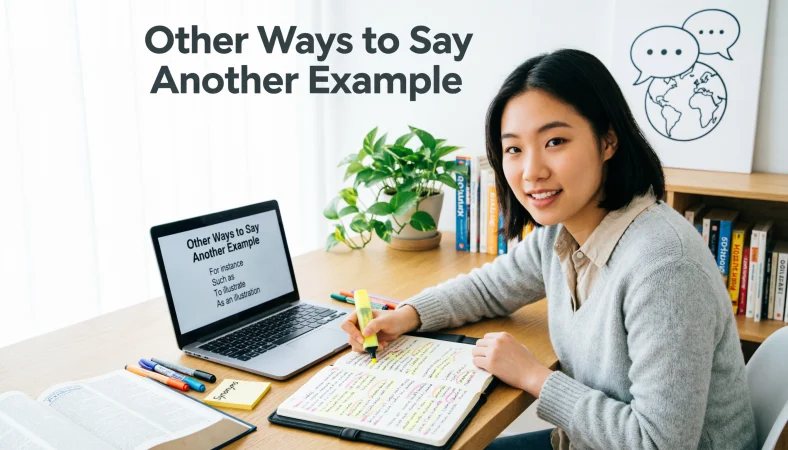
If you want to avoid repeating the phrase “another example,” you can choose a phrase that better matches your tone and context. Strong alternatives include another illustration, a further example, one more example, an additional example, another instance.
Top alternatives: “another example” include a further example, an additional example, another illustration, and another instance.
The phrase “another example” is commonly used when introducing an additional illustration, idea, situation, or piece of evidence. It is simple, grammatically correct, and easy for both native and non-native English speakers to understand. However, repeating the same expression too often can make your speech or writing feel predictable. Learning alternatives to another example can help you communicate ideas with greater variety and precision.
Knowing other ways to say another example is especially useful in professional writing, academic discussions, presentations, emails, and everyday conversations. These expressions can help you vary your language, strengthen an explanation, or introduce supporting evidence more naturally. They can also help you express excitement in English when presenting an interesting idea, discovery, or successful result. The key is choosing a phrase that matches your audience, purpose, and level of formality.
Quick Categories
Formal alternatives to “another example”
- A further example
- An additional illustration
- Another instance
- A further case
Pro Tip: Use these expressions in academic papers, reports, presentations, and formal explanations when you want a polished tone.
Casual alternatives
- One more example
- Here’s another one
- Another case
- One more case
Pro Tip: In everyday conversation, choose shorter expressions that sound natural when spoken aloud.
Professional alternatives
- An additional example
- A further illustration
- Another relevant case
- A supporting example
Pro Tip: In professional communication, connect the example directly to your main point so the phrase adds value rather than repetition.
Informal expressions
- Here’s another example
- Take this example
- Consider this one
- Look at another case
Pro Tip: Informal expressions in English work best in conversations, discussions, presentations, and friendly explanations.
“The best alternative is not always the most formal one. It is the one that fits your audience.”
Common Mistakes
1. Repeating the same phrase too often
Mistake: Another example is the new policy. Another example is the updated process.
Better: Another example is the new policy. A further illustration is the updated process.
2. Using an overly formal phrase in casual conversation
Mistake: “Permit me to provide an additional illustration.”
Better: “Here’s another example.”
3. Choosing a phrase that does not match the meaning
Mistake: Using “another instance” when discussing a physical object.
Better: “Here’s another example of the product.”
4. Using “another example” when evidence is required
Mistake: “Another example proves the theory.”
Better: “Additional evidence supports the theory.”
5. Using a casual expression in formal writing
Mistake: “Here’s another one” in an academic research paper.
Better: “A further example demonstrates this pattern.”
What Does “Another Example” Mean?
“Another example” means an additional example that illustrates, explains, supports, or demonstrates an idea.
The word another means one more or an additional one, while example refers to something used to clarify or demonstrate a concept.
Example:
“Another example of effective teamwork is the successful completion of the project.”
Grammatically, “another” functions as a determiner before the singular countable noun “example.”
When to Use “Another Example”
You can use the phrase in many situations, including:
• Introducing additional evidence
• Explaining a difficult concept
• Giving examples during a presentation
• Supporting an argument
• Comparing different situations
• Teaching English or another subject
• Discussing professional experiences
• Adding information to an email or report
Spoken vs Written
In spoken English, “another example” sounds natural and straightforward.
In written English, especially academic or professional writing, alternatives such as a further example or an additional illustration can provide more variety.
Formal vs Informal
Formal contexts generally favor precise expressions such as “a further example” or “another relevant case.”
Informal contexts can use simpler phrases such as “one more example” or “here’s another one.”
Is “Another Example” Professional or Polite to Say?
Yes, the phrase is polite and grammatically correct. However, professionalism depends on the surrounding sentence and context.
In formal communication, varying the expression can make your writing more sophisticated and reduce repetition.
Business example:
“An additional example can be found in the customer feedback collected last quarter.”
Polite? ✔️ Yes
Professional? ❌ No, not always the strongest choice for formal writing
The phrase itself is not unprofessional. The issue is that more precise alternatives may communicate your intended meaning more effectively.
Pros and Cons of Using “Another Example”
Pros
• Simple and natural
• Friendly tone
• Common usage
• Easy to understand
Cons
• Too informal for some work situations
• Can become repetitive
• Has limited emotional range
• Not always ideal for formal writing
“Simple English is powerful, but strategic variation makes your communication more memorable.”
Other Ways to Say “Another Example” With Examples
These alternatives will help you sound more fluent, confident, and natural in different situations.
Use them according to tone, context, and audience to express excitement, admiration, or approval. The following professional reaction phrases are especially useful when discussing ideas, evidence, projects, and results.
1. Phrase: A Further Example
Meaning: An additional example of something already being discussed.
Explanation: This is a polished choice for formal and academic communication.
Example Sentence: “A further example can be found in the company’s recent expansion.”
Best Use: Academic writing
Worst Use: Casual chat
Tone: Formal, polished, precise
Context Variability: Casual: uncommon. Professional: excellent. Spoken: suitable in presentations.
2. Phrase: An Additional Example
Meaning: One more example added to previous information.
Explanation: This phrase clearly signals that more supporting information is coming.
Example Sentence: “An additional example is the improvement in customer satisfaction.”
Best Use: Business writing
Worst Use: Casual conversation
Tone: Professional, clear, neutral
Context Variability: Casual: slightly formal. Professional: excellent. Spoken: suitable for meetings.
3. Phrase: One More Example
Meaning: An extra example beyond those already mentioned.
Explanation: This is simple and natural in everyday English.
Example Sentence: “Let me give you one more example before we move on.”
Best Use: Spoken English
Worst Use: Formal reports
Tone: Casual, friendly, natural
Context Variability: Casual: excellent. Professional: acceptable. Spoken: excellent.
4. Phrase: Another Illustration
Meaning: Another example that makes an idea easier to understand.
Explanation: “Illustration” is useful when explaining concepts rather than simply listing facts.
Example Sentence: “Another illustration of this principle is the company’s hiring strategy.”
Best Use: Academic discussion
Worst Use: Casual chat
Tone: Formal, explanatory, polished
Context Variability: Casual: uncommon. Professional: strong. Spoken: suitable for presentations.
5. Phrase: An Additional Illustration
Meaning: A further situation or example used for explanation.
Explanation: This expression is particularly effective in formal educational writing.
Example Sentence: “An additional illustration of this concept appears in the final chapter.”
Best Use: Academic writing
Worst Use: Friendly chat
Tone: Formal, educational, precise
Context Variability: Casual: uncommon. Professional: excellent. Spoken: suitable in lectures.
6. Phrase: Another Instance
Meaning: Another occurrence or case of something.
Explanation: This works well when referring to repeated events, behaviors, or situations.
Example Sentence: “Another instance of effective leadership occurred during the crisis.”
Best Use: Formal analysis
Worst Use: Casual speech
Tone: Formal, analytical, objective
Context Variability: Casual: less natural. Professional: excellent. Spoken: suitable in formal discussions.
7. Phrase: A Further Case
Meaning: Another situation that demonstrates a particular point.
Explanation: This is useful when discussing situations, events, or examples in analysis.
Example Sentence: “A further case demonstrates the importance of clear communication.”
Best Use: Formal analysis
Worst Use: Casual chat
Tone: Formal, analytical, objective
Context Variability: Casual: uncommon. Professional: excellent. Spoken: appropriate in presentations.
8. Phrase: An Additional Case
Meaning: Another situation or instance relevant to the discussion.
Explanation: It is especially useful in business, legal, academic, and analytical contexts.
Example Sentence: “An additional case supports the findings of the study.”
Best Use: Research writing
Worst Use: Friendly conversation
Tone: Formal, precise, analytical
Context Variability: Casual: uncommon. Professional: excellent. Spoken: appropriate for formal meetings.
9. Phrase: Another Relevant Case
Meaning: Another situation directly connected to the current topic.
Explanation: The word “relevant” emphasizes that the example has a clear connection to the subject.
Example Sentence: “Another relevant case involves the company’s response to customer complaints.”
Best Use: Professional analysis
Worst Use: Casual greeting
Tone: Professional, focused, precise
Context Variability: Casual: somewhat formal. Professional: excellent. Spoken: strong for meetings.
10. Phrase: A Supporting Example
Meaning: An example that provides evidence for an idea or claim.
Explanation: This phrase is excellent when the purpose of the example is to strengthen an argument.
Example Sentence: “A supporting example can be found in the latest market data.”
Best Use: Business writing
Worst Use: Casual storytelling
Tone: Professional, analytical, convincing
Context Variability: Casual: less common. Professional: excellent. Spoken: useful in presentations.
11. Phrase: Another Case in Point
Meaning: Another example that clearly demonstrates a particular point.
Explanation: “Case in point” is useful when an example strongly supports an argument.
Example Sentence: “Another case in point is the company’s rapid response to the crisis.”
Best Use: Business discussion
Worst Use: Casual small talk
Tone: Professional, confident, persuasive
Context Variability: Casual: acceptable. Professional: excellent. Spoken: natural in discussions.
12. Phrase: A Further Illustration of This
Meaning: Another example that explains the idea being discussed.
Explanation: It directly connects the new example to the previous point.
Example Sentence: “A further illustration of this can be seen in the team’s communication strategy.”
Best Use: Formal explanation
Worst Use: Casual texting
Tone: Formal, explanatory, polished
Context Variability: Casual: uncommon. Professional: excellent. Spoken: strong for presentations.
13. Phrase: Another Relevant Example
Meaning: Another example that has a direct connection to the topic.
Explanation: Adding “relevant” makes the connection between the example and subject explicit.
Example Sentence: “Another relevant example comes from the technology sector.”
Best Use: Professional writing
Worst Use: Casual conversation
Tone: Professional, clear, focused
Context Variability: Casual: acceptable. Professional: excellent. Spoken: natural in meetings.
14. Phrase: One Additional Example
Meaning: Exactly one more example.
Explanation: This phrase is useful when you want to signal that you will provide one final supporting point.
Example Sentence: “I would like to provide one additional example before concluding.”
Best Use: Presentations
Worst Use: Casual chat
Tone: Professional, courteous, structured
Context Variability: Casual: formal. Professional: excellent. Spoken: excellent for presentations.
15. Phrase: Here’s Another One
Meaning: Here is one more example or item.
Explanation: This is conversational and natural when speaking with friends or colleagues.
Example Sentence: “Here’s another one that shows how the system works.”
Best Use: Casual conversation
Worst Use: Academic paper
Tone: Friendly, casual, natural
Context Variability: Casual: excellent. Professional: acceptable. Spoken: excellent.
16. Phrase: Here’s One More Example
Meaning: Here is one additional example.
Explanation: This is a friendly expression that works especially well in spoken English.
Example Sentence: “Here’s one more example to make the idea clearer.”
Best Use: Teaching English
Worst Use: Formal report
Tone: Friendly, clear, conversational
Context Variability: Casual: excellent. Professional: acceptable. Spoken: excellent.
17. Phrase: Consider This Example
Meaning: Look at this example as evidence or explanation.
Explanation: This phrase directly invites the listener or reader to examine an example.
Example Sentence: “Consider this example when evaluating the effectiveness of the policy.”
Best Use: Formal discussion
Worst Use: Casual texting
Tone: Direct, professional, analytical
Context Variability: Casual: somewhat formal. Professional: excellent. Spoken: excellent in presentations.
18. Phrase: Take This Example
Meaning: Use this particular example to understand an idea.
Explanation: It is a concise way to introduce a relevant situation.
Example Sentence: “Take this example: a small change can significantly improve productivity.”
Best Use: Explanations
Worst Use: Formal research
Tone: Direct, conversational, clear
Context Variability: Casual: excellent. Professional: good. Spoken: excellent.
19. Phrase: Look at Another Case
Meaning: Examine another situation related to the discussion.
Explanation: This expression works well when comparing situations.
Example Sentence: “Look at another case involving customer retention.”
Best Use: Spoken analysis
Worst Use: Formal report
Tone: Direct, conversational, focused
Context Variability: Casual: good. Professional: acceptable. Spoken: excellent.
20. Phrase: For Another Illustration
Meaning: Used to introduce another example that explains an idea.
Explanation: It is especially useful in structured explanations.
Example Sentence: “For another illustration, consider the company’s approach to employee training.”
Best Use: Formal explanation
Worst Use: Casual chat
Tone: Formal, educational, structured
Context Variability: Casual: uncommon. Professional: excellent. Spoken: strong for presentations.
21. Phrase: Another Demonstration
Meaning: Another example that shows how something works or is true.
Explanation: It is useful when the example provides visible or practical evidence.
Example Sentence: “Another demonstration of the system’s efficiency is its faster processing time.”
Best Use: Technical writing
Worst Use: Casual conversation
Tone: Professional, technical, precise
Context Variability: Casual: uncommon. Professional: excellent. Spoken: suitable for technical presentations.
22. Phrase: Additional Evidence
Meaning: More information that supports a claim or conclusion.
Explanation: This is stronger than a general example when discussing proof or research.
Example Sentence: “Additional evidence suggests that the strategy is effective.”
Best Use: Research writing
Worst Use: Casual storytelling
Tone: Formal, analytical, authoritative
Context Variability: Casual: uncommon. Professional: excellent. Spoken: suitable for formal discussions.
23. Phrase: Further Support
Meaning: Additional information that strengthens an argument or conclusion.
Explanation: This expression emphasizes reinforcement rather than simply giving another example.
Example Sentence: “Further support for this conclusion comes from recent customer surveys.”
Best Use: Formal writing
Worst Use: Casual chat
Tone: Formal, analytical, confident
Context Variability: Casual: uncommon. Professional: excellent. Spoken: suitable in presentations.
24. Phrase: Another Point of Reference
Meaning: Another example or source that can be used for comparison.
Explanation: This phrase works when an example provides useful context.
Example Sentence: “Another point of reference is the company’s performance during the previous quarter.”
Best Use: Business analysis
Worst Use: Casual conversation
Tone: Professional, analytical, sophisticated
Context Variability: Casual: uncommon. Professional: excellent. Spoken: suitable for meetings.
25. Phrase: A Comparable Example
Meaning: Another example that is similar enough to support a comparison.
Explanation: This is particularly useful when comparing products, situations, or results.
Example Sentence: “A comparable example can be found in the healthcare industry.”
Best Use: Comparative analysis
Worst Use: Casual chat
Tone: Formal, analytical, precise
Context Variability: Casual: uncommon. Professional: excellent. Spoken: suitable for presentations.
26. Phrase: A Similar Case
Meaning: Another situation with comparable characteristics.
Explanation: Use this phrase when similarity is more important than simply adding information.
Example Sentence: “A similar case occurred during the company’s previous expansion.”
Best Use: Case studies
Worst Use: Friendly small talk
Tone: Neutral, professional, analytical
Context Variability: Casual: acceptable. Professional: excellent. Spoken: natural.
27. Phrase: Another Practical Example
Meaning: Another example based on a realistic or useful situation.
Explanation: This is ideal when explaining how an idea works in real life.
Example Sentence: “Another practical example is using automation to reduce repetitive tasks.”
Best Use: Training sessions
Worst Use: Formal theory
Tone: Clear, practical, educational
Context Variability: Casual: good. Professional: excellent. Spoken: excellent.
28. Phrase: A Real World Example
Meaning: An example based on an actual or realistic situation.
Explanation: It helps connect abstract ideas to practical experiences.
Example Sentence: “A real world example is the way businesses use customer data to improve services.”
Best Use: Presentations
Worst Use: Highly formal theory
Tone: Practical, accessible, educational
Context Variability: Casual: excellent. Professional: excellent. Spoken: excellent.
29. Phrase: Another Case Worth Considering
Meaning: Another situation that deserves attention.
Explanation: This phrase is useful when introducing an example that adds an important perspective.
Example Sentence: “Another case worth considering is the impact of remote collaboration.”
Best Use: Professional discussion
Worst Use: Casual greeting
Tone: Thoughtful, professional, analytical
Context Variability: Casual: somewhat formal. Professional: excellent. Spoken: excellent in discussions.
30. Phrase: To Give Another Illustration
Meaning: Used to introduce another example that clarifies a point.
Explanation: It creates a smooth transition to additional supporting information.
Example Sentence: “To give another illustration, consider how the team handled the unexpected deadline.”
Best Use: Formal presentation
Worst Use: Casual texting
Tone: Formal, polished, explanatory
Context Variability: Casual: uncommon. Professional: excellent. Spoken: excellent in presentations.
“Use ‘another example’ when simplicity matters, but switch expressions when precision or variety matters more.”
Mini Quiz and Self Check
1. Which phrase is best for an academic paper?
A. Here’s another one
B. One more example
C. A further example
D. Take this example
Answer: C
2. You are explaining something to a friend. Which sounds most natural?
A. An additional illustration
B. Here’s one more example
C. A further case
D. Another point of reference
Answer: B
3. You are presenting evidence in a business report. Which phrase fits best?
A. Here’s another one
B. Additional evidence
C. Look at another case
D. One more example
Answer: B
4. You want to compare two similar situations. Which phrase is most suitable?
A. A similar case
B. Here’s another one
C. One more example
D. Take this example
Answer: A
Comparison Table: Top Alternatives
| Phrase | Tone | Best Use |
| A further example | Formal | Academic writing |
| An additional example | Professional | Business writing |
| One more example | Casual | Spoken English |
| Another illustration | Formal | Explanations |
| Another instance | Formal | Analysis |
| A further case | Formal | Research |
| A supporting example | Professional | Arguments |
| Consider this example | Professional | Presentations |
| Here’s one more example | Friendly | Teaching |
| Additional evidence | Formal | Research |
FAQs
What are the best alternatives to “another example”?
Some of the strongest choices are “a further example,” “an additional example,” “another illustration,” “another instance,” and “a supporting example.”
What is a formal alternative to “another example”?
“A further example” and “an additional illustration” are excellent formal choices for academic, business, and professional writing.
Can I use “another example” in professional communication?
Yes. The phrase is correct and professional enough in many situations, but varying your wording can make reports and presentations sound more polished.
What is a casual alternative to “another example”?
“One more example,” “here’s another one,” and “here’s one more example” are natural choices for casual conversations and spoken English.
How can I avoid repeating “another example”?
Choose alternatives based on meaning. Use “additional evidence” for support, “a similar case” for comparison, and “another illustration” for explanation.
Conclusion
Learning different ways to introduce examples gives you more control over your English. Instead of relying on one repeated phrase, you can choose expressions that communicate whether you are explaining, comparing, supporting an argument, or presenting evidence.
The best approach is to practice several alternatives in real sentences. Pay attention to tone, audience, and purpose, especially when switching between casual conversation, academic writing, and professional communication. With regular practice, your vocabulary will become more flexible and natural.
CTA: Which alternative do you use most often? Share your favorite phrase and practice using it in a sentence.