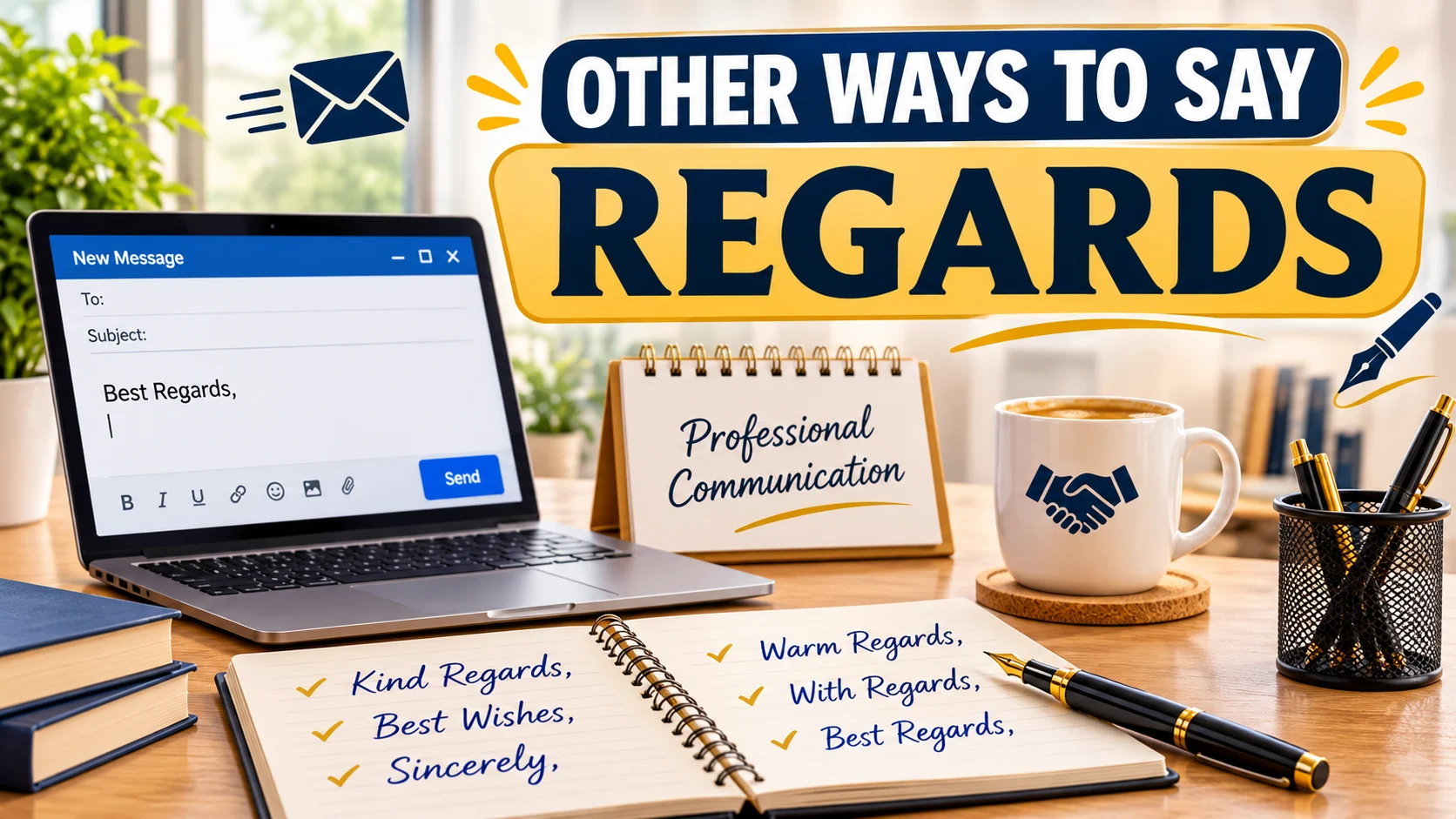
If you want to find other ways to say regards, several alternatives can make your emails, letters, and professional messages sound more natural and appropriate. The best choice depends on your relationship with the recipient and the level of formality you want to convey.
Best alternatives: Best wishes, Kind regards, Warm regards, Sincerely, With appreciation.
Introduction
The word regards is commonly used at the end of emails, letters, and professional messages to express politeness, goodwill, or respect. It is a simple and widely recognized closing that helps create a friendly impression without sounding overly personal.
However, using the same sign-off in every email can make your communication feel repetitive. Learning alternatives to regards gives you more flexibility when writing to colleagues, clients, managers, friends, and business partners. Some expressions sound formal and respectful, while others communicate warmth, appreciation, or familiarity.
Understanding these differences can help you choose the right closing for every situation. Whether you want to improve professional correspondence, make everyday messages more engaging, or express excitement in English without sounding unnatural, knowing different sign-offs can strengthen your communication skills. This guide explores 30 useful expressions, explains their meanings, and provides practical examples so you can use them confidently.
Quick Categories: Different Ways to Say Regards
Before exploring all 30 alternatives, here are some useful expressions organized by tone and communication style.
Formal alternatives to “Regards”
- Sincerely
- Respectfully
- Yours sincerely
- With appreciation
These expressions are suitable for formal letters, official correspondence, and situations where professionalism matters.
Pro Tip: Use Sincerely for formal business emails and official communication when you want to maintain a respectful tone.
Casual alternatives
- Best wishes
- Take care
- All the best
- Warm wishes
These expressions create a friendly impression without being overly informal.
Pro Tip: Choose Best wishes or All the best when writing to someone you know but still want to address politely.
Professional alternatives
- Kind regards
- Best regards
- With thanks
- Thank you
These expressions work particularly well in workplace communication, client correspondence, and professional follow-ups.
Pro Tip: Use Kind regards for everyday professional emails and With thanks when the message involves a request or appreciation.
Informal expressions
- Cheers
- Talk soon
- See you soon
- Until next time
These options are better suited to familiar colleagues, friends, and everyday conversations.
Pro Tip: Keep informal expressions for people with whom you already have a comfortable relationship.
The best email closing is not necessarily the most formal one. It is the one that matches your relationship with the reader.
Common Mistakes When Using “Regards”
Although regards is a simple expression, people sometimes use it incorrectly or choose it for situations where another closing would be more appropriate.
Here are five common mistakes to avoid.
1. Using “Regards” Without a Clear Email Context
Mistake: Treating regards as a complete replacement for a thank-you message.
Example:
“Regards for helping me yesterday.”
Better: “Thank you for helping me yesterday.”
Regards is generally used as an email or letter sign-off, not as a direct substitute for thank you.
2. Mixing Formal and Informal Expressions
Mistake: Combining a highly formal closing with an overly casual message.
Example:
“Hey, what’s up? Yours faithfully.”
Better: “Hey, what’s up? Talk soon!”
Keep the closing consistent with the rest of your message.
3. Using “Regards” in Every Email
Mistake: Repeating the same sign-off regardless of the situation.
Example:
“Regards” at the end of every message to colleagues, clients, and friends.
Better: Alternate between Kind regards, Best wishes, and With thanks when appropriate.
4. Using “Yours Faithfully” Incorrectly
Mistake: Using Yours faithfully in every business email.
Example:
“Dear Sarah, … Yours faithfully.”
Better: “Dear Sarah, … Yours sincerely.”
In traditional British letter-writing conventions, Yours faithfully is generally used when the recipient’s name is unknown, while Yours sincerely follows a named greeting.
5. Forgetting the Name After the Sign-Off
Mistake: Ending a professional email without identifying yourself.
Example:
“Kind regards.”
Better:
“Kind regards,
Alex”
Adding your name makes the message more complete and professional.
A professional email is judged by its overall tone, not just the final words you choose.
What Does “Regards” Mean?
Regards is a polite expression used to communicate goodwill, respect, or friendly acknowledgment. In written communication, it commonly appears at the end of an email or letter as a closing sign-off.
It can also refer to consideration, respect, or attention toward someone or something.
Grammar explanation:
- Regards: A plural noun commonly used in email closings.
- Give my regards: An expression used to send greetings or good wishes to another person.
- With regards to: A phrase meaning concerning or regarding a particular subject.
Example sentences:
- “Please give my regards to your family.”
- “Kind regards, Sarah.”
- “With regard to your request, I will respond tomorrow.”
In professional correspondence, Regards communicates courtesy without adding unnecessary emotional detail.
When to Use “Regards”
The expression is appropriate in several everyday and professional situations.
Common contexts
- Business emails: When communicating with clients, colleagues, and business partners.
- Workplace messages: When ending routine professional correspondence.
- Formal letters: When maintaining a respectful and neutral tone.
- Follow-up emails: When responding after a meeting or conversation.
- Academic communication: When contacting teachers, professors, or administrators.
- Customer service: When responding to inquiries and customer requests.
Spoken vs. Written
Written communication: Regards is primarily used in emails, letters, and written messages.
Example:
“Thank you for your response.
Kind regards,
Daniel”
Spoken communication: People generally do not say Regards as a conversational goodbye. Expressions such as Take care, See you soon, and Have a great day sound more natural.
Formal vs. Informal
| Communication Style | Suitable Expression |
|---|---|
| Formal | Sincerely |
| Professional | Kind regards |
| Friendly | Best wishes |
| Casual | Take care |
| Very familiar | Cheers |
Is It Professional or Polite to Say “Regards”?
Yes. Regards is generally considered polite, neutral, and acceptable in professional communication.
However, it is not always the strongest choice for every business situation. For example, Kind regards often sounds warmer, while Sincerely may be more suitable for formal letters and official correspondence.
Business-style example:
Dear Mr. Thompson,
Thank you for reviewing the proposal. I appreciate your feedback and look forward to discussing the next steps.
Kind regards,
James
Politeness: ✔️ Yes
Professionalism: ✔️ Yes, particularly in routine business communication.
Best recommendation: Use Kind regards when you want a professional closing that feels both respectful and approachable.
Pros and Cons of Using “Regards”
Understanding the advantages and limitations of this expression can help you decide when to use it.
Pros
- Simple and natural: Easy to include in almost any professional email.
- Friendly tone: Communicates goodwill without being overly personal.
- Common usage: Widely recognized in business correspondence.
- Easy to understand: Suitable for readers with different levels of English proficiency.
Cons
- Too neutral for some situations: It may not communicate strong appreciation or warmth.
- Overused: Repeating it in every message can make communication feel predictable.
- Limited emotional range: It does not express gratitude or enthusiasm as clearly as some alternatives.
- Not ideal for every formal document: Certain official letters require a more traditional closing.
Other Ways to Say Regards (With Examples)
These alternatives will help you sound more fluent, confident, and natural in different situations.
Use them according to tone, context, and audience to communicate respect, appreciation, friendliness, or goodwill.
30 Alternatives to Regards
1. Phrase: Kind Regards
Meaning: A polite expression that communicates goodwill and respect.
Explanation: It is one of the most widely accepted closings for professional and business emails.
Example Sentence: Thank you for your time and consideration. Kind regards, Michael.
Best Use: Business emails
Worst Use: Casual texting
Tone: Polite, warm, professional
Context Variability:
- Casual: Kind regards to you and your family.
- Professional: I look forward to hearing from you. Kind regards.
- Spoken: Have a good day. Take care.
2. Phrase: Best Regards
Meaning: A courteous closing that expresses friendly respect.
Explanation: It is appropriate for professional relationships and routine workplace correspondence.
Example Sentence: Thank you for reviewing the document. Best regards, Emily.
Best Use: Work correspondence
Worst Use: Personal letters
Tone: Professional, friendly, neutral
Context Variability:
- Casual: Best regards to everyone.
- Professional: Best regards, David.
- Spoken: All the best!
3. Phrase: Warm Regards
Meaning: A friendly sign-off that communicates genuine warmth and goodwill.
Explanation: It is useful when you want a professional email to feel more personal.
Example Sentence: It was wonderful working with you. Warm regards, Olivia.
Best Use: Friendly business
Worst Use: Strictly official
Tone: Warm, thoughtful, courteous
Context Variability:
- Casual: Warm regards to your family.
- Professional: Warm regards, Olivia.
- Spoken: Take care and enjoy your weekend.
4. Phrase: Sincerely
Meaning: An expression of genuine respect and honesty.
Explanation: It is a traditional closing used in formal letters and professional communication.
Example Sentence: Thank you for considering my application. Sincerely, Daniel.
Best Use: Formal letters
Worst Use: Casual chats
Tone: Formal, respectful, sincere
Context Variability:
- Casual: I sincerely appreciate your help.
- Professional: Sincerely, Daniel.
- Spoken: I genuinely appreciate your support.
5. Phrase: Best Wishes
Meaning: A friendly expression that communicates positive thoughts and goodwill.
Explanation: It is suitable for professional contacts, acquaintances, and personal correspondence.
Example Sentence: Congratulations on your new position. Best wishes, Sarah.
Best Use: Friendly emails
Worst Use: Legal notices
Tone: Positive, friendly, encouraging
Context Variability:
- Casual: Best wishes for your new adventure.
- Professional: Best wishes, Sarah.
- Spoken: I wish you all the best.
6. Phrase: All the Best
Meaning: A friendly way to express good wishes.
Explanation: It works well when ending an email to someone you know reasonably well.
Example Sentence: I hope everything goes smoothly with your new project. All the best, James.
Best Use: Friendly correspondence
Worst Use: Highly formal letters
Tone: Warm, positive, relaxed
Context Variability:
- Casual: All the best with your plans.
- Professional: All the best, James.
- Spoken: I wish you the best.
7. Phrase: Respectfully
Meaning: An expression that communicates considerable respect toward the recipient.
Explanation: It is often appropriate for official correspondence and communication involving authority.
Example Sentence: Thank you for considering my request. Respectfully, Andrew.
Best Use: Official correspondence
Worst Use: Friendly chats
Tone: Formal, respectful, serious
Context Variability:
- Casual: I respect your decision.
- Professional: Respectfully, Andrew.
- Spoken: I appreciate your perspective.
8. Phrase: With Appreciation
Meaning: A closing that communicates gratitude and recognition.
Explanation: It is particularly useful when someone has provided assistance, guidance, or support.
Example Sentence: Thank you for helping us complete the project. With appreciation, Laura.
Best Use: Thank-you emails
Worst Use: Routine updates
Tone: Grateful, professional, warm
Context Variability:
- Casual: With appreciation for everything you’ve done.
- Professional: With appreciation, Laura.
- Spoken: I really appreciate your help.
9. Phrase: With Thanks
Meaning: A brief expression of gratitude.
Explanation: It works well when closing an email that includes a request or acknowledgment.
Example Sentence: Thank you for sending the revised report. With thanks, Robert.
Best Use: Follow-up emails
Worst Use: Formal applications
Tone: Polite, grateful, concise
Context Variability:
- Casual: With thanks for your help.
- Professional: With thanks, Robert.
- Spoken: Thanks again for your assistance.
10. Phrase: Many Thanks
Meaning: An expression of sincere gratitude.
Explanation: It is a friendly and practical closing for messages where appreciation is the main purpose.
Example Sentence: Many thanks for arranging the meeting. Sophie.
Best Use: Thank-you messages
Worst Use: Legal documents
Tone: Friendly, appreciative, positive
Context Variability:
- Casual: Many thanks for everything.
- Professional: Many thanks, Sophie.
- Spoken: Thank you so much.
11. Phrase: Take Care
Meaning: A friendly expression showing concern for someone’s well-being.
Explanation: It is a natural closing for personal messages and familiar workplace relationships.
Example Sentence: It was lovely catching up with you. Take care, Emma.
Best Use: Friendly messages
Worst Use: Official letters
Tone: Caring, friendly, relaxed
Context Variability:
- Casual: Take care and enjoy your holiday.
- Professional: Take care, Emma.
- Spoken: Take care. See you tomorrow.
12. Phrase: Yours Sincerely
Meaning: A traditional formal closing expressing respect and sincerity.
Explanation: It is particularly common in formal British English correspondence when addressing a recipient by name.
Example Sentence: Dear Ms. Parker, Thank you for your consideration. Yours sincerely, William.
Best Use: Formal letters
Worst Use: Casual emails
Tone: Formal, respectful, traditional
Context Variability:
- Casual: I sincerely hope you are well.
- Professional: Yours sincerely, William.
- Spoken: I sincerely appreciate your time.
13. Phrase: Yours Faithfully
Meaning: A traditional formal sign-off used in certain letter-writing conventions.
Explanation: In traditional British English, it is generally used when the recipient’s name is unknown.
Example Sentence: Dear Sir or Madam, Thank you for reviewing my application. Yours faithfully, Thomas.
Best Use: Formal letters
Worst Use: Friendly emails
Tone: Formal, traditional, respectful
Context Variability:
- Casual: I remain grateful for your support.
- Professional: Yours faithfully, Thomas.
- Spoken: Thank you for your consideration.
14. Phrase: Warm Wishes
Meaning: A positive closing that expresses friendliness and goodwill.
Explanation: It is suitable for personal correspondence and friendly professional relationships.
Example Sentence: I hope your new venture brings you success. Warm wishes, Rachel.
Best Use: Personal emails
Worst Use: Official notices
Tone: Warm, optimistic, friendly
Context Variability:
- Casual: Warm wishes for your birthday.
- Professional: Warm wishes, Rachel.
- Spoken: Wishing you a wonderful day.
15. Phrase: With Kindness
Meaning: An expression intended to communicate goodwill and consideration.
Explanation: It can work in personal or reflective writing, although it is less conventional as a business sign-off than Kind regards.
Example Sentence: Thank you for your thoughtful message. With kindness, Anna.
Best Use: Personal correspondence
Worst Use: Routine business
Tone: Gentle, thoughtful, considerate
Context Variability:
- Casual: Sending kindness your way.
- Professional: With kindness, Anna.
- Spoken: I hope you have a lovely day.
16. Phrase: Cordially
Meaning: A polite and formal expression of goodwill.
Explanation: It is sometimes used in formal invitations and traditional business correspondence.
Example Sentence: We appreciate your interest in our organization. Cordially, Mark.
Best Use: Formal correspondence
Worst Use: Casual conversations
Tone: Formal, courteous, traditional
Context Variability:
- Casual: I hope to see you soon.
- Professional: Cordially, Mark.
- Spoken: It was a pleasure meeting you.
17. Phrase: In Appreciation
Meaning: A phrase that highlights gratitude for someone’s contribution or assistance.
Explanation: It is suitable for messages centered on recognition and acknowledgment.
Example Sentence: Your contribution made this event possible. In appreciation, Jennifer.
Best Use: Recognition emails
Worst Use: Routine updates
Tone: Grateful, respectful, sincere
Context Variability:
- Casual: In appreciation of your kindness.
- Professional: In appreciation, Jennifer.
- Spoken: Your support means a lot to us.
18. Phrase: With Gratitude
Meaning: A heartfelt expression of thankfulness.
Explanation: It is particularly effective when someone has made a meaningful contribution.
Example Sentence: Thank you for your continued guidance and encouragement. With gratitude, Daniel.
Best Use: Appreciation messages
Worst Use: Neutral notices
Tone: Sincere, warm, appreciative
Context Variability:
- Casual: With gratitude for your friendship.
- Professional: With gratitude, Daniel.
- Spoken: I am truly grateful for your help.
19. Phrase: Thank You
Meaning: A direct expression of appreciation.
Explanation: It can function as an email closing when the message involves a request, assistance, or acknowledgment.
Example Sentence: Thank you for sharing the updated schedule. Maria.
Best Use: Business requests
Worst Use: Unrelated messages
Tone: Polite, simple, appreciative
Context Variability:
- Casual: Thank you for everything.
- Professional: Thank you, Maria.
- Spoken: Thanks for your time.
20. Phrase: Cheers
Meaning: An informal expression used to communicate friendliness or thanks.
Explanation: It is common in British and Australian English and is suitable for familiar professional contacts.
Example Sentence: I’ve attached the presentation for your review. Cheers, Alex.
Best Use: Casual emails
Worst Use: Formal letters
Tone: Relaxed, friendly, informal
Context Variability:
- Casual: Cheers for your help!
- Professional: Cheers, Alex.
- Spoken: Cheers! See you later.
21. Phrase: Talk Soon
Meaning: A friendly expression suggesting that another conversation will happen soon.
Explanation: It is suitable when you expect to communicate with the recipient again.
Example Sentence: I’ll send you the remaining details tomorrow. Talk soon, Chris.
Best Use: Ongoing conversations
Worst Use: Official letters
Tone: Friendly, relaxed, conversational
Context Variability:
- Casual: Talk soon!
- Professional: Talk soon, Chris.
- Spoken: I’ll speak to you soon.
22. Phrase: See You Soon
Meaning: A friendly expression anticipating another meeting.
Explanation: It is best when you expect to see the recipient in person.
Example Sentence: Looking forward to our meeting next week. See you soon, Jessica.
Best Use: Upcoming meetings
Worst Use: Formal applications
Tone: Friendly, positive, casual
Context Variability:
- Casual: See you soon!
- Professional: See you soon, Jessica.
- Spoken: I’ll see you next week.
23. Phrase: Until Next Time
Meaning: A friendly farewell suggesting a future conversation or meeting.
Explanation: It is suitable for recurring interactions and familiar relationships.
Example Sentence: It was wonderful collaborating with everyone. Until next time, David.
Best Use: Recurring events
Worst Use: Official requests
Tone: Friendly, optimistic, relaxed
Context Variability:
- Casual: Until next time!
- Professional: Until next time, David.
- Spoken: See you again soon.
24. Phrase: Have a Great Day
Meaning: A positive expression wishing someone an enjoyable day.
Explanation: It is a natural closing for everyday correspondence and customer communication.
Example Sentence: Thank you for contacting our support team. Have a great day, Olivia.
Best Use: Customer emails
Worst Use: Serious complaints
Tone: Cheerful, polite, friendly
Context Variability:
- Casual: Have a great day!
- Professional: Have a great day, Olivia.
- Spoken: Enjoy the rest of your day.
25. Phrase: Have a Wonderful Weekend
Meaning: A friendly expression wishing someone an enjoyable weekend.
Explanation: It is especially suitable for emails sent toward the end of the working week.
Example Sentence: Thank you for your feedback. Have a wonderful weekend, James.
Best Use: Friday emails
Worst Use: Monday updates
Tone: Warm, positive, courteous
Context Variability:
- Casual: Have a wonderful weekend!
- Professional: Have a wonderful weekend, James.
- Spoken: Enjoy your weekend.
26. Phrase: Looking Forward to Hearing From You
Meaning: An expression showing interest in receiving a future response.
Explanation: It is particularly useful for business emails that require a reply or decision.
Example Sentence: Please let me know if you need additional information. I look forward to hearing from you.
Best Use: Business follow-ups
Worst Use: Personal goodbyes
Tone: Professional, expectant, courteous
Context Variability:
- Casual: Looking forward to your reply.
- Professional: I look forward to hearing from you.
- Spoken: I hope to hear from you soon.
27. Phrase: With Best Wishes
Meaning: A polite expression communicating positive thoughts toward someone.
Explanation: It is appropriate for personal milestones, professional transitions, and friendly correspondence.
Example Sentence: Congratulations on your promotion. With best wishes, Natalie.
Best Use: Special occasions
Worst Use: Routine notices
Tone: Positive, thoughtful, courteous
Context Variability:
- Casual: With best wishes for your journey.
- Professional: With best wishes, Natalie.
- Spoken: Wishing you every success.
28. Phrase: Respectfully Yours
Meaning: A formal closing that emphasizes respect toward the recipient.
Explanation: It is more traditional than everyday email sign-offs and is best reserved for appropriate formal correspondence.
Example Sentence: Thank you for your attention to this matter. Respectfully yours, George.
Best Use: Official letters
Worst Use: Casual messages
Tone: Formal, deferential, serious
Context Variability:
- Casual: I appreciate your opinion.
- Professional: Respectfully yours, George.
- Spoken: I respect your decision.
29. Phrase: Sending My Best
Meaning: A friendly way to communicate goodwill and positive thoughts.
Explanation: It is suitable for personal emails and warm relationships with professional contacts.
Example Sentence: I hope your new project goes well. Sending my best, Lauren.
Best Use: Friendly emails
Worst Use: Legal documents
Tone: Warm, personal, encouraging
Context Variability:
- Casual: Sending my best to everyone.
- Professional: Sending my best, Lauren.
- Spoken: Wishing you all the best.
30. Phrase: Best
Meaning: A short, convenient expression of goodwill.
Explanation: It is a popular modern email sign-off, especially in concise professional correspondence.
Example Sentence: I’ve attached the requested document. Best, Matthew.
Best Use: Short emails
Worst Use: Traditional letters
Tone: Concise, neutral, professional
Context Variability:
- Casual: Best to you!
- Professional: Best, Matthew.
- Spoken: All the best.
Scroll-Stopping Highlights: Choosing the Right Sign-Off
“Kind regards” is a reliable choice when you want your professional emails to sound polite and approachable.
“Sincerely” works best when your communication requires a formal and respectful closing.
“Warm regards” adds a personal touch without losing its professional character.
“Take care” and “Cheers” are better suited to familiar relationships than formal business correspondence.
A thoughtful email closing can strengthen the impression your entire message creates.
Mini Quiz: Test Your Understanding
Choose the most appropriate expression for each situation.
English Sign-Off Challenge
0/4 answered
1. You are sending a formal job application to a company. Which closing is most appropriate?CheersSincerelyTalk soonSee you soon
2. You are thanking a colleague for helping with a project. Which option communicates appreciation?With appreciationYours faithfullyUntil next timeRespectfully yours
3. You are emailing a familiar colleague about an upcoming meeting. Which closing sounds natural?Yours faithfullyTalk soonRespectfully yoursCordially
4. You are writing a routine professional email to a client. Which sign-off is a reliable choice?Kind regardsCheersTake careUntil next time
Check My Answers
Comparison Table: Top 10 Alternatives to Regards
Here is a quick comparison of the most useful options and their appropriate communication styles.
| Phrase | Tone | Best Use |
|---|---|---|
| Kind regards | Polite, professional | Business emails |
| Best regards | Friendly, professional | Workplace messages |
| Warm regards | Warm, courteous | Friendly business |
| Sincerely | Formal, respectful | Official letters |
| Best wishes | Friendly, positive | Personal emails |
| All the best | Warm, relaxed | Friendly correspondence |
| Respectfully | Formal, serious | Official communication |
| With appreciation | Grateful, warm | Thank-you emails |
| Take care | Caring, casual | Personal messages |
| Best | Concise, neutral | Short professional emails |
Frequently Asked Questions
1. What are the best alternatives to regards in an email?
The best alternatives include Kind regards, Best regards, Warm regards, Sincerely, and Best wishes. Choose one according to your relationship with the recipient and the formality of the message.
2. What is a more professional word than regards?
Sincerely, Respectfully, and Kind regards are suitable professional alternatives. Sincerely is particularly useful for formal letters, while Kind regards works well in everyday business emails.
3. Can I use Kind regards instead of Regards?
Yes. Kind regards is a widely accepted alternative that sounds slightly warmer and more personable while remaining professional.
4. Is Best regards more formal than Kind regards?
Both are appropriate for professional communication. Best regards is slightly more neutral, while Kind regards can feel somewhat warmer. Neither is universally more formal.
5. What is the most polite way to end a professional email?
Kind regards and Sincerely are reliable choices. For messages expressing gratitude, With appreciation or With thanks can be more suitable.
Conclusion
Learning different ways to say regards can make your written English more natural, flexible, and professional. Expressions such as Kind regards, Best wishes, Sincerely, and Warm regards help you communicate respect and goodwill while avoiding repetitive email closings. The most important thing is understanding the difference between formal, professional, friendly, and informal expressions.
Make a habit of practicing these alternatives in your everyday communication. Pay attention to your audience, relationship, and purpose before choosing a sign-off. With regular practice, you will become more confident in selecting expressions that make your emails and messages sound appropriate and polished.
Which email closing do you use most often? Share your favorite alternative in the comments and help other English learners discover new expressions.