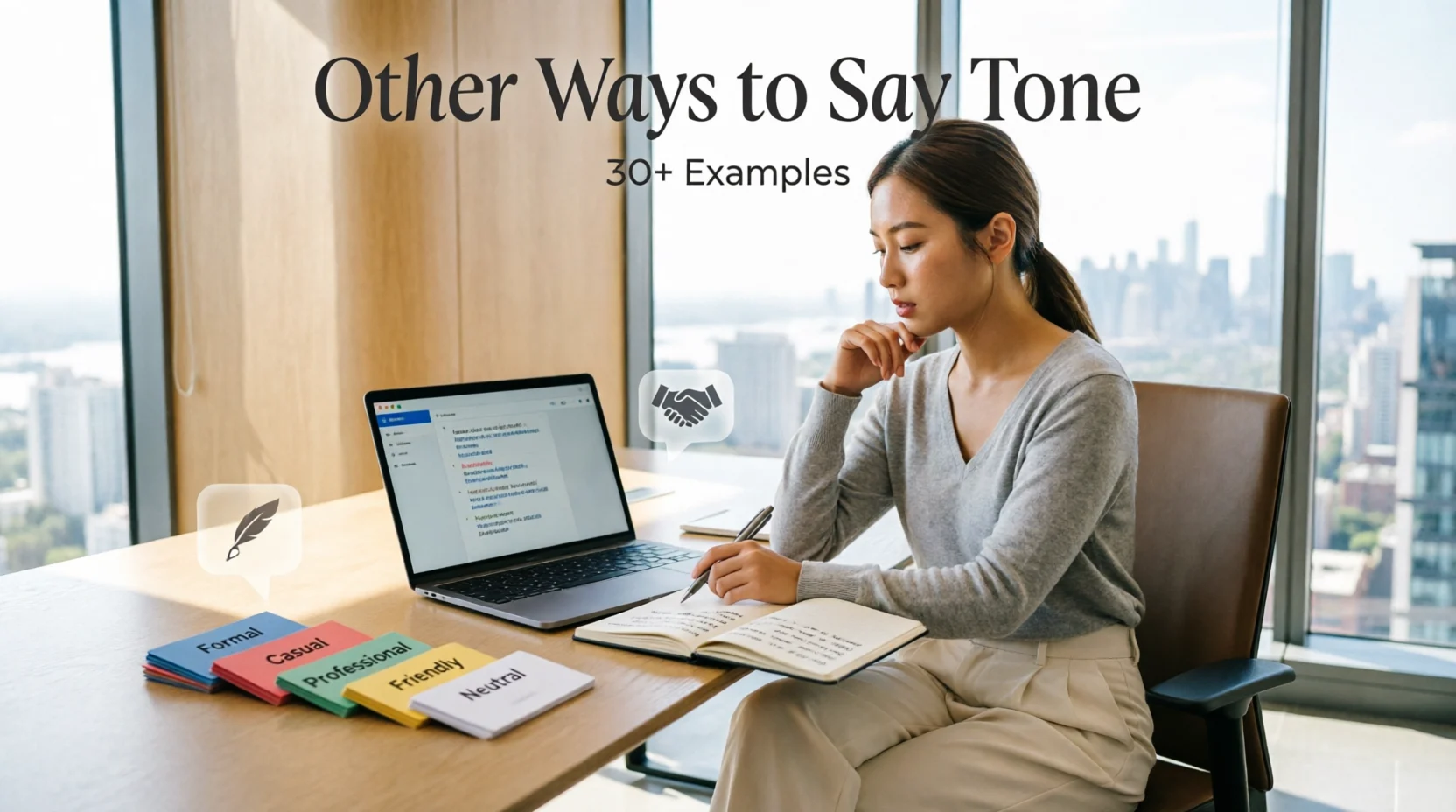
There are many other ways to say tone depending on whether you mean attitude, mood, style, or manner of communication. Common alternatives include attitude, mood, manner, style, voice, and expression.
The word tone is widely used in everyday conversations, professional communication, academic writing, emails, and social interactions. It describes the feeling, attitude, or manner behind someone’s words. The same sentence can sound friendly, serious, respectful, angry, confident, or sarcastic depending on its tone. Understanding this difference is important because your word choice can affect how others understand your message.
Learning alternatives to tone can make your English more precise and flexible. Words such as attitude, mood, manner, voice, style, and expression can describe different aspects of communication. These expressions are especially useful when discussing emails, conversations, speeches, presentations, and written content. They can also help you express excitement in English while choosing language that matches your audience and situation.
Quick Categories
Formal alternatives to “tone”
- Manner
- Demeanor
- Attitude
- Disposition
Pro Tip: Use these words when discussing someone’s communication style in formal or academic settings.
Casual alternatives
- Mood
- Vibe
- Feeling
- Style
Pro Tip: Choose simple words like mood or feeling when speaking in everyday conversations.
Professional alternatives
- Communication style
- Professional manner
- Voice
- Approach
Pro Tip: In workplace writing, “communication style” often sounds clearer than simply saying tone.
Informal expressions
- The way it sounds
- The feel of the message
- The attitude behind it
- The overall vibe
Pro Tip: Use these expressions in relaxed conversations rather than formal reports or business documents.
“The right word can describe not only what someone says, but how the message feels.”
Common Mistakes
1. Using “tone” when you mean volume
Incorrect idea: “His tone was very loud.”
Better: “His voice was very loud.”
Tone describes attitude or emotional quality, while volume describes loudness.
2. Treating tone and mood as identical
Example: “The email had a happy tone.”
A better description may be “The email created a positive mood” if you are discussing the feeling experienced by the reader.
3. Using formal alternatives in casual conversations
Example: “I analyzed your demeanor in the message.”
This can sound unnecessarily formal. “I noticed your attitude in the message” may sound more natural.
4. Assuming tone is always negative
Example: “Her tone sounded rude.”
Tone can also be friendly, respectful, professional, confident, warm, excited, or encouraging.
5. Ignoring context
Example: “That sentence has a professional tone.”
The same sentence may sound different depending on who says it, where it appears, and how it is delivered.
What Does “Tone” Mean?
Tone refers to the attitude, emotion, or feeling communicated through someone’s words, voice, or writing.
As a noun, it commonly describes how a message sounds or feels rather than its literal meaning.
Example:
“Her email had a friendly tone.”
The word can describe communication in both spoken and written English.
When to Use “Tone”
You can use tone when discussing:
- Emails and business messages
- Conversations
- Speeches and presentations
- Academic writing
- Social media posts
- Customer service communication
- Personal relationships
- Public statements
Spoken vs Written
In spoken English, tone can describe how someone’s voice communicates emotion or attitude.
In written English, tone describes the feeling created through word choice, sentence structure, and overall style.
Formal vs Informal
Formal:
“The report uses a professional and objective tone.”
Informal:
“Your message has a friendly tone.”
“Tone changes how your message is received, even when the words stay the same.”
Is It Professional or Polite to Say “Tone”?
Polite? ✔️ Yes
Professional? ✔️ Yes
The word tone is completely acceptable in professional communication. However, more specific alternatives can make your meaning clearer.
Business example:
“Please review the tone of the email before sending it to the client.”
Pros and Cons of Using “Tone”
Pros
- Simple and natural
- Friendly tone
- Common usage
- Easy to understand
Cons
- Can be too general
- Sometimes overused
- Limited emotional detail
- May require additional context
Other Ways to Say “Tone” With Examples
These alternatives will help you sound more fluent, confident, and natural in different situations.
Use them according to tone, context, and audience to express excitement, admiration, or approval.
1. Phrase: Attitude
Meaning: The way someone feels or thinks about something.
Explanation: It often describes the feeling or position communicated through words.
Example Sentence: “Her positive attitude made the presentation more engaging.”
Best Use: Professional communication
Worst Use: Physical sound
Tone: Professional, clear, direct
Context Variability: Casual: “I like his attitude.” Professional: “Her attitude toward the project was positive.” Spoken: “Your attitude sounds different today.”
2. Phrase: Mood
Meaning: The emotional feeling surrounding a person, situation, or message.
Explanation: Mood focuses more on emotional atmosphere than communication style.
Example Sentence: “The article creates a calm and positive mood.”
Best Use: Emotional contexts
Worst Use: Technical reports
Tone: Emotional, neutral, descriptive
Context Variability: Casual: “The room has a good mood.” Professional: “The campaign creates a positive mood.” Spoken: “That song changes my mood.”
3. Phrase: Manner
Meaning: The way someone behaves or communicates.
Explanation: Manner is useful when describing how someone expresses themselves.
Example Sentence: “He explained the issue in a respectful manner.”
Best Use: Formal communication
Worst Use: Casual slang
Tone: Formal, respectful, polished
Context Variability: Casual: “I like her manner.” Professional: “He handled the complaint in a professional manner.” Spoken: “She spoke in a calm manner.”
4. Phrase: Style
Meaning: A particular way of communicating or presenting something.
Explanation: Style can describe someone’s consistent approach to speaking or writing.
Example Sentence: “Her writing style is clear and professional.”
Best Use: Writing discussions
Worst Use: Temporary emotions
Tone: Neutral, flexible, descriptive
Context Variability: Casual: “I like his style.” Professional: “The company has a clear communication style.” Spoken: “Her speaking style is confident.”
5. Phrase: Voice
Meaning: A distinctive way of expressing ideas or personality.
Explanation: Voice is especially common when discussing writing and public communication.
Example Sentence: “The article has a confident and approachable voice.”
Best Use: Written content
Worst Use: Physical volume
Tone: Creative, professional, expressive
Context Variability: Casual: “She has a unique voice.” Professional: “The brand uses a consistent voice.” Spoken: “His voice sounds confident.”
6. Phrase: Expression
Meaning: The way a thought or feeling is communicated.
Explanation: Expression focuses on how an emotion or idea is shown.
Example Sentence: “His expression of concern was sincere.”
Best Use: Emotional messages
Worst Use: Technical volume
Tone: Neutral, emotional, descriptive
Context Variability: Casual: “I liked her expression.” Professional: “The statement was a clear expression of concern.” Spoken: “His expression showed excitement.”
7. Phrase: Demeanor
Meaning: A person’s outward behavior and manner.
Explanation: Demeanor often describes how someone appears to behave in a particular situation.
Example Sentence: “The manager maintained a calm demeanor during the meeting.”
Best Use: Formal settings
Worst Use: Casual texting
Tone: Formal, professional, serious
Context Variability: Casual: “He had a relaxed demeanor.” Professional: “Her professional demeanor impressed the client.” Spoken: “His calm demeanor helped everyone relax.”
8. Phrase: Disposition
Meaning: A person’s usual emotional character or attitude.
Explanation: Disposition usually describes a person’s general nature rather than one message.
Example Sentence: “She has a friendly disposition.”
Best Use: Character description
Worst Use: Short messages
Tone: Formal, descriptive, positive
Context Variability: Casual: “He has a cheerful disposition.” Professional: “Her positive disposition supports teamwork.” Spoken: “His disposition is naturally calm.”
9. Phrase: Communication Style
Meaning: The way someone usually communicates.
Explanation: This phrase is especially useful in workplace and interpersonal discussions.
Example Sentence: “Her communication style is direct but respectful.”
Best Use: Workplace settings
Worst Use: Simple emotions
Tone: Professional, clear, practical
Context Variability: Casual: “I like your communication style.” Professional: “The team values clear communication styles.” Spoken: “His communication style is easy to understand.”
10. Phrase: Approach
Meaning: The way someone handles a situation or communicates about it.
Explanation: Approach focuses on a person’s method rather than only their emotional tone.
Example Sentence: “His approach to customer communication is helpful and respectful.”
Best Use: Business contexts
Worst Use: Emotional description
Tone: Professional, practical, direct
Context Variability: Casual: “I like your approach.” Professional: “We need a more professional approach.” Spoken: “Her approach was very friendly.”
“Use specific alternatives when the word tone feels too broad.”
11. Phrase: Feeling
Meaning: The emotional quality communicated by something.
Explanation: Feeling is a simple and natural alternative in everyday English.
Example Sentence: “The message has a warm feeling.”
Best Use: Everyday English
Worst Use: Formal analysis
Tone: Simple, warm, natural
Context Variability: Casual: “I like the feeling of this message.” Professional: “The design creates a welcoming feeling.” Spoken: “There is a positive feeling in the room.”
12. Phrase: Atmosphere
Meaning: The emotional environment created by people or communication.
Explanation: Atmosphere usually describes the overall feeling surrounding a situation.
Example Sentence: “The speaker created a positive atmosphere during the meeting.”
Best Use: Group situations
Worst Use: Individual wording
Tone: Descriptive, neutral, formal
Context Variability: Casual: “The party had a great atmosphere.” Professional: “The meeting had a productive atmosphere.” Spoken: “The atmosphere feels relaxed.”
13. Phrase: Character
Meaning: The distinctive qualities shown through communication or behavior.
Explanation: Character can describe the qualities reflected in someone’s words.
Example Sentence: “The message reflects the company’s professional character.”
Best Use: Brand communication
Worst Use: Simple emails
Tone: Formal, descriptive, thoughtful
Context Variability: Casual: “His character shows in his words.” Professional: “The brand has a trustworthy character.” Spoken: “Her character comes through when she speaks.”
14. Phrase: Emotional Quality
Meaning: The emotional nature communicated by something.
Explanation: This phrase provides a more specific description of emotional tone.
Example Sentence: “The speech has a strong emotional quality.”
Best Use: Content analysis
Worst Use: Casual chat
Tone: Analytical, descriptive, formal
Context Variability: Casual: “The song has an emotional quality.” Professional: “The campaign has a strong emotional quality.” Spoken: “His speech had emotional quality.”
15. Phrase: Attitude Behind the Words
Meaning: The feeling or position communicated through someone’s words.
Explanation: This phrase helps explain the meaning beyond the literal wording.
Example Sentence: “The attitude behind his words sounded supportive.”
Best Use: Communication analysis
Worst Use: Formal reports
Tone: Clear, explanatory, conversational
Context Variability: Casual: “I understand the attitude behind your words.” Professional: “The attitude behind the statement appears supportive.” Spoken: “I can hear the attitude behind her words.”
16. Phrase: The Way It Sounds
Meaning: How spoken or written communication is perceived.
Explanation: This is a natural conversational way to discuss tone.
Example Sentence: “I like the way it sounds, but we can make it more formal.”
Best Use: Casual discussion
Worst Use: Academic writing
Tone: Casual, natural, conversational
Context Variability: Casual: “I like the way it sounds.” Professional: “We should consider how the message sounds to clients.” Spoken: “Listen to how it sounds.”
17. Phrase: Overall Feel
Meaning: The general emotional impression created by something.
Explanation: Overall feel describes the broad impression rather than one specific emotion.
Example Sentence: “The overall feel of the website is modern and welcoming.”
Best Use: General feedback
Worst Use: Legal writing
Tone: Friendly, descriptive, flexible
Context Variability: Casual: “I like the overall feel.” Professional: “The overall feel should remain professional.” Spoken: “The overall feel is positive.”
18. Phrase: Emotional Impact
Meaning: The emotional effect something has on people.
Explanation: This phrase focuses on the result of communication rather than its style.
Example Sentence: “The story has a strong emotional impact on readers.”
Best Use: Content analysis
Worst Use: Simple greetings
Tone: Analytical, serious, descriptive
Context Variability: Casual: “That movie had a big emotional impact.” Professional: “The campaign has strong emotional impact.” Spoken: “Her story had an emotional impact.”
19. Phrase: Communication Manner
Meaning: The way a person communicates with others.
Explanation: It describes communication behavior in a clear and professional way.
Example Sentence: “His communication manner is respectful and thoughtful.”
Best Use: Workplace feedback
Worst Use: Casual texting
Tone: Professional, formal, respectful
Context Variability: Casual: “I like her communication manner.” Professional: “His communication manner supports effective teamwork.” Spoken: “Her communication manner is calm.”
20. Phrase: Speaking Style
Meaning: The particular way someone speaks.
Explanation: Speaking style focuses specifically on spoken communication.
Example Sentence: “Her speaking style is confident and engaging.”
Best Use: Public speaking
Worst Use: Written emails
Tone: Professional, descriptive, positive
Context Variability: Casual: “I like his speaking style.” Professional: “Her speaking style suits presentations.” Spoken: “His speaking style is easy to follow.”
21. Phrase: Writing Style
Meaning: The distinctive way someone writes.
Explanation: Writing style focuses on vocabulary, structure, sentence patterns, and presentation.
Example Sentence: “Her writing style is clear and concise.”
Best Use: Written content
Worst Use: Spoken conversations
Tone: Professional, academic, descriptive
Context Variability: Casual: “I like your writing style.” Professional: “The brand has a consistent writing style.” Spoken: “We discussed his writing style.”
22. Phrase: Emotional Expression
Meaning: The way emotions are communicated.
Explanation: It is useful when the focus is specifically on feelings.
Example Sentence: “Her emotional expression was warm and sincere.”
Best Use: Emotional contexts
Worst Use: Technical instructions
Tone: Emotional, descriptive, formal
Context Variability: Casual: “His emotional expression was clear.” Professional: “The message uses controlled emotional expression.” Spoken: “Her emotional expression showed happiness.”
23. Phrase: Communication Approach
Meaning: The method someone uses to communicate.
Explanation: It emphasizes strategy and behavior rather than emotion alone.
Example Sentence: “Our communication approach should remain respectful.”
Best Use: Business communication
Worst Use: Personal feelings
Tone: Professional, practical, structured
Context Variability: Casual: “I like your approach.” Professional: “Our communication approach needs improvement.” Spoken: “Her communication approach is direct.”
24. Phrase: Vocal Quality
Meaning: The characteristics of someone’s voice.
Explanation: Vocal quality focuses on how a person’s voice sounds rather than the message itself.
Example Sentence: “His vocal quality made the presentation sound confident.”
Best Use: Speaking analysis
Worst Use: Written content
Tone: Technical, descriptive, professional
Context Variability: Casual: “I like her vocal quality.” Professional: “The speaker has strong vocal quality.” Spoken: “His vocal quality changed during the speech.”
25. Phrase: Emotional Tone
Meaning: The specific emotion communicated through words or speech.
Explanation: Emotional tone is more specific than simply saying tone.
Example Sentence: “The emotional tone of the message is supportive.”
Best Use: Emotional writing
Worst Use: Technical instructions
Tone: Emotional, clear, analytical
Context Variability: Casual: “The emotional tone feels positive.” Professional: “The emotional tone should remain respectful.” Spoken: “Her emotional tone sounded calm.”
26. Phrase: Professional Manner
Meaning: A respectful and appropriate way of communicating or behaving.
Explanation: It is useful when discussing workplace behavior.
Example Sentence: “She addressed the concern in a professional manner.”
Best Use: Workplace settings
Worst Use: Casual conversations
Tone: Formal, respectful, professional
Context Variability: Casual: “He handled it well.” Professional: “She responded in a professional manner.” Spoken: “He explained the issue professionally.”
27. Phrase: Overall Attitude
Meaning: The general attitude communicated by someone or something.
Explanation: It describes the broad emotional or mental position behind communication.
Example Sentence: “His overall attitude toward the project was positive.”
Best Use: Workplace feedback
Worst Use: Physical voice
Tone: Neutral, professional, descriptive
Context Variability: Casual: “Her overall attitude was positive.” Professional: “His overall attitude supports collaboration.” Spoken: “I noticed a change in his overall attitude.”
28. Phrase: Emotional Character
Meaning: The emotional nature or quality of communication.
Explanation: It can describe whether a message feels warm, serious, tense, or positive.
Example Sentence: “The email has a respectful emotional character.”
Best Use: Detailed analysis
Worst Use: Everyday speech
Tone: Formal, analytical, descriptive
Context Variability: Casual: “The message feels warm.” Professional: “The campaign has a positive emotional character.” Spoken: “The speech has a serious emotional character.”
29. Phrase: Message Style
Meaning: The particular way a message is presented.
Explanation: Message style can describe the wording, structure, and feeling of communication.
Example Sentence: “The message style is friendly but professional.”
Best Use: Digital communication
Worst Use: Physical voice
Tone: Clear, modern, practical
Context Variability: Casual: “I like your message style.” Professional: “The message style should match the brand.” Spoken: “We discussed the message style.”
30. Phrase: Overall Vibe
Meaning: The general feeling or impression created by something.
Explanation: It is an informal expression that works well in relaxed conversations.
Example Sentence: “The overall vibe of the presentation was positive.”
Best Use: Casual conversation
Worst Use: Formal reports
Tone: Informal, friendly, conversational
Context Variability: Casual: “I like the overall vibe.” Professional: “The overall impression is positive.” Spoken: “The overall vibe feels welcoming.”
“Professional communication becomes stronger when you describe exactly what you mean.”
Scroll Stopping Highlights
“Tone describes more than words. It communicates attitude, emotion, and intention.”
“Use manner for behavior, voice for expression, and mood for emotional atmosphere.”
“The best alternative depends on your audience, purpose, and communication context.”
Mini Quiz and Self Check
1. Which word best describes someone’s general way of communicating?
A. Volume
B. Communication style
C. Silence
D. Grammar
Answer: B. Communication style
2. Which alternative is most suitable for formal workplace communication?
A. Vibe
B. Manner
C. Feeling
D. Overall vibe
Answer: B. Manner
3. You are discussing how a website makes visitors feel. Which word works best?
A. Atmosphere
B. Volume
C. Accent
D. Pronunciation
Answer: A. Atmosphere
4. Which phrase is more informal?
A. Professional manner
B. Communication approach
C. Overall vibe
D. Emotional quality
Answer: C. Overall vibe
Comparison Table: Top Alternatives
| Phrase | Tone | Best Use |
|---|---|---|
| Attitude | Neutral, professional | Personal position |
| Mood | Emotional, descriptive | Emotional atmosphere |
| Manner | Formal, respectful | Professional behavior |
| Style | Neutral, flexible | Communication style |
| Voice | Professional, expressive | Writing and branding |
| Demeanor | Formal, serious | Workplace behavior |
| Communication style | Professional, clear | Workplace communication |
| Approach | Practical, direct | Business situations |
| Expression | Neutral, emotional | Feelings and ideas |
| Overall vibe | Informal, friendly | Casual conversations |
FAQs
What are the best alternatives to tone?
Common alternatives include attitude, manner, mood, style, voice, expression, and communication style. The best choice depends on context.
What is a professional way to say tone?
In professional communication, you can use communication style, manner, approach, or professional manner when they accurately describe the situation.
Is tone the same as attitude?
Not always. Tone describes how communication feels, while attitude usually describes someone’s feelings, opinions, or position toward something.
What is another word for tone in writing?
Useful alternatives include voice, writing style, expression, and emotional quality. Each word emphasizes a slightly different aspect of written communication.
What are informal expressions in English for tone?
In casual English, people may say the way it sounds, the overall feel, or the overall vibe. These expressions are usually less suitable for formal writing.
Conclusion
Learning other ways to say tone helps you communicate more precisely in professional, academic, and everyday situations. Words such as attitude, manner, style, voice, mood, and expression allow you to explain different aspects of communication without repeating the same word.
Practice these alternatives by using them in emails, conversations, presentations, and writing exercises. Paying attention to context will help you choose the right expression and develop stronger communication skills.
Which alternative do you use most often? Share your favorite phrase and practice it in a sentence.