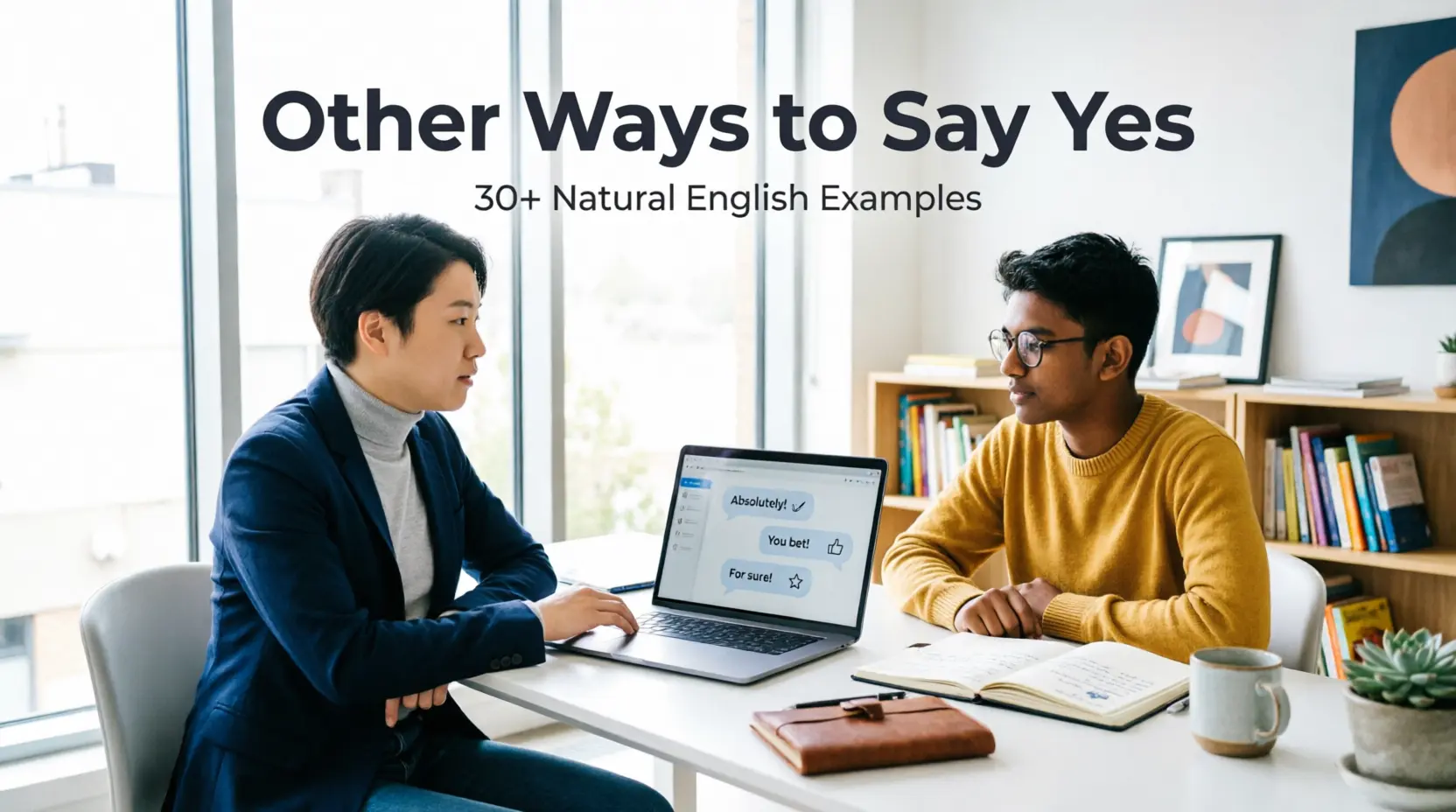
There are many natural ways to say yes depending on your tone, relationship, and situation. Use phrases such as Absolutely, Certainly, Of course, Definitely, I agree, That sounds great, I’d be happy to, and Without a doubt.
Top alternatives: Absolutely, Certainly, Definitely, Of course, I agree, Sure, Sounds good, That works for me, I’d be happy to, I’d love to.
Saying yes is one of the simplest ways to show agreement, acceptance, approval, or willingness. However, repeating the same word in every conversation can make your English sound limited. People use yes in everyday conversations, professional discussions, emails, meetings, customer service, and social situations. Learning different alternatives helps you communicate your attitude more precisely and choose words that match the situation.
Learning other ways to say yes can improve your fluency by giving you more control over tone and meaning. The right expression can help you sound formal, friendly, enthusiastic, polite, or confident. These alternatives also help you express excitement in English without sounding repetitive. Understanding alternatives to yes can make your spoken and written English more natural, effective, and engaging.
Quick Categories
Formal alternatives to “yes”
- Certainly
- Indeed
- Absolutely
- Without a doubt
Pro Tip: Use formal alternatives when speaking with clients, managers, teachers, or other professional contacts.
Casual alternatives
- Sure
- Of course
- Sounds good
- That works
Pro Tip: Casual expressions work well with friends, classmates, and people you know well.
Professional alternatives
- I agree
- I’d be happy to
- Certainly, I can
- That would be fine
Pro Tip: Professional responses should communicate agreement while remaining clear and respectful.
Informal expressions
- Yep
- Yeah
- You bet
- Definitely
Pro Tip: Use informal expressions in relaxed conversations rather than formal emails or business documents.
“Tone matters as much as meaning when you want to sound natural in English.”
Common Mistakes When Saying “Yes”
1. Using “yes” for every situation
Simply repeating yes can sound repetitive.
Example: Yes, yes, yes. I understand.
Better: Absolutely. I understand your point.
2. Using informal expressions at work
Expressions such as yep or yeah may sound too relaxed in formal communication.
Example: Yep, I will send the report today.
Better: Certainly. I will send the report today.
3. Confusing agreement with enthusiasm
A simple yes does not always show strong excitement.
Example: Yes, I would love to attend.
Better: Absolutely. I’d love to attend.
4. Using “of course” in the wrong context
Of course can sometimes sound impatient when answering an obvious question.
Example: Of course you should submit the form.
Better: Certainly. You should submit the form before Friday.
5. Giving unclear agreement
A short response may not explain exactly what you agree to.
Example: Yes.
Better: Yes, I agree with the proposed schedule.
What Does “Yes” Mean?
Yes is an affirmative word used to show agreement, acceptance, confirmation, permission, or a positive response.
It can function as an independent response or appear within a longer sentence.
Example: Yes, I agree with your suggestion.
The meaning can change slightly depending on tone, context, and the words surrounding it.
When to Use “Yes”
You can use yes in many everyday and professional situations, including:
- Confirming information
- Accepting an invitation
- Agreeing with an opinion
- Giving permission
- Accepting an offer
- Showing willingness
- Responding to a question
- Confirming a decision
Spoken vs Written
Spoken English: Yes, sure, absolutely, definitely, of course
Written English: Certainly, I agree, that would be fine, I’d be happy to
Formal vs Informal
Formal: Certainly, indeed, absolutely
Informal: Yeah, yep, sure, you bet
“A strong English speaker knows when to agree, how strongly to agree, and which tone to use.”
Is It Professional or Polite to Say “Yes”?
Polite? ✔ Yes
Professional? ✔ Yes, but context matters
The word yes is completely polite and professional when used appropriately. However, some situations benefit from a more specific response.
For example:
Business style: Yes, I agree with the proposed approach.
More polished: Certainly. I agree with the proposed approach.
Using a more specific expression can make your response sound confident and intentional.
Pros and Cons of Using “Yes”
Pros
- Simple and natural
- Friendly tone
- Common usage
- Easy to understand
Cons
- Can become repetitive
- May sound too basic in formal situations
- Has limited emotional range
- Does not always communicate enthusiasm
Other Ways to Say “Yes” With Examples
These alternatives will help you sound more fluent, confident, and natural in different situations.
Use them according to tone, context, and audience to express excitement, admiration, agreement, or approval.
1. Phrase: Absolutely
Meaning: Shows strong agreement or enthusiastic acceptance.
Explanation: It communicates a confident and positive response.
Example Sentence: Absolutely, I would be happy to help with the project.
Best Use: Strong agreement
Worst Use: Negative response
Tone: Confident, enthusiastic, positive
Context Variability: Casual and professional spoken English
2. Phrase: Certainly
Meaning: Shows polite and confident agreement.
Explanation: It is especially suitable for formal and professional communication.
Example Sentence: Certainly, I can send you the revised document today.
Best Use: Formal requests
Worst Use: Casual jokes
Tone: Formal, polite, confident
Context Variability: Professional and written English
3. Phrase: Of course
Meaning: Shows agreement or willingness to help.
Explanation: It often communicates that something is acceptable or expected.
Example Sentence: Of course, I can explain the process again.
Best Use: Helpful responses
Worst Use: Sensitive disagreement
Tone: Friendly, helpful, natural
Context Variability: Casual and professional spoken English
4. Phrase: Definitely
Meaning: Shows strong certainty or agreement.
Explanation: It emphasizes that you completely agree or intend to do something.
Example Sentence: Definitely, I’ll join the meeting tomorrow.
Best Use: Strong agreement
Worst Use: Formal confirmations
Tone: Confident, enthusiastic, direct
Context Variability: Casual and professional conversations
5. Phrase: Sure
Meaning: Shows willingness or agreement.
Explanation: It is a common alternative when accepting a request.
Example Sentence: Sure, I can help you prepare the presentation.
Best Use: Simple requests
Worst Use: Formal letters
Tone: Casual, friendly, cooperative
Context Variability: Casual and spoken English
6. Phrase: I agree
Meaning: Shows that you share someone’s opinion.
Explanation: It directly communicates agreement with an idea or statement.
Example Sentence: I agree with your recommendation about the new strategy.
Best Use: Sharing agreement
Worst Use: Accepting invitations
Tone: Direct, professional, neutral
Context Variability: Professional and academic English
7. Phrase: That sounds good
Meaning: Shows approval of an idea or proposal.
Explanation: It is useful when responding positively to a suggestion.
Example Sentence: That sounds good. Let’s schedule the meeting for Friday.
Best Use: Suggestions
Worst Use: Serious decisions
Tone: Friendly, positive, natural
Context Variability: Casual and professional spoken English
8. Phrase: That works for me
Meaning: Shows that a proposed option is acceptable.
Explanation: It is commonly used when discussing plans or schedules.
Example Sentence: Thursday afternoon works for me.
Best Use: Scheduling plans
Worst Use: Formal approvals
Tone: Casual, cooperative, practical
Context Variability: Workplace and everyday conversations
9. Phrase: I’d be happy to
Meaning: Shows willingness to do something.
Explanation: It communicates agreement while adding a helpful and positive tone.
Example Sentence: I’d be happy to review the document before the meeting.
Best Use: Professional requests
Worst Use: Simple questions
Tone: Polite, professional, helpful
Context Variability: Professional spoken and written English
10. Phrase: No problem
Meaning: Shows that you are willing to accept or do something.
Explanation: It reassures the other person that their request is acceptable.
Example Sentence: No problem. I can send the files this afternoon.
Best Use: Everyday requests
Worst Use: Formal approvals
Tone: Casual, reassuring, friendly
Context Variability: Casual and workplace conversations
11. Phrase: Sounds great
Meaning: Shows enthusiastic approval.
Explanation: It is stronger and more energetic than a simple yes.
Example Sentence: Sounds great. I’m looking forward to the event.
Best Use: Positive plans
Worst Use: Serious negotiations
Tone: Friendly, enthusiastic, positive
Context Variability: Casual and professional spoken English
12. Phrase: For sure
Meaning: Shows strong agreement or certainty.
Explanation: It is a relaxed way to confirm something.
Example Sentence: For sure, I’ll call you after work.
Best Use: Casual agreement
Worst Use: Formal emails
Tone: Informal, confident, friendly
Context Variability: Informal spoken English
13. Phrase: You bet
Meaning: Shows enthusiastic agreement or willingness.
Explanation: It is a friendly expression used mainly in informal conversations.
Example Sentence: You bet. I’d love to come along.
Best Use: Friendly conversations
Worst Use: Business reports
Tone: Informal, upbeat, friendly
Context Variability: Informal spoken English
14. Phrase: Indeed
Meaning: Shows agreement or confirms that something is true.
Explanation: It has a more formal and sometimes literary quality.
Example Sentence: Indeed, this approach could improve the overall results.
Best Use: Formal discussion
Worst Use: Casual texting
Tone: Formal, measured, confident
Context Variability: Formal and written English
15. Phrase: Without a doubt
Meaning: Shows complete certainty or agreement.
Explanation: It emphasizes that you have no uncertainty about your response.
Example Sentence: Without a doubt, this is the best option for our team.
Best Use: Strong opinions
Worst Use: Simple requests
Tone: Strong, confident, emphatic
Context Variability: Professional and general English
16. Phrase: I’m in
Meaning: Shows willingness to participate.
Explanation: It means you accept an invitation, plan, or opportunity.
Example Sentence: I’m in. Let’s start the project next week.
Best Use: Accepting plans
Worst Use: Formal meetings
Tone: Informal, enthusiastic, direct
Context Variability: Casual spoken English
17. Phrase: Count me in
Meaning: Shows that you want to participate.
Explanation: It is a friendly way to accept an invitation or activity.
Example Sentence: Count me in for the team dinner.
Best Use: Social plans
Worst Use: Formal requests
Tone: Casual, friendly, enthusiastic
Context Variability: Informal spoken English
18. Phrase: I’m happy to
Meaning: Shows willingness to do something.
Explanation: It communicates cooperation in a positive way.
Example Sentence: I’m happy to discuss the proposal with you.
Best Use: Helpful responses
Worst Use: Refusing requests
Tone: Polite, positive, cooperative
Context Variability: Professional and everyday English
19. Phrase: I’m willing to
Meaning: Shows readiness to do something.
Explanation: It emphasizes your willingness rather than excitement.
Example Sentence: I’m willing to consider your proposal.
Best Use: Negotiations
Worst Use: Exciting invitations
Tone: Professional, neutral, measured
Context Variability: Professional and formal English
20. Phrase: That would be fine
Meaning: Shows that a proposed option is acceptable.
Explanation: It works well when confirming arrangements or decisions.
Example Sentence: That would be fine. Please send the details by email.
Best Use: Confirming arrangements
Worst Use: Excited occasions
Tone: Polite, neutral, professional
Context Variability: Workplace and formal conversations
21. Phrase: I approve
Meaning: Shows official acceptance of something.
Explanation: It is stronger and more formal than a simple yes.
Example Sentence: I approve the proposed changes to the schedule.
Best Use: Formal decisions
Worst Use: Casual invitations
Tone: Formal, authoritative, direct
Context Variability: Professional and organizational English
22. Phrase: Agreed
Meaning: Shows complete agreement with a statement or decision.
Explanation: It is concise and useful when confirming a shared decision.
Example Sentence: Agreed. We will proceed with the original plan.
Best Use: Decisions
Worst Use: Friendly invitations
Tone: Direct, professional, decisive
Context Variability: Professional and spoken English
23. Phrase: Precisely
Meaning: Shows agreement with a specific point.
Explanation: It indicates that another person’s statement is exactly correct.
Example Sentence: Precisely. That is the main issue we need to address.
Best Use: Confirming points
Worst Use: Accepting favors
Tone: Formal, confident, precise
Context Variability: Academic and professional English
24. Phrase: That’s right
Meaning: Confirms that information or a statement is correct.
Explanation: It is useful when agreeing with factual information.
Example Sentence: That’s right. The meeting begins at nine.
Best Use: Confirming facts
Worst Use: Formal approval
Tone: Natural, confident, conversational
Context Variability: Spoken and everyday English
25. Phrase: Correct
Meaning: Confirms that something is accurate.
Explanation: It provides a direct and professional confirmation.
Example Sentence: Correct. The final report is due on Monday.
Best Use: Confirming information
Worst Use: Social invitations
Tone: Formal, concise, professional
Context Variability: Workplace and academic English
26. Phrase: I completely agree
Meaning: Shows very strong agreement.
Explanation: It makes your level of agreement clear and emphatic.
Example Sentence: I completely agree with your assessment of the situation.
Best Use: Strong agreement
Worst Use: Simple confirmation
Tone: Strong, professional, emphatic
Context Variability: Professional and academic English
27. Phrase: I couldn’t agree more
Meaning: Shows the strongest possible agreement.
Explanation: It emphasizes that you fully share another person’s opinion.
Example Sentence: I couldn’t agree more with your recommendation.
Best Use: Shared opinions
Worst Use: Accepting requests
Tone: Enthusiastic, confident, conversational
Context Variability: Professional and general spoken English
28. Phrase: Certainly, I can
Meaning: Shows polite willingness to complete a task.
Explanation: It combines confirmation with a clear commitment to action.
Example Sentence: Certainly, I can provide the information by tomorrow.
Best Use: Professional requests
Worst Use: Casual chats
Tone: Formal, polite, helpful
Context Variability: Professional spoken and written English
29. Phrase: Absolutely, I will
Meaning: Shows strong agreement with a commitment.
Explanation: It confirms that you intend to complete the requested action.
Example Sentence: Absolutely, I will send the final version this evening.
Best Use: Confirming actions
Worst Use: Casual questions
Tone: Confident, positive, professional
Context Variability: Workplace and professional conversations
30. Phrase: I’d love to
Meaning: Shows enthusiastic willingness to accept an invitation or opportunity.
Explanation: It communicates both agreement and genuine enthusiasm.
Example Sentence: I’d love to join you for the conference.
Best Use: Enthusiastic acceptance
Worst Use: Formal approvals
Tone: Warm, enthusiastic, friendly
Context Variability: Casual and professional spoken English
“Use stronger expressions when your enthusiasm matters, not simply when agreement matters.”
Professional Reaction Phrases
In workplace communication, you may need more than a basic yes. Professional reaction phrases can show agreement, willingness, confirmation, or approval more precisely.
Consider these examples:
- I agree with your recommendation.
- Certainly, I can take care of that.
- That would be acceptable.
- I’d be happy to assist.
- Agreed. Let’s move forward.
- Absolutely. I support this approach.
These expressions help you sound professional without making your English unnecessarily complicated.
Mini Quiz and Self Check
1. Your manager asks whether you can send a report today. Which response is most professional?
A. Yep
B. You bet
C. Certainly, I can
D. Yeah
Answer: C
2. Your friend invites you to a party. Which response sounds natural and enthusiastic?
A. I approve
B. I’d love to
C. Correct
D. Indeed
Answer: B
3. Someone suggests a meeting time that suits you. What is a natural response?
A. That works for me
B. I approve
C. Precisely
D. Without a doubt
Answer: A
4. Someone makes an opinion you strongly share. Which phrase shows strong agreement?
A. Sure
B. No problem
C. I couldn’t agree more
D. That would be fine
Answer: C
Comparison Table: Top Alternatives
| Phrase | Tone | Best Use |
| Absolutely | Confident, enthusiastic | Strong agreement |
| Certainly | Formal, polite | Professional requests |
| Of course | Friendly, helpful | Everyday responses |
| Definitely | Confident, positive | Strong confirmation |
| I agree | Direct, professional | Sharing opinions |
| I’d be happy to | Polite, helpful | Workplace requests |
| That sounds good | Friendly, positive | Suggestions |
| That works for me | Casual, practical | Scheduling |
| I couldn’t agree more | Strong, enthusiastic | Opinions |
| I’d love to | Warm, enthusiastic | Invitations |
FAQs
What are the best other ways to say yes?
Some of the best alternatives include absolutely, certainly, definitely, of course, I agree, and I’d be happy to. Your choice should match the context and level of formality.
What are formal alternatives to yes?
Formal alternatives include certainly, indeed, absolutely, agreed, correct, and I’d be happy to. These work well in professional and academic communication.
What are casual alternatives to yes?
Common casual alternatives include sure, yeah, yep, sounds good, that works, and for sure. These expressions are more suitable for relaxed conversations.
How can I express excitement instead of simply saying yes?
Use phrases such as absolutely, definitely, sounds great, I’d love to, or I’m in. These responses communicate stronger enthusiasm.
Which alternatives to yes are best for professional English?
For professional communication, use certainly, I agree, I’d be happy to, that would be fine, agreed, or certainly, I can. These expressions sound clear, respectful, and confident.
Conclusion
Learning other ways to say yes gives you more control over your English. Instead of relying on one simple response, you can show agreement, enthusiasm, willingness, certainty, or professional approval.
Practice several alternatives in real conversations and emails. Most importantly, pay attention to tone. A phrase that sounds natural with friends may not work equally well in professional communication. Choosing the right expression will help you sound more fluent, confident, and appropriate.
Which alternative do you use most often? Share your favorite expression and practice using it in a sentence.