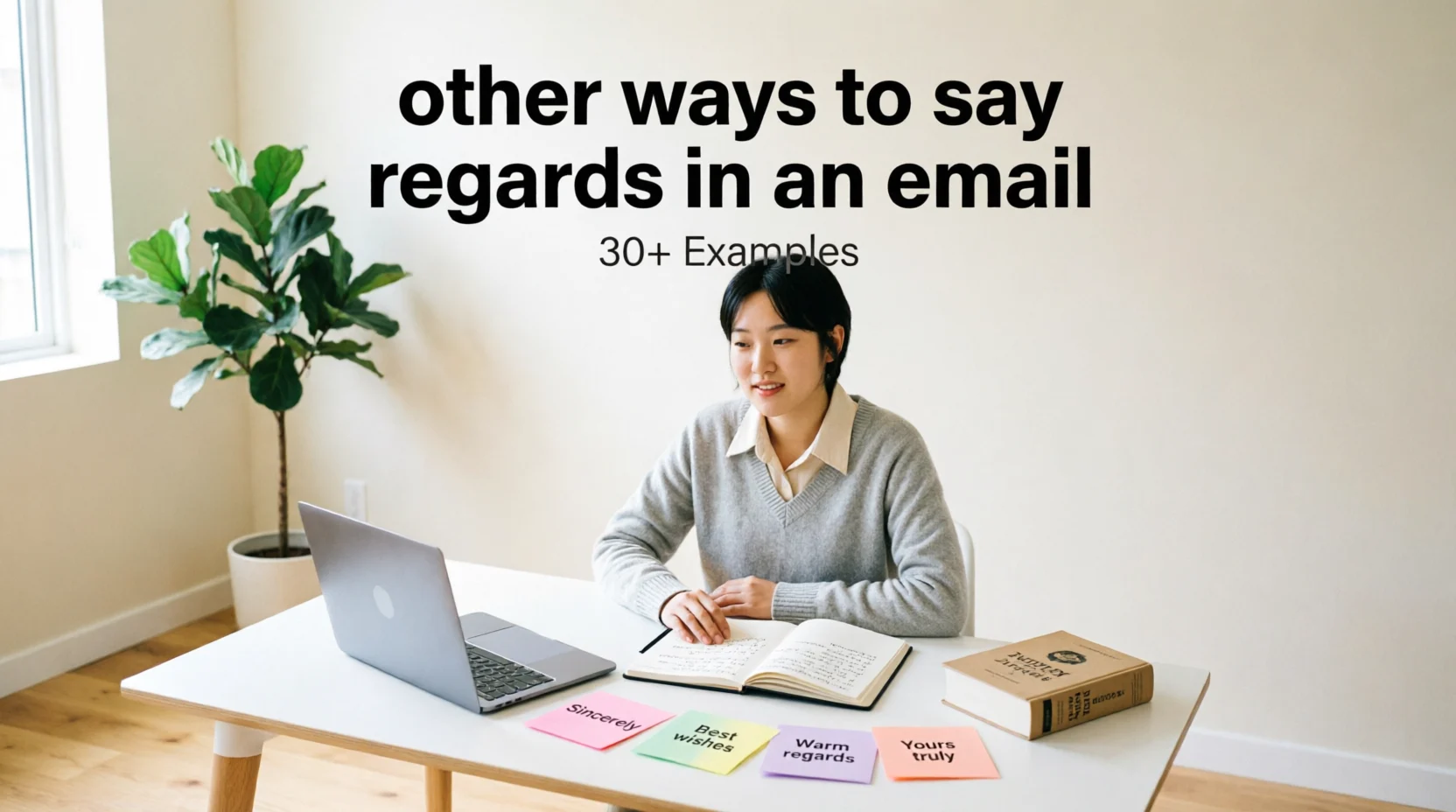
The best alternatives depend on your relationship with the recipient and the level of formality you need. Strong choices include Best regards, Kind regards, Warm regards, Sincerely, and Best wishes.
Top alternatives: Best regards, Kind regards, Warm regards, Best wishes, Sincerely, Yours sincerely, All the best, With appreciation, Best, With thanks.
The phrase “regards” is commonly used at the end of an email to show politeness and close a message respectfully. It is especially common in workplace communication, customer service, business correspondence, and professional networking. However, using the same closing in every message can make your writing sound repetitive. Learning alternatives to other ways to say regards in an email can help you choose a closing that matches your relationship with the reader, purpose, and level of formality. A formal business email may require a different expression from a friendly message to a colleague.
This guide explains 30 useful alternatives with meanings, examples, tone information, and practical usage advice. These expressions can also improve your broader communication skills, including professional reaction phrases and ways to express excitement in English naturally. By understanding tone and context, you can make your emails sound more confident, polished, and appropriate.
Quick Categories
Formal alternatives to “regards in an email”
- Sincerely
- Yours sincerely
- Respectfully
- Yours faithfully
These expressions work well when writing to someone you do not know personally or when the message requires a formal tone.
Pro Tip: Use a formal closing when contacting a company, institution, senior professional, or unfamiliar recipient.
Casual alternatives
- Best wishes
- Warm wishes
- All the best
- Take care
These expressions create a warmer and more approachable tone while remaining polite.
Pro Tip: Choose a casual closing when you already have a friendly relationship with the recipient.
Professional alternatives
- Best regards
- Kind regards
- Warm regards
- With appreciation
These are useful for workplace emails, client communication, networking, and professional follow ups.
Pro Tip: For most everyday business emails, Best regards and Kind regards are reliable choices.
Informal expressions
- Thanks
- Thank you
- Talk soon
- Speak soon
These expressions are suitable when the relationship is already established and the context is relaxed.
Pro Tip: Do not use highly informal expressions when writing your first email to a client, manager, or unfamiliar professional.
“Your closing is part of your message. It can make the final impression feel formal, friendly, appreciative, or distant.”
Common Mistakes
1. Using a casual closing in a formal email
Mistake: Ending a formal application with “Take care.”
Example: “Thank you for reviewing my application. Take care.”
A better choice would be Sincerely or Kind regards.
2. Using the same closing for every recipient
Mistake: Using “Best regards” in every email regardless of context.
Example: “Best regards” after a very personal thank you message.
A warmer expression such as Warm wishes may sound more natural.
3. Adding unnecessary punctuation
Mistake: Writing several punctuation marks after the closing.
Example: “Kind regards!!!”
A professional closing normally needs simple punctuation.
4. Mixing several closings
Mistake: Combining different expressions.
Example: “Best regards and sincerely.”
Choose one suitable closing instead.
5. Using an overly formal expression with a close colleague
Mistake: Writing “Yours faithfully” to a colleague you communicate with daily.
Example: “Yours faithfully, Sarah.”
This can sound unnecessarily distant. Best or Thanks may be more natural depending on the situation.
What Does “Regards in an Email” Mean?
“Regards” is a polite email closing used before the sender’s name. It communicates respect and goodwill while bringing the message to a close.
The word regards functions as a noun in this expression. It refers to respectful or positive feelings toward another person.
Example:
“Thank you for your time. Regards, Daniel.”
The expression is more common in written communication than spoken English. In everyday professional writing, variations such as Best regards and Kind regards are often more natural.
When to Use “Regards in an Email”
You can use this type of closing in several situations:
- Business emails
- Workplace communication
- Customer service messages
- Professional networking
- Follow up emails
- Requests for information
- Communication with clients
- Communication with colleagues
- Formal correspondence
Spoken vs Written
“Regards” is primarily a written expression. People generally do not say “Regards” when ending a face to face conversation.
In spoken English, people are more likely to say:
- Have a good day.
- Take care.
- Speak to you soon.
- See you soon.
- Thanks again.
Formal vs Informal
The level of formality depends on the exact closing.
More formal: Sincerely, Respectfully, Yours faithfully
Professional: Best regards, Kind regards, With appreciation
Friendly: Best wishes, Warm wishes, All the best
Informal: Thanks, Take care, Talk soon
Is It Professional or Polite to Say “Regards in an Email”?
Yes. Regards is polite and can be professional, especially when used as part of Best regards or Kind regards.
However, the exact expression matters. A simple “Regards” can sometimes sound brief or distant. In many professional situations, Best regards or Kind regards feels more complete and natural.
Polite? ✔ Yes
Professional? ✔ Yes, depending on the context
Business example:
“Thank you for providing the requested information. I look forward to hearing from you.
Kind regards,
Michael”
“Professional English is not about sounding complicated. It is about choosing words that fit the situation.”
Pros and Cons of Using “Regards”
Pros
- Simple and natural
- Friendly tone
- Common usage
- Easy to understand
Cons
- Can become repetitive
- May sound brief in some contexts
- Offers limited emotional range
- May feel less personal than other closings
Other Ways to Say “Regards in an Email”
These alternatives will help you sound more fluent, confident, and natural in different situations.
Use them according to tone, context, and audience to communicate respect, appreciation, warmth, or professionalism.
1. Phrase: Best regards
Meaning: A polite expression showing goodwill toward the recipient.
Explanation: It is one of the safest choices for everyday professional emails.
Example Sentence: Thank you for your assistance. Best regards, Emma.
Best Use: Business emails
Worst Use: Very personal messages
Tone: Professional, friendly, neutral
Context Variability: Professional email, workplace message, client communication
2. Phrase: Kind regards
Meaning: A polite and slightly warm email closing.
Explanation: It combines professionalism with a friendly tone.
Example Sentence: I appreciate your quick response. Kind regards, James.
Best Use: Client communication
Worst Use: Casual texting
Tone: Polite, warm, professional
Context Variability: Professional email, client message, networking
3. Phrase: Warm regards
Meaning: A respectful closing with additional warmth.
Explanation: It works well when you want your message to feel more personal.
Example Sentence: Thank you for your continued support. Warm regards, Olivia.
Best Use: Friendly business
Worst Use: Strictly formal letters
Tone: Warm, respectful, personal
Context Variability: Client email, colleague message, professional relationship
4. Phrase: Sincerely
Meaning: A formal expression of respect and goodwill.
Explanation: It is especially suitable for formal correspondence and applications.
Example Sentence: Thank you for considering my application. Sincerely, Daniel.
Best Use: Formal correspondence
Worst Use: Casual messages
Tone: Formal, respectful, traditional
Context Variability: Application letter, formal email, business communication
5. Phrase: Yours sincerely
Meaning: A formal closing commonly used in professional correspondence.
Explanation: It is traditionally used when you know the recipient’s name.
Example Sentence: I look forward to discussing this opportunity with you. Yours sincerely, Sarah.
Best Use: Formal letters
Worst Use: Casual emails
Tone: Formal, respectful, traditional
Context Variability: Formal email, application, official correspondence
6. Phrase: Yours faithfully
Meaning: A formal closing used traditionally when the recipient is not named.
Explanation: It is more common in British English formal correspondence.
Example Sentence: Thank you for your consideration. Yours faithfully, Ahmed.
Best Use: Formal letters
Worst Use: Friendly emails
Tone: Formal, traditional, respectful
Context Variability: Official letter, formal complaint, institutional email
7. Phrase: Respectfully
Meaning: A closing that emphasizes respect.
Explanation: It is appropriate when communicating with authority figures or in sensitive situations.
Example Sentence: Thank you for considering my request. Respectfully, Maria.
Best Use: Sensitive matters
Worst Use: Casual messages
Tone: Respectful, serious, formal
Context Variability: Official communication, formal request, sensitive email
8. Phrase: With appreciation
Meaning: A closing that expresses gratitude.
Explanation: Use it when you genuinely appreciate the recipient’s help or effort.
Example Sentence: Thank you for resolving this issue. With appreciation, Noah.
Best Use: Thank you emails
Worst Use: Routine updates
Tone: Grateful, professional, warm
Context Variability: Client email, workplace message, support communication
9. Phrase: With thanks
Meaning: A concise way to express gratitude.
Explanation: It works particularly well when the email includes a request that the recipient has helped with.
Example Sentence: Thank you for sending the documents. With thanks, Emma.
Best Use: Helpful responses
Worst Use: Formal applications
Tone: Polite, grateful, concise
Context Variability: Workplace email, client response, professional request
10. Phrase: Best wishes
Meaning: A friendly expression of goodwill.
Explanation: It is warmer than a strictly formal closing while remaining polite.
Example Sentence: I wish you success with your new role. Best wishes, David.
Best Use: Friendly correspondence
Worst Use: Legal notices
Tone: Friendly, warm, positive
Context Variability: Colleague email, networking, personal professional message
11. Phrase: Warm wishes
Meaning: A warm and friendly expression of goodwill.
Explanation: It works well when the relationship is positive and established.
Example Sentence: Congratulations on your new position. Warm wishes, Sophia.
Best Use: Positive occasions
Worst Use: Formal complaints
Tone: Warm, friendly, positive
Context Variability: Congratulations, colleague email, professional celebration
12. Phrase: All the best
Meaning: A friendly wish for the recipient’s success or well being.
Explanation: It is natural in professional and personal communication.
Example Sentence: I hope everything goes well with the project. All the best, Ryan.
Best Use: Friendly emails
Worst Use: Highly formal letters
Tone: Friendly, positive, relaxed
Context Variability: Workplace email, networking, personal communication
13. Phrase: Best
Meaning: A short form of goodwill used at the end of an email.
Explanation: It is concise and widely used in modern professional communication.
Example Sentence: Thanks for the update. Best, Laura.
Best Use: Short emails
Worst Use: Formal applications
Tone: Concise, professional, friendly
Context Variability: Workplace email, colleague message, quick response
14. Phrase: Many thanks
Meaning: A stronger expression of gratitude.
Explanation: It works well when you want to emphasize appreciation.
Example Sentence: Many thanks for sending the report so quickly.
Best Use: Thank you emails
Worst Use: Legal correspondence
Tone: Grateful, friendly, professional
Context Variability: Workplace email, client communication, requests
15. Phrase: Thank you
Meaning: A direct expression of gratitude.
Explanation: It is useful when the main purpose of the closing is to thank the recipient.
Example Sentence: Thank you for your help with this matter.
Best Use: Appreciation emails
Worst Use: No gratitude
Tone: Polite, direct, appreciative
Context Variability: Workplace, customer service, professional requests
16. Phrase: Thanks again
Meaning: A repeated expression of appreciation.
Explanation: It is especially natural when the recipient has already helped you.
Example Sentence: Thanks again for taking the time to meet with me.
Best Use: Follow up emails
Worst Use: First contact
Tone: Friendly, appreciative, natural
Context Variability: Follow up, colleague email, networking
17. Phrase: Take care
Meaning: A friendly expression wishing someone well.
Explanation: It is more informal and works best with people you already know.
Example Sentence: Thanks for everything. Take care, Hannah.
Best Use: Friendly communication
Worst Use: Formal applications
Tone: Warm, casual, friendly
Context Variability: Colleague message, personal email, familiar contact
18. Phrase: Speak soon
Meaning: A friendly indication that you expect to communicate again soon.
Explanation: It works naturally when another conversation or meeting is expected.
Example Sentence: Thanks for your message. Speak soon, Adam.
Best Use: Ongoing communication
Worst Use: Formal complaints
Tone: Friendly, informal, positive
Context Variability: Colleague email, client relationship, familiar contact
19. Phrase: Talk soon
Meaning: A casual expression suggesting future communication.
Explanation: It is best used when the relationship is relaxed.
Example Sentence: I will send the details tomorrow. Talk soon.
Best Use: Casual emails
Worst Use: Formal requests
Tone: Casual, friendly, relaxed
Context Variability: Friendly email, colleague message, familiar contact
20. Phrase: Until next time
Meaning: A friendly closing suggesting future contact.
Explanation: It creates a warm ending when another interaction is likely.
Example Sentence: It was great speaking with you. Until next time.
Best Use: Friendly follow up
Worst Use: Formal applications
Tone: Warm, relaxed, friendly
Context Variability: Networking, colleagues, personal professional relationships
21. Phrase: Looking forward to hearing from you
Meaning: An expression showing that you expect a response.
Explanation: It is particularly useful after making a question or request.
Example Sentence: Please let me know your availability. I look forward to hearing from you.
Best Use: Business requests
Worst Use: No response needed
Tone: Professional, polite, expectant
Context Variability: Client email, job application, business request
22. Phrase: Looking forward to working with you
Meaning: An expression of positive expectation about future cooperation.
Explanation: It is useful when beginning a professional relationship.
Example Sentence: Thank you for choosing our service. I look forward to working with you.
Best Use: New partnerships
Worst Use: Unrelated messages
Tone: Positive, professional, confident
Context Variability: Business email, client onboarding, collaboration
23. Phrase: Have a great day
Meaning: A friendly wish for the recipient to have a pleasant day.
Explanation: It is useful for routine professional communication with a friendly tone.
Example Sentence: Thank you for your quick response. Have a great day.
Best Use: Daily communication
Worst Use: Formal applications
Tone: Friendly, positive, polite
Context Variability: Customer service, workplace email, everyday communication
24. Phrase: Have a wonderful week
Meaning: A warm wish for the recipient’s week.
Explanation: It can make a routine email sound more personable.
Example Sentence: Thank you for the update. Have a wonderful week.
Best Use: Weekly communication
Worst Use: Emergency messages
Tone: Warm, positive, friendly
Context Variability: Workplace email, client communication, friendly business message
25. Phrase: Wishing you success
Meaning: A direct expression of goodwill toward someone’s future success.
Explanation: It works especially well when someone is starting a new project, position, or opportunity.
Example Sentence: Congratulations on your new position. Wishing you success in your new role.
Best Use: Career occasions
Worst Use: Routine updates
Tone: Positive, professional, encouraging
Context Variability: Career email, congratulations, networking
26. Phrase: Wishing you all the best
Meaning: A warm expression of goodwill.
Explanation: It combines friendliness with a sincere wish for positive results.
Example Sentence: It was a pleasure working with you. Wishing you all the best.
Best Use: Farewell messages
Worst Use: Routine notices
Tone: Warm, sincere, positive
Context Variability: Farewell, career change, professional relationship
27. Phrase: With best wishes
Meaning: A polite expression of goodwill.
Explanation: It offers a warmer alternative to a purely formal closing.
Example Sentence: Thank you for your support. With best wishes, Daniel.
Best Use: Friendly professional
Worst Use: Legal notices
Tone: Warm, polite, professional
Context Variability: Professional email, colleague message, networking
28. Phrase: Cordially
Meaning: A formal expression of friendliness and respect.
Explanation: It is less common in everyday modern email but can work in formal correspondence.
Example Sentence: Thank you for reviewing the proposal. Cordially, Maria.
Best Use: Formal correspondence
Worst Use: Casual messages
Tone: Formal, courteous, traditional
Context Variability: Business letter, formal email, institutional communication
29. Phrase: In appreciation
Meaning: A closing that communicates gratitude and recognition.
Explanation: It is suitable when acknowledging someone’s contribution or assistance.
Example Sentence: Your guidance has been extremely helpful. In appreciation, James.
Best Use: Recognition emails
Worst Use: Routine updates
Tone: Grateful, formal, sincere
Context Variability: Workplace recognition, thank you email, professional correspondence
30. Phrase: Thank you for your time
Meaning: A polite acknowledgment of the recipient’s time and attention.
Explanation: It works especially well after interviews, meetings, requests, or detailed discussions.
Example Sentence: Thank you for discussing the position with me. Thank you for your time.
Best Use: Professional follow up
Worst Use: Casual chat
Tone: Polite, professional, appreciative
Context Variability: Interview email, business meeting, professional request
“Fluent English means knowing not only what a phrase means, but when it sounds natural.”
How to Choose the Right Closing
Choosing the right alternative depends on three main factors: relationship, purpose, and formality.
If you are writing to a client
Use:
- Best regards
- Kind regards
- With appreciation
- Looking forward to working with you
If you are writing to a colleague
Use:
- Best
- Best regards
- All the best
- Thanks
If you are writing to a manager
Use:
- Kind regards
- Best regards
- Sincerely
- With appreciation
If you are writing a formal application
Use:
- Sincerely
- Yours sincerely
- Yours faithfully
If you are writing to a familiar contact
Use:
- All the best
- Best wishes
- Take care
- Speak soon
A Simple Formula for Professional Email Closings
A strong professional email ending can follow this structure:
Final message + appropriate closing + name
For example:
“Thank you for reviewing the proposal. I look forward to hearing your feedback.
Kind regards,
Daniel”
This structure is simple, clear, and suitable for many professional situations.
Professional vs Casual Closing Guide
| Situation | Recommended Closing |
|---|---|
| Formal application | Sincerely |
| Formal letter | Yours faithfully |
| Client email | Kind regards |
| Business email | Best regards |
| Friendly colleague | All the best |
| Thank you email | With appreciation |
| Quick workplace message | Best |
| Familiar contact | Take care |
| Future communication | Speak soon |
| Career opportunity | Wishing you success |
Mini Quiz and Self Check
1. You are emailing a new business client. Which closing is most suitable?
A. Talk soon
B. Kind regards
C. Take care
D. See you
Answer: B. Kind regards
2. You are writing a formal job application. Which option is most appropriate?
A. Sincerely
B. Talk soon
C. Take care
D. Best
Answer: A. Sincerely
3. Your colleague has helped you complete an important task. Which closing sounds natural?
A. Yours faithfully
B. With appreciation
C. Cordially
D. Respectfully
Answer: B. With appreciation
4. You are emailing a close colleague about a routine matter. Which option can sound natural?
A. Best
B. Yours faithfully
C. Respectfully
D. Yours sincerely
Answer: A. Best
“When in doubt, match your closing to the relationship rather than choosing the longest or most formal phrase.”
Comparison Table: Top Alternatives
| Phrase | Tone | Best Use |
|---|---|---|
| Best regards | Professional, friendly | Business emails |
| Kind regards | Polite, warm | Client communication |
| Warm regards | Warm, personal | Established relationships |
| Sincerely | Formal, respectful | Applications |
| Yours sincerely | Formal, traditional | Formal letters |
| Best wishes | Friendly, positive | Professional relationships |
| All the best | Friendly, relaxed | Colleagues |
| With appreciation | Grateful, professional | Thank you emails |
| Best | Concise, modern | Short workplace emails |
| Take care | Casual, warm | Familiar contacts |
Why Tone Matters in Email Writing
Words can have similar meanings but create very different impressions.
For example, Sincerely can sound formal and traditional, while Take care feels much more personal. Best regards sits comfortably between formal and friendly communication.
This is why learning other ways to say regards in an email is useful for both English learners and experienced professionals. You are not simply memorizing synonyms. You are learning how English speakers adjust their language according to social context.
The same principle applies to informal expressions in English. An expression can be grammatically correct but still sound unnatural if it does not match the situation.
How English Learners Can Practice
Try replacing the same closing with different alternatives based on the situation.
Practice 1: Formal
“Thank you for considering my application.”
Sincerely,
Alex
Practice 2: Professional
“Thank you for your assistance.”
Kind regards,
Alex
Practice 3: Friendly
“It was great speaking with you.”
All the best,
Alex
Practice 4: Informal
“Thanks for helping me with this.”
Take care,
Alex
This simple exercise helps you understand tone instead of memorizing isolated vocabulary.
Frequently Asked Questions
What are the best alternatives to regards in an email?
Best regards, Kind regards, Warm regards, Sincerely, and Best wishes are widely useful options. The best choice depends on the relationship and level of formality.
Is “Best regards” more professional than “Regards”?
Both can be professional, but Best regards often sounds warmer and more complete. A simple Regards can feel brief depending on the context.
Can I use “Kind regards” in a formal email?
Yes. Kind regards is widely suitable for professional and formal business communication, particularly when you want to sound polite without being overly formal.
Is “Take care” appropriate for a business email?
It can be appropriate when you already have a friendly relationship with the recipient. For a new client or formal contact, Kind regards or Best regards is usually more suitable.
How can I avoid repeating the same email closing?
Choose your closing according to context. Use professional expressions for business communication, warmer expressions for established relationships, and formal expressions for official correspondence.
Conclusion
Learning different email closings gives you greater control over tone, professionalism, and clarity. Instead of relying on one expression in every situation, you can choose from formal, professional, friendly, and informal options according to your audience.
The key is to practice regularly and pay attention to context. As you learn more professional reaction phrases and informal expressions in English, your overall communication will become more flexible and natural. Try using one new closing in your next few emails and notice how it changes the tone.
Which email closing do you use most often? Share your favorite alternative and help other English learners discover a natural option.