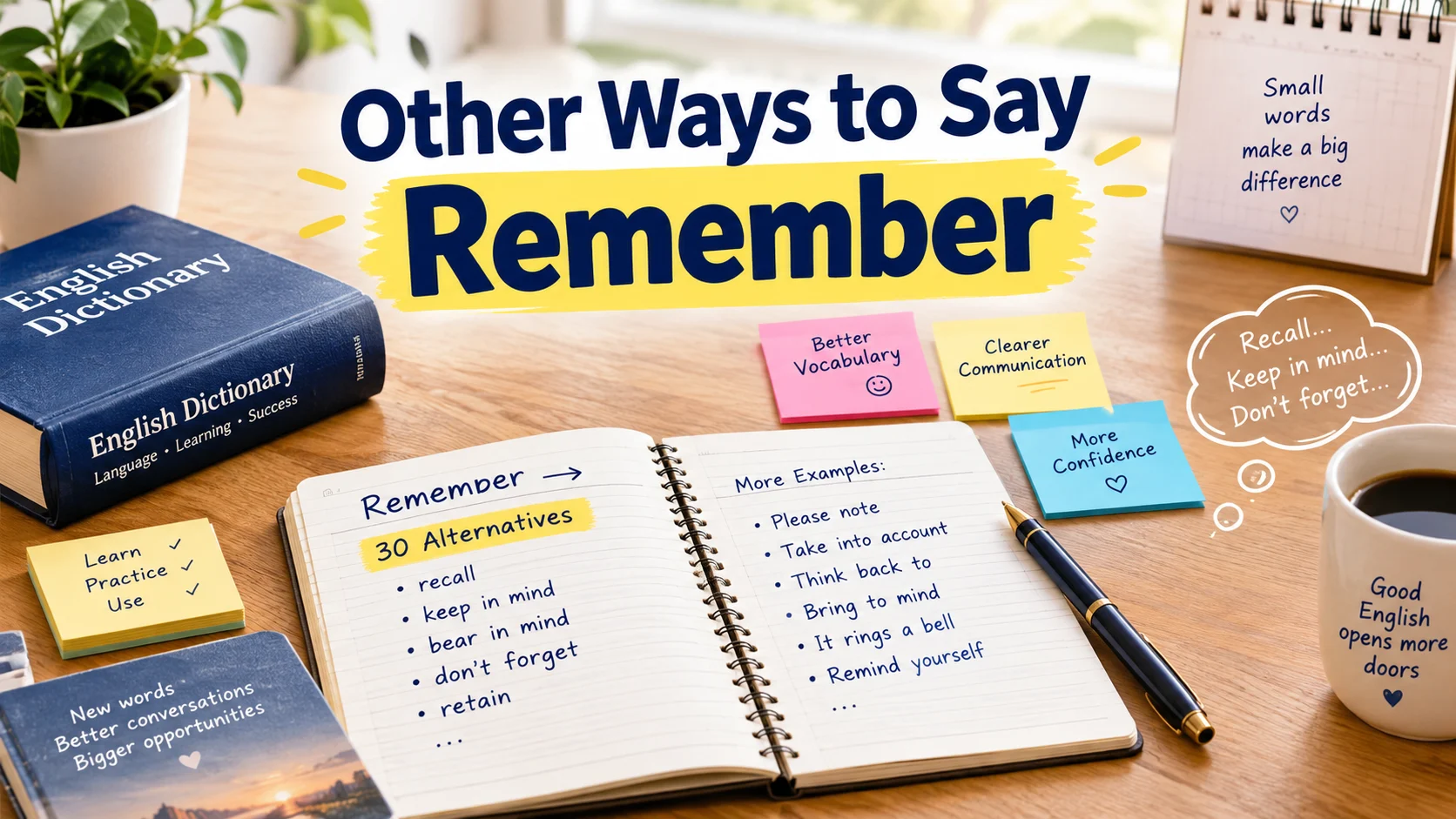
The phrase “remember” means to keep something in your mind, recall information, or avoid forgetting an important detail. Learning alternatives helps you communicate more naturally in everyday conversations, professional emails, academic writing, and formal discussions.
Top 5 alternatives: recall, keep in mind, bear in mind, don’t forget, retain.
Introduction
The word “remember” is one of the most common expressions in English. We use it when recalling past experiences, giving reminders, keeping important information in mind, or asking someone not to forget a task. Although it is simple and widely understood, repeating the same word in every conversation can make your communication sound less varied.
Learning alternatives to remember helps English learners express ideas more precisely. For example, “recall” often fits academic writing, “keep in mind” works well when offering advice, and “bear in mind” sounds appropriate in formal discussions. Each expression communicates a slightly different meaning depending on the situation.
For students, professionals, and advanced English learners, understanding these differences improves fluency and confidence. It also helps you choose the right words when writing reports, preparing presentations, sending workplace messages, or trying to express excitement in English about a meaningful experience. This guide covers 30 practical alternatives, with definitions, natural examples, tone guidance, and common mistakes to help you use each phrase accurately.
Formal alternatives to “remember”
Use these expressions when writing academic assignments, formal letters, reports, or communicating respectfully.
- Recall: Retrieve information from memory.
- Bear in mind: Consider an important fact.
- Keep in mind: Remember something while making a decision.
- Retain: Continue to possess information in your memory.
Pro tip: Choose “recall” for retrieving information and “bear in mind” when asking someone to consider a fact.
Casual alternatives
These phrases sound natural in everyday conversations with friends, classmates, and colleagues.
- Don’t forget: A direct reminder.
- Think back to: Revisit a past experience.
- Call to mind: Bring a memory into your thoughts.
- Bring back memories: Make someone remember a past experience.
Pro tip: Use “don’t forget” for everyday reminders and “think back to” when discussing the past.
Professional alternatives
These expressions work well in business emails, meetings, presentations, and workplace discussions.
- Please note: Direct attention to important information.
- Take note of: Pay attention to a detail.
- Keep in consideration: Consider something carefully. More natural alternatives include “take into account” and “bear in mind.”
- Take into account: Consider information before making a decision.
Pro tip: “Please note” works well for instructions, while “take into account” is useful when discussing decisions, plans, or reports.
Informal expressions
Use these phrases when speaking naturally with people you know well or discussing personal experiences.
- I haven’t forgotten: Confirm that something remains in your memory.
- It rings a bell: Suggest that something seems familiar.
- Jog my memory: Help someone recall forgotten information.
- Bring it to mind: Cause a thought or memory to return.
Pro tip: “It rings a bell” expresses partial recognition, not complete certainty that you remember something.
“Fluent English is not about using complicated words. It is about choosing the expression that fits the moment.”
Common mistakes when using “remember”
Even familiar English words can cause confusion. Avoid these five common mistakes.
1. Using the wrong verb pattern
Incorrect: I remember to meeting her last year.
Correct: I remember meeting her last year.
Explanation: Use remember + verb-ing for a past experience you recall.
2. Confusing a memory with a responsibility
Incorrect: I remember locking the door tomorrow.
Correct: I must remember to lock the door tomorrow.
Explanation: Use remember + to + verb for something you need to do.
3. Using “remember about” unnecessarily
Incorrect: Please remember about your appointment.
Correct: Please remember your appointment.
Explanation: “Remember about” is possible in some contexts, but the direct verb is usually more natural here.
4. Treating “recall” and “remind” as interchangeable
Incorrect: Please recall me to submit the report.
Correct: Please remind me to submit the report.
Explanation: You recall information yourself, while someone can remind you of something.
5. Using a casual phrase in a formal document
Incorrect: That old event rings a bell in my official report.
Better: The event remains familiar to me.
Explanation: Choose precise, professional wording when writing formal reports.
What does “remember” mean?
Remember is a verb meaning to retain information in your mind, bring a past experience back into your thoughts, or keep something in mind so you do not forget it.
It has several grammatical patterns:
- Remember + noun: I remember the meeting.
- Remember + verb-ing: I remember meeting the manager.
- Remember + to + verb: Remember to send the email.
- Remember + that-clause: I remember that the deadline is Friday.
The distinction between the second and third patterns is especially important. “I remember sending the email” means you recall doing it. “I remembered to send the email” means you did not forget to do it.
When to use “remember”
The word fits many situations, but the best alternative depends on your purpose.
- Recalling past experiences: Use “recall,” “think back to,” or “bring back memories.”
- Giving a reminder: Use “don’t forget,” “remember to,” or “please note.”
- Offering advice: Use “keep in mind” or “bear in mind.”
- Discussing learning: Use “retain” or “memorize.”
- Recognizing something familiar: Use “it rings a bell.”
- Making business decisions: Use “take into account.”
- Writing academic content: Use “recall” or “retain,” depending on the meaning.
Spoken vs. written English
In spoken English, expressions such as “don’t forget,” “I remember,” and “it rings a bell” sound natural. In writing, “recall,” “retain,” and “please note” may be more appropriate depending on the context.
Formal vs. informal English
Formal settings generally benefit from clear, precise expressions. Informal conversations allow more personal and conversational wording. However, “remember” itself is neutral and appropriate in both settings.
“A small change in wording can make a reminder sound more considerate, more precise, or more professional.”
Is it professional or polite to say “remember”?
Yes. “Remember” is both professional and polite when used appropriately. However, a direct command can sound abrupt if the relationship or situation calls for a softer tone.
Business-style example:
“Please remember to review the attached document before Friday’s meeting.”
Polite? ✔️ Yes
Professional? ✔️ Yes
Compare it with “Don’t forget to check this!” The second version can be friendly in a casual workplace conversation, but the first sounds more suitable for a formal email.
Pros and cons of using “remember”
Pros
- Simple and natural: Easy to understand and use.
- Friendly tone: Works well in everyday conversation.
- Common usage: Familiar to English speakers at different proficiency levels.
- Easy to understand: Communicates reminders and memories clearly.
Cons
- May sound too direct: Certain commands can feel abrupt in professional settings.
- Can become repetitive: Overusing it reduces vocabulary variety.
- Limited emotional range: It may not express nostalgia, recognition, or careful consideration as precisely as alternatives.
- Not always suitable for formal writing: More specific wording may be preferable in academic or technical contexts.
Other Ways to Say Remember (With Examples)
These alternatives will help you sound more fluent, confident, and natural in different situations.
Use them according to tone, context, and audience to communicate memories, reminders, and important information accurately.
1. Phrase: Recall
Meaning: To bring information or an experience back into your memory.
Explanation: “Recall” is a precise alternative often used in formal, academic, and professional English.
Example Sentence: I cannot recall where I saved the original document.
Best Use: Academic writing
Worst Use: Casual reminders
Tone: Formal, precise, neutral
Context Variability:
- Casual: I can’t recall his name.
- Professional: Please recall the main points discussed during the meeting.
- Spoken: Do you recall seeing this person before?
2. Phrase: Keep in mind
Meaning: To remember or consider something while thinking or making a decision.
Explanation: This expression is useful when sharing advice, explaining conditions, or highlighting an important consideration.
Example Sentence: Keep in mind that the application deadline is approaching.
Best Use: Giving advice
Worst Use: Recalling memories
Tone: Helpful, neutral, considerate
Context Variability:
- Casual: Keep in mind that traffic gets busy after five.
- Professional: Please keep in mind the client’s requirements.
- Spoken: Keep in mind that we may need more time.
3. Phrase: Bear in mind
Meaning: To remember and consider a particular fact.
Explanation: This slightly formal expression emphasizes that information should influence your thinking.
Example Sentence: Bear in mind that the final figures may change.
Best Use: Formal discussions
Worst Use: Personal nostalgia
Tone: Formal, thoughtful, measured
Context Variability:
- Casual: Bear in mind that the shop closes early.
- Professional: Bear in mind the limitations of the current proposal.
- Spoken: We should bear in mind what the customer requested.
4. Phrase: Don’t forget
Meaning: To make sure that something stays in your mind or gets done.
Explanation: This common expression works for reminders about tasks, events, appointments, and responsibilities.
Example Sentence: Don’t forget to attach your résumé before sending the email.
Best Use: Daily reminders
Worst Use: Sensitive criticism
Tone: Direct, friendly, practical
Context Variability:
- Casual: Don’t forget your keys.
- Professional: Don’t forget to submit your timesheet.
- Spoken: Don’t forget that we’re meeting at noon.
5. Phrase: Retain
Meaning: To continue holding information in your memory.
Explanation: “Retain” is particularly useful when discussing learning, training, knowledge, or information processing.
Example Sentence: Regular revision helps students retain important concepts.
Best Use: Learning discussions
Worst Use: Friendly reminders
Tone: Academic, precise, professional
Context Variability:
- Casual: I find it easier to retain information when I take notes.
- Professional: Employees must retain knowledge of essential procedures.
- Spoken: How can we retain what we learn?
6. Phrase: Recall from memory
Meaning: To reproduce information using what you already know or remember.
Explanation: This phrase emphasizes retrieving information without necessarily consulting a source.
Example Sentence: Please recall the main steps from memory before checking your notes.
Best Use: Knowledge testing
Worst Use: Simple reminders
Tone: Educational, focused, neutral
Context Variability:
- Casual: I can recall most of the story from memory.
- Professional: Participants were asked to recall the figures from memory.
- Spoken: Can you recall the instructions from memory?
7. Phrase: Think back to
Meaning: To remember and reflect on something that happened in the past.
Explanation: This expression is ideal for discussing personal experiences, earlier decisions, and meaningful events.
Example Sentence: Think back to your first day at school.
Best Use: Past experiences
Worst Use: Urgent instructions
Tone: Reflective, conversational, warm
Context Variability:
- Casual: Think back to our first trip together.
- Professional: Think back to the challenges we faced during the launch.
- Spoken: When I think back to that day, I still smile.
8. Phrase: Bring to mind
Meaning: To cause a particular thought, image, or memory to appear in your mind.
Explanation: Use this expression when something reminds you of a person, place, idea, or experience.
Example Sentence: The photograph brings to mind our summer holidays.
Best Use: Describing memories
Worst Use: Task reminders
Tone: Descriptive, thoughtful, expressive
Context Variability:
- Casual: This song brings to mind my childhood.
- Professional: The example brings to mind a similar challenge.
- Spoken: What does this picture bring to mind?
9. Phrase: It rings a bell
Meaning: To seem familiar because you may have encountered something before.
Explanation: This idiom is useful when a name, place, or detail feels familiar but you cannot remember it completely.
Example Sentence: That company name rings a bell, but I cannot remember where I heard it.
Best Use: Partial recognition
Worst Use: Formal reports
Tone: Casual, conversational, uncertain
Context Variability:
- Casual: His face rings a bell.
- Professional: The proposal sounds familiar, although I cannot recall the details.
- Spoken: Does that name ring a bell?
10. Phrase: Reminisce about
Meaning: To talk or think fondly about past experiences.
Explanation: “Reminisce about” focuses on reflecting on memories, often with warmth or nostalgia.
Example Sentence: We spent the evening reminiscing about our university days.
Best Use: Shared memories
Worst Use: Urgent reminders
Tone: Nostalgic, warm, reflective
Context Variability:
- Casual: We reminisced about our childhood games.
- Professional: The retired colleagues reminisced about the early years of the company.
- Spoken: Do you ever reminisce about your school days?
11. Phrase: Memorize
Meaning: To learn information so that you can reproduce it from memory.
Explanation: Use “memorize” when you deliberately learn facts, words, instructions, or passages rather than simply recalling something spontaneously.
Example Sentence: I need to memorize the key definitions before the examination.
Best Use: Exam preparation
Worst Use: Personal memories
Tone: Educational, purposeful, direct
Context Variability:
- Casual: I memorized the lyrics to my favorite song.
- Professional: Staff members must memorize the emergency contact procedure.
- Spoken: Do we need to memorize these terms?
12. Phrase: Take note of
Meaning: To pay attention to and remember important information.
Explanation: This expression is useful when someone needs to notice a detail and keep it available for later use.
Example Sentence: Take note of the changes to the meeting schedule.
Best Use: Important details
Worst Use: Emotional memories
Tone: Professional, instructive, clear
Context Variability:
- Casual: Take note of that restaurant for our next visit.
- Professional: Please take note of the revised reporting requirements.
- Spoken: Take note of where you parked.
13. Phrase: Please note
Meaning: To direct someone’s attention to important information.
Explanation: “Please note” is especially common in notices, business emails, announcements, and formal instructions.
Example Sentence: Please note that the office will be closed on Monday.
Best Use: Formal notices
Worst Use: Recalling childhood
Tone: Polite, formal, informative
Context Variability:
- Casual: Just a reminder that we’re meeting at six.
- Professional: Please note that the submission deadline has changed.
- Spoken: Please note the new room number.
14. Phrase: Take into account
Meaning: To consider information when making a decision or judgment.
Explanation: This phrase is not a direct synonym for recalling a memory; it is appropriate when remembering information matters to a decision.
Example Sentence: Please take the client’s budget into account when preparing the proposal.
Best Use: Decision-making
Worst Use: Recalling events
Tone: Analytical, professional, considerate
Context Variability:
- Casual: Take the weather into account before we leave.
- Professional: We must take customer feedback into account.
- Spoken: Have you taken the extra costs into account?
15. Phrase: Keep in the back of your mind
Meaning: To remember something without focusing on it constantly.
Explanation: This conversational expression is helpful when a detail may become relevant later.
Example Sentence: Keep the alternative plan in the back of your mind in case the first option fails.
Best Use: Future possibilities
Worst Use: Critical instructions
Tone: Casual, thoughtful, practical
Context Variability:
- Casual: Keep that café in the back of your mind for next weekend.
- Professional: Keep the potential risks in the back of your mind.
- Spoken: It’s worth keeping that possibility in the back of your mind.
16. Phrase: Jog someone’s memory
Meaning: To help someone remember something they have partly or completely forgotten.
Explanation: This phrase often describes giving a clue, showing a photograph, or mentioning a detail that restores a memory.
Example Sentence: Could you jog my memory about the client’s original request?
Best Use: Helpful reminders
Worst Use: Formal directives
Tone: Friendly, conversational, supportive
Context Variability:
- Casual: Show me the picture to jog my memory.
- Professional: Could you share the earlier notes to jog my memory?
- Spoken: Can you jog my memory about what happened?
17. Phrase: Bring back memories
Meaning: To make someone remember past experiences, often emotionally.
Explanation: Use this phrase when a sound, photograph, place, or familiar object reminds you of an earlier time.
Example Sentence: Hearing that song brings back memories of my school days.
Best Use: Nostalgic moments
Worst Use: Workplace instructions
Tone: Emotional, nostalgic, warm
Context Variability:
- Casual: These old photographs bring back so many memories.
- Professional: The anniversary event brought back memories of the company’s early days.
- Spoken: This place brings back memories, doesn’t it?
18. Phrase: Have a recollection of
Meaning: To have a memory or awareness of a past event.
Explanation: This expression is more formal than “remember” and can be useful when describing the limits of your memory.
Example Sentence: I have no recollection of receiving that message.
Best Use: Formal statements
Worst Use: Casual chats
Tone: Formal, measured, precise
Context Variability:
- Casual: I don’t remember that happening.
- Professional: I have a clear recollection of the discussion.
- Spoken: Do you have any recollection of the incident?
19. Phrase: Never forget
Meaning: To emphasize that something is important enough to remain in your memory.
Explanation: This phrase may express a strong emotional connection, a lasting lesson, or a serious reminder.
Example Sentence: I will never forget the kindness you showed me.
Best Use: Lasting memories
Worst Use: Minor reminders
Tone: Emotional, emphatic, sincere
Context Variability:
- Casual: I’ll never forget that amazing weekend.
- Professional: We should never forget the lessons learned from this project.
- Spoken: Never forget how much your support matters.
20. Phrase: Remind yourself
Meaning: To deliberately bring an important fact or goal back into your awareness.
Explanation: This expression is useful for self-motivation, personal development, and maintaining focus on priorities.
Example Sentence: Remind yourself why you started working toward this goal.
Best Use: Personal motivation
Worst Use: Formal notices
Tone: Encouraging, reflective, purposeful
Context Variability:
- Casual: Remind yourself to drink water during the day.
- Professional: Remind yourself of the project’s main objectives before the presentation.
- Spoken: I remind myself to stay patient when things get difficult.
21. Phrase: Keep something in mind
Meaning: To remember a specific fact, possibility, or instruction.
Explanation: This flexible phrase directs attention to a particular piece of information that may matter later.
Example Sentence: Keep the return policy in mind before purchasing the item.
Best Use: Practical advice
Worst Use: Emotional storytelling
Tone: Neutral, helpful, practical
Context Variability:
- Casual: Keep my suggestion in mind.
- Professional: Keep the agreed timeline in mind when allocating resources.
- Spoken: Keep that in mind for tomorrow.
22. Phrase: Commit to memory
Meaning: To make a conscious effort to remember something.
Explanation: This expression is more formal than “memorize” and often emphasizes deliberate or lasting learning.
Example Sentence: The trainees were asked to commit the safety instructions to memory.
Best Use: Deliberate learning
Worst Use: Casual greetings
Tone: Formal, deliberate, educational
Context Variability:
- Casual: I tried to commit the directions to memory.
- Professional: Employees should commit the essential safety procedures to memory.
- Spoken: I need to commit these key points to memory.
23. Phrase: Be mindful of
Meaning: To remain aware of something and give it appropriate consideration.
Explanation: This phrase often expresses careful awareness rather than simply retrieving a memory.
Example Sentence: Be mindful of the time when preparing your presentation.
Best Use: Careful awareness
Worst Use: Recalling old events
Tone: Considerate, professional, thoughtful
Context Variability:
- Casual: Be mindful of your neighbors when playing music.
- Professional: Be mindful of confidentiality when sharing client information.
- Spoken: Please be mindful of the deadline.
24. Phrase: Recall vividly
Meaning: To remember something clearly and in considerable detail.
Explanation: Use this phrase when a memory remains particularly strong, detailed, or easy to picture.
Example Sentence: I vividly recall my first day at university.
Best Use: Detailed memories
Worst Use: Routine reminders
Tone: Descriptive, reflective, expressive
Context Variability:
- Casual: I vividly recall that family holiday.
- Professional: She vividly recalled the negotiations that led to the agreement.
- Spoken: I can still vividly recall the moment.
25. Phrase: Recognize
Meaning: To identify someone or something because it is familiar.
Explanation: “Recognize” overlaps with remembering when you identify a person, object, or detail you have encountered before, but it does not mean exactly the same thing.
Example Sentence: I recognize his voice, but I cannot remember his name.
Best Use: Familiar identification
Worst Use: Task reminders
Tone: Neutral, direct, observational
Context Variability:
- Casual: I recognize that building.
- Professional: The reviewer recognized the terminology from an earlier report.
- Spoken: Do you recognize this logo?
26. Phrase: Recollect
Meaning: To remember an event or piece of information from the past.
Explanation: “Recollect” is a close synonym of “remember,” though it often sounds slightly more formal or deliberate.
Example Sentence: I recollect discussing this issue during our previous meeting.
Best Use: Past discussions
Worst Use: Quick reminders
Tone: Formal, reflective, precise
Context Variability:
- Casual: I recollect visiting that place as a child.
- Professional: I recollect that the original proposal included three options.
- Spoken: Do you recollect what she said?
27. Phrase: Store in your memory
Meaning: To keep information available for later recall.
Explanation: This expression is useful when explaining how people learn, retain information, or remember experiences.
Example Sentence: Connecting new ideas to familiar examples can help you store them in your memory.
Best Use: Learning strategies
Worst Use: Quick commands
Tone: Educational, explanatory, neutral
Context Variability:
- Casual: I store little details in my memory by taking photos.
- Professional: Training should help employees store essential procedures in memory.
- Spoken: How do you store new vocabulary in your memory?
28. Phrase: Recall the details
Meaning: To remember specific facts or information about an event.
Explanation: This expression is useful when the focus is on exact information rather than a general impression.
Example Sentence: Can you recall the details of the conversation?
Best Use: Specific information
Worst Use: Emotional reflection
Tone: Precise, neutral, focused
Context Variability:
- Casual: I can’t recall the details of the film.
- Professional: Please recall the details of the client’s request.
- Spoken: Do you recall the details clearly?
29. Phrase: Call to mind
Meaning: To bring a memory, image, or idea into your thoughts.
Explanation: This expression is often used in reflective writing and descriptions of associations between ideas.
Example Sentence: Her words call to mind an important lesson from my childhood.
Best Use: Reflective writing
Worst Use: Urgent reminders
Tone: Literary, thoughtful, descriptive
Context Variability:
- Casual: That smell calls to mind my grandmother’s kitchen.
- Professional: The findings call to mind a similar case from last year.
- Spoken: What does that name call to mind?
30. Phrase: I haven’t forgotten
Meaning: To confirm that you still remember something important.
Explanation: This phrase can reassure someone that you remember a promise, event, responsibility, or meaningful experience.
Example Sentence: I haven’t forgotten our agreement, and I’ll send the documents this afternoon.
Best Use: Reassuring others
Worst Use: Academic definitions
Tone: Reassuring, sincere, conversational
Context Variability:
- Casual: I haven’t forgotten your birthday.
- Professional: I haven’t forgotten the outstanding request and will address it today.
- Spoken: Don’t worry, I haven’t forgotten what you told me.
Mini quiz: Test your understanding
Choose the best expression for each situation.
1. You want someone to consider a possible risk before making a decision.Think back toBear in mindBring back memories
2. You recognize a name but cannot fully identify where you heard it.It rings a bellCommit to memoryNever forget
3. You are writing a formal email about a changed deadline.That rings a bellPlease noteReminisce about
4. You want to describe a song that reminds you of childhood.Take into accountRetainBring back memories
0 of 4 answeredReset quiz
Comparison table: Top 10 alternatives
| Phrase | Tone | Best Use |
|---|---|---|
| Recall | Formal | Academic writing |
| Keep in mind | Neutral | Advice and reminders |
| Bear in mind | Formal | Careful consideration |
| Don’t forget | Casual | Daily reminders |
| Retain | Academic | Learning and memory |
| Think back to | Conversational | Past experiences |
| Please note | Professional | Business notices |
| Take note of | Professional | Important details |
| It rings a bell | Informal | Partial recognition |
| Remind yourself | Encouraging | Personal goals |
FAQs
1. What are the best alternatives to remember in English?
The most useful options include recall, keep in mind, bear in mind, retain, and don’t forget. Choose one according to whether you mean remembering information, considering a fact, or completing a task.
2. What is a formal way to say remember?
“Recall” is useful when referring to information or past events. “Bear in mind” is appropriate when asking someone to consider an important point.
3. How do you say remember in a professional email?
Use phrases such as “Please note,” “Please keep in mind,” or “Please remember to.” For example, “Please note that the submission deadline has changed.”
4. What is the difference between remember and recall?
Both can refer to retrieving information from memory. “Remember” is more common in everyday English, while “recall” often sounds more formal or emphasizes retrieving specific information.
5. What is the difference between remember doing something and remember to do something?
“Remember doing something” means recalling an action that happened. “Remember to do something” means not forgetting a task that needs to be completed.
Conclusion
Learning 30 alternatives to remember helps you communicate with greater precision, avoid repetitive wording, and adapt your English to different situations. Expressions such as “recall,” “keep in mind,” “bear in mind,” and “please note” each have distinct uses, making them valuable additions to your vocabulary.
Practice by replacing one familiar expression with a suitable alternative each day. Pay attention to tone, audience, grammar, and context before choosing a phrase. The goal is not simply to use more synonyms, but to communicate clearly, naturally, and confidently.
CTA: Which alternative to remember do you use most often? Share your favorite expression and an example sentence to help other English learners.