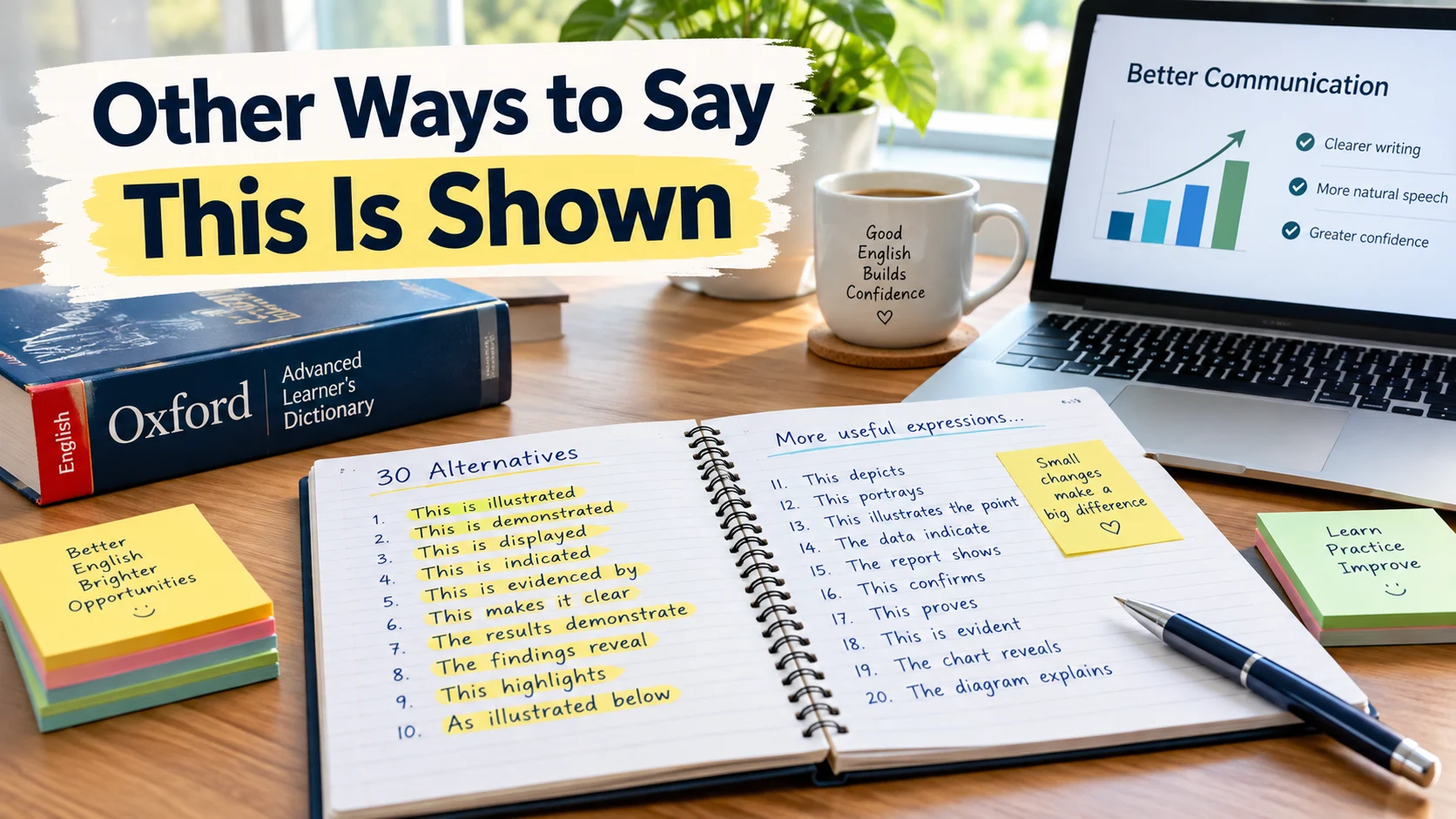
The phrase “this is shown” is used to explain that something is displayed, illustrated, presented, or made visible through an image, chart, example, or piece of evidence. Choosing a more precise alternative can make your English sound clearer and more natural in academic writing, presentations, and professional communication.
Top 5 alternatives: This is illustrated, this is demonstrated, this is displayed, this is indicated, this is presented.
Introduction
The phrase “this is shown” is useful when explaining information, describing visual content, or referring to evidence that supports a statement. You might use it while discussing a graph, explaining a process, writing a report, or pointing out a detail in a presentation. Although the phrase is grammatically correct, repeating it throughout your writing can make your language sound predictable.
Learning alternatives to this expression helps you communicate with greater precision. For example, this is illustrated works well when referring to a diagram, while this is demonstrated emphasizes proof or a practical example. Similarly, this is indicated can introduce a sign, result, or piece of evidence.
Understanding these distinctions is an important part of developing advanced English skills. Whether you are an English learner, student, teacher, researcher, or professional, the right wording helps you explain ideas confidently. These expressions also help you express excitement in English when a visual result, achievement, or discovery deserves a more enthusiastic response.
This guide covers 30 practical alternatives, their meanings, example sentences, appropriate contexts, and common mistakes so you can choose the right expression for every situation.
Quick Categories: Choose the Right Expression
Formal alternatives to “this is shown”
- This is illustrated
- This is demonstrated
- This is indicated
- This is evidenced by
Pro tip: Use precise verbs in academic papers and formal reports. Choose illustrated for visual explanations and indicated for signs or findings.
Casual alternatives
- You can see this
- This makes it clear
- Here you can see
- This is easy to see
Pro tip: Use conversational expressions when explaining something to a friend, teaching a beginner, or speaking during an informal discussion.
Professional alternatives
- The results indicate
- The data demonstrate
- The report highlights
- The findings reveal
Pro tip: In business communication, name the source of the information when possible. “The results indicate” sounds more specific than repeatedly writing “this is shown.”
Informal expressions
- There it is
- Look at this
- See for yourself
- This proves the point
Pro tip: Informal expressions work well in everyday conversation, but choose evidence-based language for reports and presentations.
Strong English is not about choosing the longest phrase. It is about choosing the phrase that communicates your meaning most accurately.
Common Mistakes to Avoid
Here are five frequent errors English learners make when using this expression or replacing it with a synonym.
1. Using an unsuitable synonym. Incorrect: “The picture proves the room’s design.” Better: “The picture illustrates the room’s design.” Why: A picture can illustrate a design without proving a claim.
2. Forgetting subject-verb agreement. Incorrect: “The results is shown in the table.” Better: “The results are shown in the table.” Why: A plural subject requires a plural verb.
3. Using the wrong verb form. Incorrect: “The trend is demonstrate in the chart.” Better: “The trend is demonstrated in the chart.” Why: Passive constructions require the appropriate past participle.
4. Repeating the same expression too often. Incorrect: “This is shown in the graph. This is shown in the report. This is shown in the table.” Better: “The graph illustrates the trend, the report explains the findings, and the table presents the figures.” Why: Varying verbs according to context improves readability.
5. Using overly formal language in conversation. Incorrect: “This is evidenced by the photograph” in a casual conversation about a family picture. Better: “You can see it in the photo.” Why: Match the expression to the audience and situation.
What Does “This Is Shown” Mean?
“This is shown” means that something is displayed, represented, explained, or made evident through a visual, example, statement, or piece of evidence.
It is a passive construction formed from the subject this, the present-tense verb is, and the past participle shown.
Example: This is shown in the diagram below.
The expression is grammatically correct, but the best replacement depends on what the sentence communicates. A diagram may illustrate an idea, while experimental results may demonstrate a pattern.
The passive voice is appropriate when the information matters more than the person presenting it. However, active sentences can sometimes communicate the same idea more directly.
When to Use “This Is Shown”
You can use the expression in several contexts:
- Academic writing: Referring to findings, evidence, research, or diagrams.
- Business reports: Explaining performance figures and trends.
- Presentations: Directing attention to information on a slide.
- Educational content: Explaining a concept through examples or illustrations.
- Everyday conversation: Pointing out something visible or explaining a result.
Spoken vs. written English
| Context | Natural expression |
|---|---|
| Spoken conversation | You can see this here. |
| Academic writing | This is illustrated in Figure 2. |
| Business presentation | The results indicate an improvement. |
| Technical report | The data demonstrate a consistent pattern. |
| Informal explanation | This makes it clear. |
Formal vs. informal English
Formal English tends to favor precise, evidence-based wording. Informal English often uses simpler expressions that sound natural when spoken.
For example, “The findings indicate a change in customer behavior” is suitable for a business report, whereas “You can see how customer behavior changed” works well in a conversation.
Is It Professional or Polite to Say “This Is Shown”?
Polite? Yes.
Professional? Yes, in appropriate contexts.
The expression is neutral rather than rude or disrespectful. It is suitable for reports, academic writing, and presentations when the reference is clear. However, it can sound vague if readers cannot tell what is being shown or where the evidence appears.
Business-style example: “The improvement in customer satisfaction is demonstrated by the latest survey results.”
This sentence is professional because it identifies the finding and connects it to a source of evidence.
For clearer communication, consider alternatives such as “The data indicate,” “The report highlights,” or “The results demonstrate.”
Pros and Cons of Using “This Is Shown”
Pros
- Simple and natural: Easy for most English speakers to understand.
- Friendly tone: Neutral enough for everyday explanations.
- Common usage: Familiar in educational and professional contexts.
- Easy to understand: Communicates that information is being presented or made evident.
Cons
- Potentially too informal for some work: A vague reference may weaken a formal report.
- Overused: Repetition can make writing monotonous.
- Limited expressive range: It may not distinguish between illustrating, proving, revealing, and displaying.
- Not suitable for every formal sentence: Some contexts require a more precise verb or an active construction.
The best replacement depends on what the evidence actually does: display information, illustrate an idea, indicate a trend, or demonstrate a conclusion.
Other Ways to Say “This Is Shown” (With Examples)
These alternatives will help you sound more fluent, confident, and natural in different situations.
Use them according to tone, context, and audience to communicate observations, evidence, explanations, and conclusions.
1. This Is Illustrated
Meaning: Something is explained or represented through a visual or example.
Explanation: Use this phrase when a diagram, picture, chart, or example helps readers understand an idea.
Example Sentence: The relationship between the two variables is illustrated in the chart.
Best Use: Academic explanations
Worst Use: Unsupported claims
Tone: Formal, explanatory, clear
Context Variability:
- Casual: “The idea is illustrated in this picture.”
- Professional: “The process is illustrated in Figure 3.”
- Spoken: “This is illustrated by the example I just gave.”
2. This Is Demonstrated
Meaning: Something is made clear through evidence, an example, or a practical demonstration.
Explanation: Choose this expression when you want to emphasize how a result or process establishes a point.
Example Sentence: The effectiveness of the new approach is demonstrated by the test results.
Best Use: Evidence-based writing
Worst Use: Mere decoration
Tone: Formal, confident, analytical
Context Variability:
- Casual: “This is demonstrated by what happened yesterday.”
- Professional: “The findings demonstrate the effectiveness of the strategy.”
- Spoken: “The experiment demonstrates how it works.”
3. This Is Displayed
Meaning: Something is presented visually on a screen, surface, or other medium.
Explanation: Use it for information that viewers can see, such as text, figures, images, or results.
Example Sentence: The current balance is displayed on the dashboard.
Best Use: Visual information
Worst Use: Abstract reasoning
Tone: Neutral, descriptive, practical
Context Variability:
- Casual: “The picture is displayed on the screen.”
- Professional: “The relevant metrics are displayed on the dashboard.”
- Spoken: “Your result is displayed right here.”
4. This Is Indicated
Meaning: Something points toward a particular fact, condition, or conclusion.
Explanation: Use this phrase when information suggests a finding without necessarily proving it conclusively.
Example Sentence: A downward trend is indicated by the latest sales figures.
Best Use: Data interpretation
Worst Use: Decorative images
Tone: Formal, analytical, measured
Context Variability:
- Casual: “This is indicated by the change in his behavior.”
- Professional: “The figures indicate a decline in demand.”
- Spoken: “That indicates something has changed.”
5. This Is Evidenced By
Meaning: Something is supported or made apparent by observable evidence.
Explanation: Use this construction when you want to connect a claim to supporting facts or observations.
Example Sentence: The team’s progress is evidenced by its improved quarterly results.
Best Use: Formal reports
Worst Use: Unsupported opinions
Tone: Formal, analytical, authoritative
Context Variability:
- Casual: “Her progress is evidenced by her better results.”
- Professional: “The improvement is evidenced by the latest performance data.”
- Spoken: “You can see the progress in the results.”
6. This Is Presented
Meaning: Information is formally introduced or made available to an audience.
Explanation: Use it for information included in a report, presentation, document, or meeting.
Example Sentence: The final proposal is presented in the following section.
Best Use: Reports and presentations
Worst Use: Proving a claim
Tone: Professional, neutral, organized
Context Variability:
- Casual: “The information is presented on this page.”
- Professional: “The recommendations are presented in the executive summary.”
- Spoken: “This is presented in the next slide.”
7. This Is Revealed
Meaning: Information becomes known or something previously unclear is uncovered.
Explanation: Use this phrase when evidence, an investigation, or an observation brings a fact to light.
Example Sentence: The survey results reveal a strong preference for flexible working hours.
Best Use: New findings
Worst Use: Already obvious details
Tone: Analytical, engaging, informative
Context Variability:
- Casual: “This reveals what happened.”
- Professional: “The analysis reveals a gap in customer satisfaction.”
- Spoken: “The results reveal something interesting.”
8. This Is Evident
Meaning: Something is clear or easy to recognize from available information.
Explanation: This phrase describes the clarity of a fact rather than simply saying it is displayed.
Example Sentence: The benefits of the revised process are evident in the improved results.
Best Use: Clear conclusions
Worst Use: Uncertain evidence
Tone: Formal, assured, objective
Context Variability:
- Casual: “It is evident that she worked hard.”
- Professional: “The impact of the changes is evident in the data.”
- Spoken: “It is evident that things have improved.”
9. This Makes It Clear
Meaning: Something helps the audience understand a point or conclusion.
Explanation: Use it when an example or explanation removes confusion.
Example Sentence: The comparison makes it clear why the second option is more efficient.
Best Use: Clear explanations
Worst Use: Highly technical summaries
Tone: Friendly, direct, explanatory
Context Variability:
- Casual: “This makes it clear what we need to do.”
- Professional: “The comparison makes it clear which approach is more effective.”
- Spoken: “That makes it clear, doesn’t it?”
10. This Confirms
Meaning: Something provides additional support for a fact or conclusion.
Explanation: Use this expression when new information supports something already suspected, reported, or established.
Example Sentence: The latest inspection confirms that the equipment is functioning correctly.
Best Use: Verified findings
Worst Use: Unverified assumptions
Tone: Confident, professional, conclusive
Context Variability:
- Casual: “This confirms what we thought.”
- Professional: “The audit confirms compliance with the requirements.”
- Spoken: “That confirms we were right.”
11. This Proves
Meaning: Something establishes that a claim is true.
Explanation: Use it when the available evidence is strong enough to justify a definite conclusion.
Example Sentence: The experiment proves that the material conducts electricity under the tested conditions.
Best Use: Strong evidence
Worst Use: Weak correlations
Tone: Assertive, decisive, emphatic
Context Variability:
- Casual: “This proves that we were prepared.”
- Professional: “The verified records prove that the transaction occurred.”
- Spoken: “That proves my point.”
12. This Highlights
Meaning: Something draws attention to an important point or feature.
Explanation: Use it when a report, example, or finding emphasizes an issue rather than merely displaying it.
Example Sentence: The annual report highlights the need for better customer support.
Best Use: Key findings
Worst Use: Neutral listings
Tone: Professional, focused, informative
Context Variability:
- Casual: “This highlights the main problem.”
- Professional: “The analysis highlights several opportunities for improvement.”
- Spoken: “This highlights what we need to fix.”
13. This Depicts
Meaning: Something represents or portrays a person, scene, process, or situation.
Explanation: Use it when referring to images, illustrations, maps, or visual representations.
Example Sentence: The illustration depicts the stages of plant growth.
Best Use: Visual descriptions
Worst Use: Statistical proof
Tone: Descriptive, formal, precise
Context Variability:
- Casual: “This picture depicts our old neighborhood.”
- Professional: “The diagram depicts the system architecture.”
- Spoken: “This depicts what the area looked like.”
14. This Portrays
Meaning: Something represents a person, situation, or idea in a particular way.
Explanation: Use it for artistic, narrative, or interpretive representations rather than simply displayed figures.
Example Sentence: The documentary portrays the challenges faced by small business owners.
Best Use: Media analysis
Worst Use: Raw numerical data
Tone: Descriptive, interpretive, thoughtful
Context Variability:
- Casual: “The film portrays their friendship.”
- Professional: “The case study portrays the challenges of organizational change.”
- Spoken: “It portrays the situation quite realistically.”
15. This Illustrates the Point
Meaning: Something provides an example that helps explain or support an idea.
Explanation: This expression is useful when connecting a specific example to a broader argument.
Example Sentence: The customer’s experience illustrates the point that clear communication matters.
Best Use: Argument support
Worst Use: Unrelated examples
Tone: Explanatory, persuasive, professional
Context Variability:
- Casual: “That illustrates the point perfectly.”
- Professional: “The case study illustrates the point about service quality.”
- Spoken: “This illustrates exactly what I mean.”
16. The Data Indicate
Meaning: Information collected through observation or measurement suggests a particular conclusion.
Explanation: Use this phrase in analytical writing when referring specifically to numerical or research data.
Example Sentence: The data indicate a steady increase in website traffic.
Best Use: Data analysis
Worst Use: Purely artistic descriptions
Tone: Objective, technical, analytical
Context Variability:
- Casual: “The numbers indicate that sales are improving.”
- Professional: “The data indicate a positive change in conversion rates.”
- Spoken: “The data indicate that we’re moving in the right direction.”
17. The Results Demonstrate
Meaning: Findings from a test, study, or activity provide evidence of a particular outcome.
Explanation: Use this phrase to communicate the outcome of a measurable process or investigation.
Example Sentence: The results demonstrate that the revised method reduces processing time.
Best Use: Research findings
Worst Use: Unrelated observations
Tone: Formal, evidence-based, confident
Context Variability:
- Casual: “The results demonstrate that the plan worked.”
- Professional: “The results demonstrate measurable operational improvements.”
- Spoken: “The results demonstrate how effective the change was.”
18. The Findings Reveal
Meaning: Conclusions or observations from research uncover important information.
Explanation: Use this expression when a study or investigation identifies something that was not previously clear.
Example Sentence: The findings reveal a significant difference between the two groups.
Best Use: Research summaries
Worst Use: Unsupported speculation
Tone: Analytical, informative, authoritative
Context Variability:
- Casual: “The findings reveal what went wrong.”
- Professional: “The findings reveal opportunities to improve retention.”
- Spoken: “The findings reveal a surprising pattern.”
19. The Report Shows
Meaning: A report presents information that supports a statement or conclusion.
Explanation: This straightforward expression is appropriate when a document contains relevant facts, findings, or figures.
Example Sentence: The report shows that customer complaints decreased during the quarter.
Best Use: Business reporting
Worst Use: Unrelated conclusions
Tone: Neutral, professional, clear
Context Variability:
- Casual: “The report shows what happened.”
- Professional: “The report shows a reduction in operating costs.”
- Spoken: “The report shows a clear improvement.”
20. As Illustrated Below
Meaning: Information is explained or represented in the material that follows.
Explanation: Use this concise transition before a diagram, image, example, or figure.
Example Sentence: As illustrated below, the process consists of three main stages.
Best Use: Document transitions
Worst Use: No following visual
Tone: Formal, concise, instructional
Context Variability:
- Casual: “As illustrated below, this is how it works.”
- Professional: “As illustrated below, each department follows the same workflow.”
- Spoken: “As illustrated here, the process is straightforward.”
21. As Shown Here
Meaning: The information being discussed can be seen in the nearby material.
Explanation: This concise phrase works when pointing to a specific image, figure, example, or screen.
Example Sentence: As shown here, the updated interface requires fewer steps.
Best Use: Visual demonstrations
Worst Use: Unavailable references
Tone: Neutral, direct, explanatory
Context Variability:
- Casual: “As shown here, the two options are different.”
- Professional: “As shown here, the revised layout improves navigation.”
- Spoken: “As shown here, we have reduced the number of steps.”
22. As Indicated By
Meaning: Something is supported or suggested by a particular sign, measurement, or source.
Explanation: Use this expression to identify the evidence behind an observation.
Example Sentence: As indicated by the survey, most participants prefer online appointments.
Best Use: Evidence references
Worst Use: Unsupported conclusions
Tone: Formal, analytical, precise
Context Variability:
- Casual: “As indicated by the sign, the entrance is closed.”
- Professional: “As indicated by the latest figures, demand has increased.”
- Spoken: “As indicated by the results, the change was effective.”
23. The Image Illustrates
Meaning: A picture helps explain or clarify an idea, process, or situation.
Explanation: Use it when the visual itself is the subject of your sentence.
Example Sentence: The image illustrates the difference between the original design and the revised version.
Best Use: Image descriptions
Worst Use: Nonvisual evidence
Tone: Descriptive, educational, clear
Context Variability:
- Casual: “The image illustrates what I mean.”
- Professional: “The image illustrates the proposed product layout.”
- Spoken: “The image illustrates how the system works.”
24. The Chart Reveals
Meaning: A chart makes a pattern, comparison, or relationship easier to recognize.
Explanation: Use it when a visual representation brings an important trend or difference to attention.
Example Sentence: The chart reveals a sharp increase in demand during the summer months.
Best Use: Trend analysis
Worst Use: Unrelated conclusions
Tone: Analytical, informative, engaging
Context Variability:
- Casual: “The chart reveals an interesting pattern.”
- Professional: “The chart reveals seasonal fluctuations in sales.”
- Spoken: “The chart reveals where the biggest changes occurred.”
25. The Diagram Explains
Meaning: A diagram helps communicate how something works or how its parts relate.
Explanation: This phrase is suitable when the visual provides an explanation rather than merely displaying an object.
Example Sentence: The diagram explains how information moves through the system.
Best Use: Process descriptions
Worst Use: Decorative graphics
Tone: Clear, instructional, practical
Context Variability:
- Casual: “The diagram explains the whole process.”
- Professional: “The diagram explains the interaction between the system components.”
- Spoken: “The diagram explains how everything connects.”
26. The Evidence Supports
Meaning: Available facts or observations provide a reason to accept a particular claim.
Explanation: Use this expression when evidence lends credibility to an argument without necessarily proving it beyond doubt.
Example Sentence: The evidence supports the conclusion that the training program improved performance.
Best Use: Evidence-based arguments
Worst Use: Unsupported opinions
Tone: Analytical, measured, persuasive
Context Variability:
- Casual: “The evidence supports what she said.”
- Professional: “The available evidence supports the proposed recommendation.”
- Spoken: “The evidence supports that conclusion.”
27. This Points To
Meaning: Something suggests a likely explanation, outcome, or direction.
Explanation: Use it when observations imply a conclusion but may not establish it conclusively.
Example Sentence: The repeated errors point to a problem with the current workflow.
Best Use: Initial analysis
Worst Use: Certain proof
Tone: Analytical, cautious, direct
Context Variability:
- Casual: “This points to a simple mistake.”
- Professional: “The trend points to a need for additional training.”
- Spoken: “That points to a bigger issue.”
28. This Makes It Apparent
Meaning: Something causes a fact or situation to become clear.
Explanation: Use it when a comparison, explanation, or observation makes a previously less obvious point easier to understand.
Example Sentence: The comparison makes it apparent that the revised process is more efficient.
Best Use: Comparative explanations
Worst Use: Unclear evidence
Tone: Formal, explanatory, deliberate
Context Variability:
- Casual: “This makes it apparent that something has changed.”
- Professional: “The analysis makes it apparent that additional resources are required.”
- Spoken: “This makes it apparent why we need a different approach.”
29. The Example Demonstrates
Meaning: A specific instance helps establish or explain a broader point.
Explanation: Use this expression when a concrete example provides evidence of how something works.
Example Sentence: The example demonstrates how a small design change can improve usability.
Best Use: Teaching concepts
Worst Use: Irrelevant examples
Tone: Educational, confident, explanatory
Context Variability:
- Casual: “The example demonstrates what I was trying to explain.”
- Professional: “The example demonstrates the value of a consistent process.”
- Spoken: “This example demonstrates how the technique works.”
30. This Is Reflected In
Meaning: Something is visible in the characteristics, results, or behavior of another thing.
Explanation: Use this phrase when a broader situation or change can be recognized through its effects.
Example Sentence: The company’s commitment to quality is reflected in its consistently positive customer feedback.
Best Use: Performance summaries
Worst Use: Unrelated evidence
Tone: Professional, interpretive, measured
Context Variability:
- Casual: “This is reflected in how everyone works together.”
- Professional: “The team’s progress is reflected in the improved delivery times.”
- Spoken: “That is reflected in the feedback we received.”
Comparison Table: Top 10 Alternatives
| Phrase | Tone | Best Use |
|---|---|---|
| This is illustrated | Formal | Diagrams and examples |
| This is demonstrated | Professional | Evidence and experiments |
| This is displayed | Neutral | Screens and visual content |
| This is indicated | Analytical | Signs and data |
| This is evidenced by | Formal | Supporting evidence |
| This makes it clear | Conversational | Explanations |
| The results demonstrate | Professional | Research and reports |
| The findings reveal | Analytical | Discoveries |
| This highlights | Professional | Important points |
| As illustrated below | Formal | Documents and reports |
Mini Quiz: Test Your Understanding
Choose the most appropriate expression for each situation.
1. You are describing a diagram in an academic report.
- A. This is illustrated in the diagram.
- B. This is displayed my opinion.
- C. This proves the diagram.
2. You are discussing numerical results that suggest sales are increasing.
- A. The data depict.
- B. The data indicate.
- C. The data portrays.
3. You want to explain a concept to a friend in everyday conversation.
- A. This makes it clear.
- B. This is evidenced by the aforementioned.
- C. The findings demonstrate.
4. A verified document confirms that a transaction occurred. Which expression is appropriate?
- A. This illustrates the transaction.
- B. This confirms the transaction.
- C. This depicts the transaction.
Answers
- A
- B
- A
- B
Frequently Asked Questions
1. What are the best alternatives to “this is shown”?
The best alternatives include “this is illustrated,” “this is demonstrated,” “this is indicated,” “this is displayed,” and “this is evident.” The right choice depends on whether you are describing a visual, evidence, or a conclusion.
2. How can I say “this is shown” in formal English?
Use expressions such as “this is demonstrated,” “this is illustrated,” or “this is indicated.” For academic writing, select the phrase that accurately describes the evidence or visual being discussed.
3. What is a professional way to say “this is shown”?
“The results indicate,” “the data demonstrate,” and “the report highlights” are useful professional alternatives. They are particularly effective in reports, presentations, and business communication.
4. Is “this is shown” grammatically correct?
Yes. It is a grammatically correct passive construction. For example, “This is shown in the following chart” is correct, although “The following chart illustrates this” may be more direct.
5. What is the difference between “shown,” “illustrated,” and “demonstrated”?
“Shown” is a general term for presenting information. “Illustrated” emphasizes explanation through visuals or examples, while “demonstrated” emphasizes evidence or a practical demonstration.
Conclusion
Learning other ways to say “this is shown” can improve your vocabulary, make your writing less repetitive, and help you communicate more accurately. Expressions such as “this is illustrated,” “the data indicate,” and “the findings reveal” serve different purposes, so understanding their meanings is more useful than memorizing synonyms alone.
Practice these alternatives in emails, reports, conversations, and academic assignments. Pay attention to tone, evidence, grammar, and audience before choosing a phrase. With consistent practice, you can develop more natural English and communicate your ideas with greater confidence.