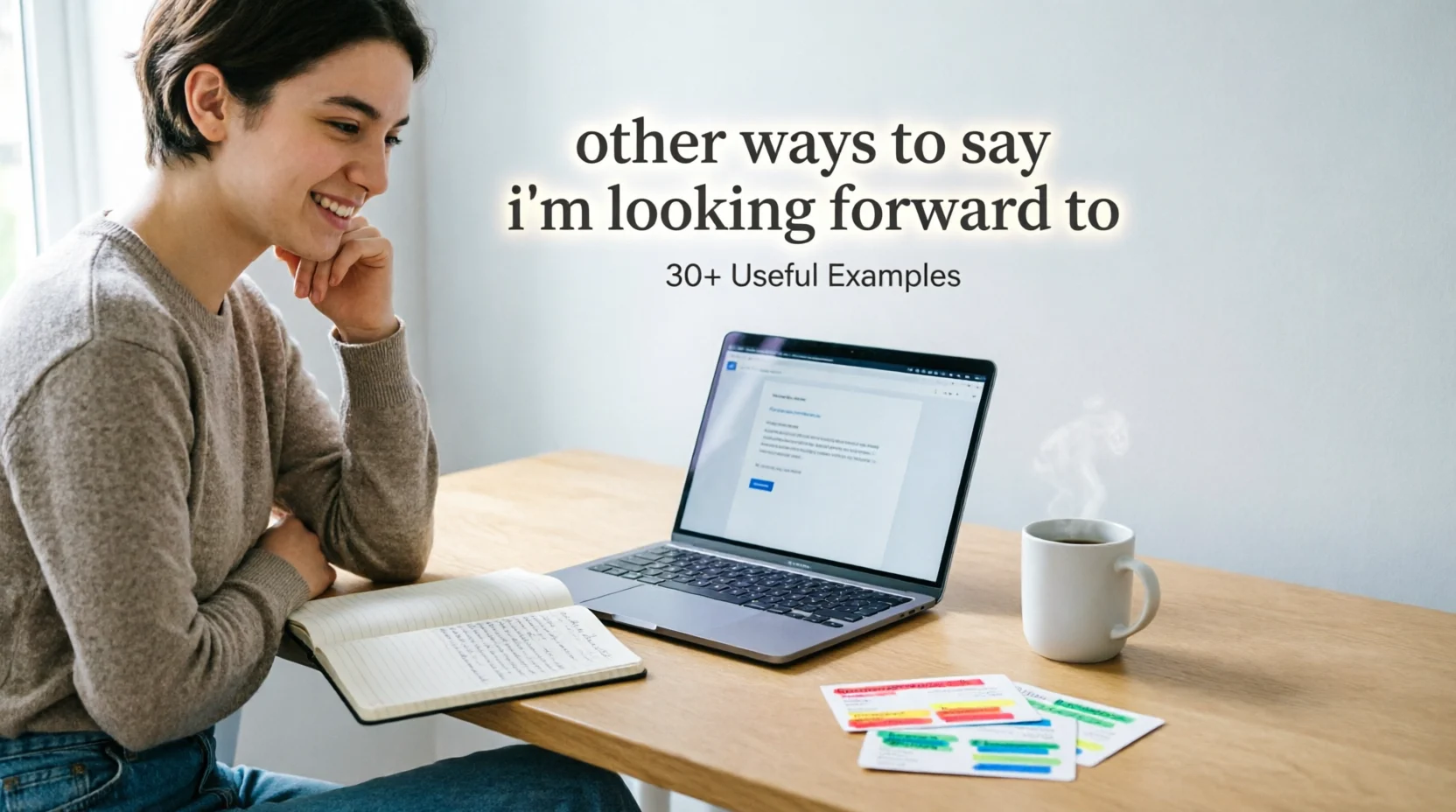
There are many natural alternatives to “I’m looking forward to” that can help you sound more fluent and confident. The best choice depends on your relationship with the reader and the level of formality.
Top alternatives: I’m excited about, I’m eager to, I can’t wait to, I anticipate, I’m pleased about
“Choosing the right phrase can make a simple message sound warmer, clearer, and more confident.”
The phrase “I’m looking forward to” is commonly used when you want to show that you feel positive or excited about something that will happen in the future. It is especially common in emails, conversations, invitations, meetings, and professional communication. For example, you might say, “I’m looking forward to meeting you” before an interview or “I’m looking forward to hearing from you” at the end of an email. However, using the same expression repeatedly can make your English sound predictable. Learning alternatives to “I’m looking forward to” gives you more flexibility when communicating with friends, colleagues, clients, teachers, and business contacts. Different expressions can also help you express excitement in English with the exact level of enthusiasm your situation requires.
Some alternatives sound formal and polished, while others are more relaxed and conversational. Understanding these differences can improve both your vocabulary and your communication skills.
“Fluent English is not only about knowing more words. It is also about knowing when to use them.”
Quick Categories
Formal alternatives to “I’m looking forward to”
- I anticipate
- I eagerly anticipate
- I await
- I am pleased to anticipate
These expressions work well in formal letters, official communication, and situations where you want a respectful tone.
Pro Tip: Use formal expressions selectively. A simple phrase often sounds more natural than overly formal vocabulary.
Casual alternatives
- I can’t wait to
- I’m excited about
- I’m really excited to
- I’m eager to
These choices are suitable when speaking with friends, classmates, familiar colleagues, or people you already know well.
Pro Tip: Match the level of excitement to the situation. “I can’t wait to” sounds much more enthusiastic than “I anticipate.”
Professional alternatives
- I look forward to
- I’m eager to
- I’m pleased to
- I anticipate
These are useful in business emails, meetings, interviews, networking, and workplace communication.
Pro Tip: In professional emails, “I look forward to” is one of the safest and most natural choices.
Informal expressions
- I can’t wait
- I’m excited for
- I’m really looking forward to it
- I’m counting down to it
These informal expressions are best for friendly conversations and personal messages.
Pro Tip: Avoid highly informal expressions when writing to a client, manager, or unfamiliar professional contact.
“The strongest vocabulary choice is the one that fits the relationship, situation, and purpose.”
Common Mistakes
1. Using the wrong verb form
After “look forward to,” use a noun or gerund form.
Incorrect: I’m looking forward to meet you.
Correct: I’m looking forward to meeting you.
2. Confusing “look forward to” with “looking forward”
The complete expression normally needs “to” when followed by an activity.
Incorrect: I’m looking forward meeting you.
Correct: I’m looking forward to meeting you.
3. Making the phrase too informal
Using “I can’t wait” in a highly formal business letter may sound overly enthusiastic.
Example: I can’t wait to discuss the contract with you.
A more professional version is:
I look forward to discussing the contract with you.
4. Using the phrase repeatedly
Repeating the same expression in every email can make your writing sound repetitive.
Example: I’m looking forward to meeting you. I’m looking forward to your reply. I’m looking forward to working with you.
Try varying your expressions according to the situation.
5. Using a strong expression when excitement is unnecessary
Some expressions communicate very strong enthusiasm.
Example: I can’t wait to receive your response.
In a formal business setting, this may sound less natural than:
I look forward to receiving your response.
What Does “I’m Looking Forward To” Mean?
“I’m looking forward to” means that you feel happy, positive, or excited about something that you expect to happen in the future.
It can describe future events, activities, meetings, experiences, or responses.
The phrase is followed by a noun or a gerund ending in “ing.”
Example: I’m looking forward to meeting the new team.
Here, “meeting” functions as a gerund after “to.”
It is important to remember that the “to” in this expression is a preposition, so it is followed by a noun or gerund rather than the base form of a verb.
“Remember: look forward to meeting, not look forward to meet.”
When to Use “I’m Looking Forward To”
You can use the expression in many situations, including:
- Before a meeting
- Before a job interview
- At the end of a professional email
- When accepting an invitation
- When discussing future plans
- When starting a new project
- When expecting a reply
- When talking about an upcoming event
- When communicating positive expectations
Spoken vs Written
In spoken English, “I’m looking forward to” sounds natural and friendly.
Spoken: I’m looking forward to seeing you tomorrow.
In written English, it is especially common in emails and professional correspondence.
Written: I look forward to hearing from you.
Formal vs Informal
The expression itself can work in both formal and informal situations. However, the exact alternative you choose can change the tone.
Formal: I eagerly anticipate your response.
Professional: I look forward to working with you.
Informal: I can’t wait to see you.
Is “I’m Looking Forward To” Professional or Polite?
Yes. “I’m looking forward to” is both polite and professional when used appropriately. It is particularly common in workplace emails, business correspondence, interviews, and networking messages.
The phrase is not inherently informal. In fact, “I look forward to hearing from you” is a standard professional email closing.
Business example:
I look forward to discussing the project with you during our meeting.
Polite? ✔️ Yes
Professional? ✔️ Yes
Best approach: Choose a stronger or more casual alternative only when the relationship and context support it.
Pros and Cons of Using “I’m Looking Forward To”
Pros
- Simple and natural
- Friendly tone
- Common usage
- Easy to understand
Cons
- Can become repetitive
- May sound predictable when overused
- Does not always show strong excitement
- Some situations benefit from a more specific expression
“Professional English does not always mean complicated English. Clear and natural wording is often more effective.”
Other Ways to Say “I’m Looking Forward To” With Examples
These alternatives will help you sound more fluent, confident, and natural in different situations.
Use them according to tone, context, and audience to express excitement, admiration, or approval.
1. Phrase: I’m excited about
Meaning: You feel enthusiastic or happy about something.
Explanation: This is a natural expression for showing positive anticipation.
Example Sentence: I’m excited about the opportunity to work with your team.
Best Use: Positive situations
Worst Use: Very formal letters
Tone: Friendly, enthusiastic, natural
Context Variability: Casual: I’m excited about the trip. Professional: I’m excited about the new project. Spoken: I’m excited about tomorrow.
2. Phrase: I’m eager to
Meaning: You strongly want to do something.
Explanation: This phrase communicates enthusiasm while remaining professional.
Example Sentence: I’m eager to contribute to the upcoming project.
Best Use: Professional communication
Worst Use: Casual small talk
Tone: Professional, positive, confident
Context Variability: Casual: I’m eager to learn. Professional: I’m eager to contribute. Spoken: I’m eager to get started.
3. Phrase: I can’t wait to
Meaning: You are very excited about something.
Explanation: It expresses strong enthusiasm and is usually informal.
Example Sentence: I can’t wait to see you at the event.
Best Use: Friendly conversations
Worst Use: Formal emails
Tone: Excited, casual, enthusiastic
Context Variability: Casual: I can’t wait to go. Professional: Use sparingly. Spoken: I can’t wait to see you.
4. Phrase: I anticipate
Meaning: You expect something to happen.
Explanation: This formal expression focuses more on expectation than excitement.
Example Sentence: I anticipate a productive discussion during the meeting.
Best Use: Formal writing
Worst Use: Friendly chats
Tone: Formal, measured, professional
Context Variability: Casual: Less common. Professional: I anticipate positive results. Spoken: I anticipate some questions.
5. Phrase: I’m pleased about
Meaning: You feel happy or satisfied about something.
Explanation: It expresses a positive reaction without sounding overly enthusiastic.
Example Sentence: I’m pleased about the opportunity to collaborate.
Best Use: Professional settings
Worst Use: Highly excited events
Tone: Polite, positive, restrained
Context Variability: Casual: I’m pleased about the news. Professional: I’m pleased about the opportunity. Spoken: I’m pleased about the decision.
6. Phrase: I’m excited to
Meaning: You feel enthusiastic about doing something.
Explanation: This is a straightforward and widely used alternative.
Example Sentence: I’m excited to begin this new chapter.
Best Use: Positive announcements
Worst Use: Serious correspondence
Tone: Warm, enthusiastic, natural
Context Variability: Casual: I’m excited to go. Professional: I’m excited to collaborate. Spoken: I’m excited to start.
7. Phrase: I’m eager for
Meaning: You strongly want or expect something.
Explanation: It works well when followed by a noun.
Example Sentence: I’m eager for the opportunity to discuss your ideas.
Best Use: Professional writing
Worst Use: Casual texting
Tone: Positive, confident, professional
Context Variability: Casual: I’m eager for the weekend. Professional: I’m eager for the opportunity. Spoken: I’m eager for the next step.
8. Phrase: I anticipate with interest
Meaning: You expect something with curiosity or positive attention.
Explanation: This is a more formal way to communicate anticipation.
Example Sentence: I anticipate with interest the results of the upcoming study.
Best Use: Formal writing
Worst Use: Casual speech
Tone: Formal, thoughtful, reserved
Context Variability: Casual: Uncommon. Professional: Suitable for reports. Spoken: Less common.
9. Phrase: I’m pleased to
Meaning: You are happy to do or announce something.
Explanation: This is especially useful in professional communication.
Example Sentence: I’m pleased to work with your organization.
Best Use: Business communication
Worst Use: Casual messages
Tone: Polished, polite, professional
Context Variability: Casual: Less common. Professional: Very suitable. Spoken: Suitable for formal speech.
10. Phrase: I’m enthusiastic about
Meaning: You feel strong interest and excitement.
Explanation: This expression clearly communicates enthusiasm while remaining professional.
Example Sentence: I’m enthusiastic about the possibilities this partnership offers.
Best Use: Professional settings
Worst Use: Casual texting
Tone: Confident, positive, professional
Context Variability: Casual: Possible but formal. Professional: Excellent fit. Spoken: Natural in presentations.
11. Phrase: I’m thrilled to
Meaning: You are extremely happy or excited.
Explanation: It expresses stronger emotion than “I’m excited to.”
Example Sentence: I’m thrilled to join the team.
Best Use: Celebratory situations
Worst Use: Routine emails
Tone: Excited, warm, expressive
Context Variability: Casual: Natural. Professional: Suitable for good news. Spoken: Very natural.
12. Phrase: I’m delighted to
Meaning: You are very happy about something.
Explanation: This polite expression works particularly well in professional English.
Example Sentence: I’m delighted to accept your invitation.
Best Use: Formal occasions
Worst Use: Casual texting
Tone: Polite, warm, professional
Context Variability: Casual: Slightly formal. Professional: Excellent fit. Spoken: Suitable for formal situations.
13. Phrase: I’m anticipating
Meaning: You are expecting something to happen.
Explanation: This focuses on future expectations rather than strong excitement.
Example Sentence: I’m anticipating a productive conversation.
Best Use: Professional settings
Worst Use: Casual chats
Tone: Formal, thoughtful, professional
Context Variability: Casual: Less common. Professional: Natural. Spoken: Moderately formal.
14. Phrase: I’m keen to
Meaning: You are very interested in doing something.
Explanation: This expression is especially common in British English.
Example Sentence: I’m keen to explore this opportunity further.
Best Use: Professional English
Worst Use: Highly formal documents
Tone: Positive, confident, natural
Context Variability: Casual: Natural. Professional: Very useful. Spoken: Common in British English.
15. Phrase: I’m happy to
Meaning: You are willing and pleased to do something.
Explanation: It is simple, polite, and useful in workplace communication.
Example Sentence: I’m happy to discuss the details with you.
Best Use: Workplace communication
Worst Use: Strong excitement
Tone: Friendly, polite, professional
Context Variability: Casual: Very natural. Professional: Very common. Spoken: Extremely natural.
16. Phrase: I’m anticipating with excitement
Meaning: You expect something and feel excited about it.
Explanation: This combines expectation with a stronger emotional response.
Example Sentence: I’m anticipating the conference with excitement.
Best Use: Special events
Worst Use: Routine emails
Tone: Enthusiastic, formal, expressive
Context Variability: Casual: Slightly formal. Professional: Suitable for events. Spoken: Moderately formal.
17. Phrase: I’m counting down to
Meaning: You are very excited about an upcoming event.
Explanation: This informal expression suggests strong anticipation.
Example Sentence: I’m counting down to the weekend.
Best Use: Personal conversations
Worst Use: Formal emails
Tone: Casual, excited, friendly
Context Variability: Casual: Excellent. Professional: Usually avoid. Spoken: Very natural.
18. Phrase: I’m excited for
Meaning: You feel enthusiastic about a future event or experience.
Explanation: This is common in conversational English, especially American English.
Example Sentence: I’m excited for the conference next month.
Best Use: Casual conversation
Worst Use: Formal documents
Tone: Casual, enthusiastic, conversational
Context Variability: Casual: Very common. Professional: Depends on context. Spoken: Very natural.
19. Phrase: I’m really excited to
Meaning: You feel especially enthusiastic about doing something.
Explanation: “Really” increases the level of excitement.
Example Sentence: I’m really excited to meet everyone at the event.
Best Use: Friendly communication
Worst Use: Formal reports
Tone: Warm, enthusiastic, casual
Context Variability: Casual: Excellent. Professional: Sometimes suitable. Spoken: Very natural.
20. Phrase: I’m happy about
Meaning: You feel positive about something.
Explanation: This is a simple way to communicate satisfaction or happiness.
Example Sentence: I’m happy about the opportunity to learn from the team.
Best Use: Everyday English
Worst Use: Formal announcements
Tone: Friendly, simple, positive
Context Variability: Casual: Excellent. Professional: Suitable in some situations. Spoken: Very natural.
21. Phrase: I’m anticipating the opportunity to
Meaning: You expect to have a future opportunity with interest.
Explanation: This formal phrase works well in professional correspondence.
Example Sentence: I’m anticipating the opportunity to discuss the proposal.
Best Use: Business emails
Worst Use: Casual chats
Tone: Formal, polished, professional
Context Variability: Casual: Too formal. Professional: Strong fit. Spoken: Formal.
22. Phrase: I’m excited about the opportunity to
Meaning: You feel enthusiastic about a future opportunity.
Explanation: It combines professionalism with genuine enthusiasm.
Example Sentence: I’m excited about the opportunity to contribute to the project.
Best Use: Job communication
Worst Use: Routine notices
Tone: Professional, positive, enthusiastic
Context Variability: Casual: Possible. Professional: Excellent. Spoken: Natural.
23. Phrase: I’m eager for the chance to
Meaning: You strongly want the opportunity to do something.
Explanation: This phrase communicates motivation and interest.
Example Sentence: I’m eager for the chance to demonstrate my skills.
Best Use: Job applications
Worst Use: Casual messages
Tone: Motivated, confident, professional
Context Variability: Casual: Formal. Professional: Excellent. Spoken: Suitable in interviews.
24. Phrase: I’m pleased about the prospect of
Meaning: You feel positive about a possible future situation.
Explanation: This is a formal expression for discussing future possibilities.
Example Sentence: I’m pleased about the prospect of working together.
Best Use: Business writing
Worst Use: Casual conversation
Tone: Formal, positive, polished
Context Variability: Casual: Too formal. Professional: Excellent. Spoken: Formal.
25. Phrase: I await
Meaning: You are waiting for something to happen.
Explanation: This is formal and should be used carefully because it can sound stiff.
Example Sentence: I await your response regarding the proposal.
Best Use: Formal correspondence
Worst Use: Friendly emails
Tone: Formal, direct, reserved
Context Variability: Casual: Avoid. Professional: Formal. Spoken: Uncommon.
26. Phrase: I eagerly anticipate
Meaning: You strongly expect and look forward to something.
Explanation: This expression communicates both anticipation and enthusiasm.
Example Sentence: I eagerly anticipate the opportunity to collaborate.
Best Use: Formal writing
Worst Use: Casual chats
Tone: Formal, enthusiastic, polished
Context Variability: Casual: Too formal. Professional: Suitable. Spoken: Formal.
27. Phrase: I’m excited about what’s ahead
Meaning: You feel positive about the future.
Explanation: This flexible phrase works when discussing upcoming changes or opportunities.
Example Sentence: I’m excited about what’s ahead for our team.
Best Use: Positive updates
Worst Use: Formal requests
Tone: Optimistic, friendly, confident
Context Variability: Casual: Excellent. Professional: Very suitable. Spoken: Natural.
28. Phrase: I’m eager to get started
Meaning: You are ready and excited to begin.
Explanation: This phrase is especially useful after accepting a project, role, or task.
Example Sentence: I’m eager to get started and contribute to the project.
Best Use: New projects
Worst Use: Delicate situations
Tone: Motivated, positive, professional
Context Variability: Casual: Natural. Professional: Excellent. Spoken: Very natural.
29. Phrase: I’m excited to see what comes next
Meaning: You are curious and enthusiastic about the future.
Explanation: This is useful when the exact future outcome is not yet known.
Example Sentence: I’m excited to see what comes next for the company.
Best Use: Future plans
Worst Use: Formal requests
Tone: Optimistic, conversational, positive
Context Variability: Casual: Excellent. Professional: Suitable. Spoken: Very natural.
30. Phrase: I’m anticipating the next step
Meaning: You are expecting the next stage of a process.
Explanation: This is useful in professional communication when discussing ongoing work.
Example Sentence: I’m anticipating the next step in the recruitment process.
Best Use: Professional emails
Worst Use: Casual conversations
Tone: Professional, measured, confident
Context Variability: Casual: Less common. Professional: Excellent. Spoken: Moderately formal.
“Do not choose an alternative simply because it sounds more advanced. Choose the one that sounds natural in your situation.”
Mini Quiz and Self Check
1. You are writing a formal email to a client. Which sentence is most appropriate?
A. I can’t wait to hear from you.
B. I look forward to hearing from you.
C. I’m counting down to your response.
Answer: B
2. You are talking to a close friend about an upcoming trip. Which expression sounds most natural?
A. I eagerly anticipate our journey.
B. I can’t wait for the trip.
C. I await the journey.
Answer: B
3. Which sentence is grammatically correct?
A. I’m looking forward to meet you.
B. I’m looking forward meeting you.
C. I’m looking forward to meeting you.
Answer: C
4. Which phrase communicates particularly strong excitement?
A. I anticipate
B. I can’t wait to
C. I await
Answer: B
Comparison Table: Top Alternatives
| Phrase | Tone | Best Use |
|---|---|---|
| I look forward to | Professional, polite | Business emails |
| I’m eager to | Confident, positive | Workplace communication |
| I’m excited about | Friendly, enthusiastic | Opportunities |
| I’m excited to | Natural, positive | Everyday communication |
| I can’t wait to | Casual, enthusiastic | Friends and family |
| I anticipate | Formal, measured | Formal writing |
| I’m pleased to | Polished, polite | Professional messages |
| I’m delighted to | Warm, formal | Invitations and announcements |
| I’m enthusiastic about | Professional, confident | Projects and opportunities |
| I’m keen to | Positive, natural | British English |
FAQs
What are the best other ways to say “I’m looking forward to”?
Some useful alternatives include “I’m eager to,” “I’m excited about,” “I anticipate,” “I’m pleased to,” and “I can’t wait to.” The best choice depends on the level of formality and enthusiasm.
What is a professional alternative to “I’m looking forward to”?
“I look forward to” is already professional and widely used in workplace emails. “I’m eager to” is another natural option when you want to communicate enthusiasm.
What are formal alternatives to “I’m looking forward to”?
Formal alternatives include “I anticipate,” “I eagerly anticipate,” “I await,” and “I’m pleased to.” Use them according to the situation because some can sound more formal than necessary.
Can I say “I can’t wait to” in professional English?
Yes, but it is more informal and enthusiastic. It is usually better for friendly workplace relationships than formal business correspondence.
What is the correct grammar after “look forward to”?
Use a noun or gerund after “look forward to.” For example, say “I look forward to meeting you,” not “I look forward to meet you.”
Conclusion
Learning different ways to say “I’m looking forward to” gives you more control over your English. Instead of repeating one expression, you can choose vocabulary that communicates exactly how formal, friendly, excited, or professional you want to sound.
Practice a few alternatives in real conversations and emails. Most importantly, pay attention to tone and context. The goal is not to use the most complicated phrase, but to choose the expression that feels natural and appropriate for your audience.
CTA: Which alternative do you use most often? Share your favorite phrase and try using a new one in your next conversation.