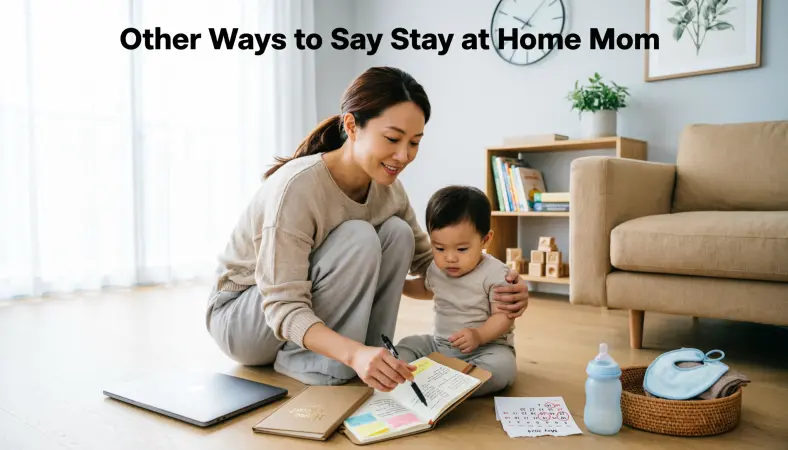
The phrase stay at home mom describes a mother who primarily manages childcare and household responsibilities rather than working in a traditional outside job. Useful alternatives include homemaker, full time mother, stay at home parent, full time homemaker, and primary caregiver.
Knowing other ways to say stay at home mom can help English learners communicate more naturally and respectfully when discussing family roles, parenting, and household responsibilities. Although “stay at home mom” is widely understood, different situations may call for more precise or professional wording. Learning suitable alternatives to stay at home mom allows you to describe someone’s role appropriately in different contexts.
For English learners, vocabulary variety is an important part of developing fluency. Knowing whether to use “homemaker,” “full-time mother,” or “primary caregiver” helps you communicate accurately with different audiences. These phrases can also make it easier to express excitement in English when talking about family life, parenting experiences, or personal achievements.
Quick Categories
Formal alternatives to “stay at home mom”
- Homemaker
- Full time homemaker
- Primary caregiver
- Full time parent
Pro Tip: Use role based descriptions such as “primary caregiver” when you need a neutral and formal expression.
Casual alternatives
- Full time mom
- At home mom
- Stay at home parent
- Mom at home
Pro Tip: Casual phrases work best in conversations, family discussions, and informal writing.
Professional alternatives
- Homemaker
- Primary caregiver
- Full time caregiver
- Household manager
Pro Tip: In professional settings, focus on responsibilities rather than simply stating that someone does not have outside employment.
Informal expressions
- Full time mom
- Mom who stays home
- Home based mom
- Full time parent
Pro Tip: Informal expressions in English should match the relationship between speakers and the context of the conversation.
Common Mistakes
1. Assuming every mother at home is unemployed
Being at home may involve substantial childcare, household management, education, caregiving, or other responsibilities.
Example: “She does not work, so she has nothing to do.”
2. Using “housewife” automatically
“Housewife” is understandable, but it can sound dated or may not reflect someone’s preferred description.
Example: “She is a housewife” may not accurately describe her current role.
3. Treating “homemaker” and “mother” as identical
A homemaker can be responsible for household management without necessarily being a mother.
Example: “Every homemaker is a mother” is incorrect.
4. Using “unemployed” as a direct synonym
Unemployment generally refers to being without employment while seeking work or being available for work. It does not accurately describe every parent who stays home.
Example: “She is unemployed because she stays home with her children.”
5. Using a gendered term when it is unnecessary
Some situations call for gender neutral language.
Example: “The stay at home mom should handle childcare” can be changed to “The stay at home parent can handle childcare.”
“Parenting is a role, not simply a job title. Choose words that describe responsibilities rather than assumptions.”
What Does “Stay at Home Mom” Mean?
Stay at home mom refers to a mother who primarily remains at home to care for her children and manage household responsibilities rather than working in a traditional workplace outside the home.
The phrase is a noun phrase. “Stay at home” functions descriptively, while “mom” identifies the parent being discussed.
Example: “She is a stay at home mom who looks after her two children.”
The phrase is common and generally neutral in everyday English, although individual preferences may vary.
When to Use “Stay at Home Mom”
You can use the phrase when:
- Talking casually about family roles.
- Describing a mother’s primary parenting arrangement.
- Discussing childcare responsibilities.
- Writing an informal personal profile.
- Explaining a household arrangement.
- Talking about parenting experiences.
- Comparing different childcare arrangements.
Spoken: Very common in everyday English.
Written: Suitable for informal and general informational writing.
Formal: Understandable, but “primary caregiver” or “homemaker” may be more appropriate in certain formal contexts.
Informal: Natural and widely recognized.
Is It Professional or Polite to Say “Stay at Home Mom”?
Polite? ✔️ Yes
Professional? ❌ No, in most cases
The phrase is generally polite and widely accepted. However, professional communication may benefit from a more specific description of responsibilities. “Primary caregiver” can be particularly useful when the focus is childcare rather than employment.
Business example: “She currently serves as the primary caregiver for her children while managing household responsibilities.”
Pros and Cons of Using “Stay at Home Mom”
Pros:
- Simple and natural
- Friendly tone
- Common usage
- Easy to understand
Cons:
- Can sound too informal for some professional contexts
- May oversimplify a person’s responsibilities
- Has limited flexibility when describing different family arrangements
- May not be suitable when gender neutral wording is preferred
Other Ways to Say “Stay at Home Mom” With Examples
These alternatives will help you sound more fluent, confident, and natural in different situations.
Use them according to tone, context, and audience to express excitement, admiration, or approval when discussing parenting and household responsibilities.
1. Phrase: Homemaker
- Meaning: A person who manages a household as a primary responsibility.
- Explanation: This traditional term focuses on household management rather than employment outside the home.
- Example Sentence: “She describes herself as a homemaker who manages the household and cares for her children.”
- Best Use: Household roles
- Worst Use: Casual introductions
- Tone: Neutral, traditional, respectful
- Context Variability: Casual: “She is a homemaker.” Professional: “She has experience as a homemaker.” Spoken: “I am a homemaker.”
2. Phrase: Full Time Mom
- Meaning: A mother whose primary daily role involves caring for her children.
- Explanation: It emphasizes the amount of time devoted to parenting.
- Example Sentence: “She has chosen to be a full time mom while her children are young.”
- Best Use: Family conversations
- Worst Use: Formal documents
- Tone: Casual, warm, straightforward
- Context Variability: Casual: “I am a full time mom.” Professional: Less suitable. Spoken: “She is a full time mom.”
3. Phrase: Stay at Home Parent
- Meaning: A parent who primarily stays home to care for children.
- Explanation: This gender neutral alternative works for mothers and fathers.
- Example Sentence: “One parent works remotely while the other is a stay at home parent.”
- Best Use: Gender neutral
- Worst Use: Mother specific
- Tone: Neutral, modern, inclusive
- Context Variability: Casual: “He is a stay at home parent.” Professional: “The stay at home parent manages daytime childcare.” Spoken: “I am a stay at home parent.”
4. Phrase: Primary Caregiver
- Meaning: The person who takes primary responsibility for someone’s daily care.
- Explanation: This term focuses on caregiving responsibilities rather than gender or employment.
- Example Sentence: “She is the primary caregiver for her young children.”
- Best Use: Formal contexts
- Worst Use: Casual introductions
- Tone: Professional, neutral, precise
- Context Variability: Casual: “She looks after the kids most of the time.” Professional: “She is the primary caregiver.” Spoken: “She is their primary caregiver.”
5. Phrase: Full Time Parent
- Meaning: A parent who devotes most of their time to parenting responsibilities.
- Explanation: It emphasizes parenting as a central daily responsibility.
- Example Sentence: “He became a full time parent after deciding to focus on childcare.”
- Best Use: Parenting discussions
- Worst Use: Employment forms
- Tone: Neutral, warm, clear
- Context Variability: Casual: “I am a full time parent.” Professional: “She currently works as a full time parent.” Spoken: “He is a full time parent.”
6. Phrase: Full Time Homemaker
- Meaning: A person who devotes their primary time to managing a household.
- Explanation: This phrase combines household responsibility with a full time commitment.
- Example Sentence: “She has worked as a full time homemaker while raising her family.”
- Best Use: Household description
- Worst Use: Job applications
- Tone: Formal, traditional, descriptive
- Context Variability: Casual: “She is a full time homemaker.” Professional: “She has extensive household management experience.” Spoken: “I am a full time homemaker.”
7. Phrase: At Home Parent
- Meaning: A parent who primarily remains at home to care for children.
- Explanation: It provides a simple alternative without specifying gender.
- Example Sentence: “Being an at home parent requires careful planning and organization.”
- Best Use: General discussion
- Worst Use: Formal titles
- Tone: Neutral, simple, conversational
- Context Variability: Casual: “She is an at home parent.” Professional: “The at home parent manages childcare.” Spoken: “I am an at home parent.”
8. Phrase: Full Time Caregiver
- Meaning: A person who provides care as a primary daily responsibility.
- Explanation: This phrase emphasizes caregiving rather than household status.
- Example Sentence: “She is a full time caregiver for her children.”
- Best Use: Caregiving context
- Worst Use: Casual biography
- Tone: Professional, neutral, descriptive
- Context Variability: Casual: “She cares for the children full time.” Professional: “She is a full time caregiver.” Spoken: “She is their full time caregiver.”
9. Phrase: Household Manager
- Meaning: A person responsible for organizing and managing household activities.
- Explanation: It highlights planning, scheduling, finances, meals, and other domestic responsibilities.
- Example Sentence: “She manages the household while caring for her children.”
- Best Use: Professional framing
- Worst Use: Simple introductions
- Tone: Professional, practical, confident
- Context Variability: Casual: “She manages the household.” Professional: “She has extensive household management responsibilities.” Spoken: “She is the household manager.”
10. Phrase: Primary Parent
- Meaning: The parent who takes the leading role in daily childcare.
- Explanation: It emphasizes responsibility rather than employment.
- Example Sentence: “She is the primary parent responsible for the children’s daily routine.”
- Best Use: Parenting roles
- Worst Use: Formal job titles
- Tone: Neutral, direct, descriptive
- Context Variability: Casual: “She is the primary parent.” Professional: “She takes primary responsibility for childcare.” Spoken: “She is the primary parent.”
“When professionalism matters, describe what someone does rather than simply where they spend their day.”
11. Phrase: Full Time Mother
- Meaning: A mother who focuses primarily on raising her children.
- Explanation: It directly emphasizes motherhood as a full time responsibility.
- Example Sentence: “She is a full time mother who spends most of her day caring for her children.”
- Best Use: Personal descriptions
- Worst Use: Formal records
- Tone: Warm, direct, traditional
- Context Variability: Casual: “She is a full time mother.” Professional: “She is currently focused on full time childcare.” Spoken: “I am a full time mother.”
12. Phrase: Home Based Parent
- Meaning: A parent whose primary parenting responsibilities take place at home.
- Explanation: It highlights the location of the caregiving role.
- Example Sentence: “As a home based parent, she coordinates the children’s daily activities.”
- Best Use: General descriptions
- Worst Use: Official titles
- Tone: Neutral, modern, descriptive
- Context Variability: Casual: “She is home based.” Professional: “She manages home based childcare responsibilities.” Spoken: “She is a home based parent.”
13. Phrase: At Home Caregiver
- Meaning: A caregiver who provides care primarily at home.
- Explanation: It focuses on the setting and caregiving responsibility.
- Example Sentence: “She works as the children’s primary at home caregiver.”
- Best Use: Caregiving roles
- Worst Use: Social introductions
- Tone: Neutral, practical, professional
- Context Variability: Casual: “She stays home with the children.” Professional: “She is the primary at home caregiver.” Spoken: “She is their caregiver at home.”
14. Phrase: Full Time Childcare Provider
- Meaning: A person who provides childcare throughout most of the day.
- Explanation: It emphasizes the practical responsibility of caring for children.
- Example Sentence: “She provides full time childcare for her young children.”
- Best Use: Childcare context
- Worst Use: Family introductions
- Tone: Professional, descriptive, formal
- Context Variability: Casual: “She provides childcare.” Professional: “She provides full time childcare.” Spoken: “She handles childcare full time.”
15. Phrase: Primary Childcare Provider
- Meaning: The person mainly responsible for providing childcare.
- Explanation: This phrase clearly identifies the person’s primary caregiving responsibility.
- Example Sentence: “She is the primary childcare provider during the week.”
- Best Use: Formal contexts
- Worst Use: Casual conversation
- Tone: Professional, precise, neutral
- Context Variability: Casual: “She looks after the children most days.” Professional: “She is the primary childcare provider.” Spoken: “She is their primary childcare provider.”
16. Phrase: Family Caregiver
- Meaning: A family member who provides regular care for relatives.
- Explanation: It is broader than a parenting specific expression.
- Example Sentence: “She is a family caregiver who coordinates childcare and household responsibilities.”
- Best Use: Broader caregiving
- Worst Use: Mother specific
- Tone: Neutral, respectful, professional
- Context Variability: Casual: “She takes care of the family.” Professional: “She serves as a family caregiver.” Spoken: “She is the family’s caregiver.”
17. Phrase: Full Time Stay at Home Parent
- Meaning: A parent who remains at home as the primary full time caregiver.
- Explanation: This combines the ideas of full time parenting and staying at home.
- Example Sentence: “She is a full time stay at home parent caring for her young children.”
- Best Use: Detailed descriptions
- Worst Use: Short introductions
- Tone: Clear, neutral, descriptive
- Context Variability: Casual: “She is a stay at home parent.” Professional: “She is responsible for full time childcare.” Spoken: “She is a full time stay at home parent.”
18. Phrase: Home Based Caregiver
- Meaning: Someone who provides care primarily from home.
- Explanation: It focuses on the caregiving environment.
- Example Sentence: “She serves as a home based caregiver for her children.”
- Best Use: Caregiving descriptions
- Worst Use: Casual titles
- Tone: Formal, neutral, descriptive
- Context Variability: Casual: “She cares for them at home.” Professional: “She is a home based caregiver.” Spoken: “She provides care at home.”
19. Phrase: Primary Family Caregiver
- Meaning: The family member who takes primary responsibility for care.
- Explanation: It works when describing broader family responsibilities.
- Example Sentence: “She is the primary family caregiver and manages the children’s daily routine.”
- Best Use: Formal descriptions
- Worst Use: Casual chat
- Tone: Professional, respectful, precise
- Context Variability: Casual: “She handles most of the family care.” Professional: “She is the primary family caregiver.” Spoken: “She is the primary caregiver.”
20. Phrase: Dedicated Full Time Parent
- Meaning: A parent who devotes substantial time and attention to raising children.
- Explanation: The word “dedicated” adds a positive emphasis on commitment.
- Example Sentence: “She is a dedicated full time parent who prioritizes her children’s development.”
- Best Use: Positive descriptions
- Worst Use: Neutral forms
- Tone: Warm, positive, appreciative
- Context Variability: Casual: “She is a dedicated parent.” Professional: “She is highly committed to full time childcare.” Spoken: “She is a dedicated full time parent.”
21. Phrase: Full Time Family Caregiver
- Meaning: A family member who provides care as a full time responsibility.
- Explanation: It describes caregiving within the family rather than employment status.
- Example Sentence: “She serves as a full time family caregiver for her children.”
- Best Use: Family caregiving
- Worst Use: Job titles
- Tone: Professional, neutral, respectful
- Context Variability: Casual: “She takes care of the family full time.” Professional: “She is a full time family caregiver.” Spoken: “She is the family’s full time caregiver.”
22. Phrase: Household Caregiver
- Meaning: A person who provides care and manages responsibilities within a household.
- Explanation: It combines caregiving with household duties.
- Example Sentence: “She is responsible for childcare and works as the household caregiver.”
- Best Use: Household roles
- Worst Use: Formal employment
- Tone: Neutral, practical, descriptive
- Context Variability: Casual: “She handles childcare at home.” Professional: “She manages household caregiving responsibilities.” Spoken: “She is the household caregiver.”
23. Phrase: At Home Mother
- Meaning: A mother who primarily remains at home to care for children.
- Explanation: It is a simple conversational alternative.
- Example Sentence: “She is an at home mother who manages the children’s daily routine.”
- Best Use: Casual descriptions
- Worst Use: Formal writing
- Tone: Simple, casual, direct
- Context Variability: Casual: “She is an at home mother.” Professional: Less suitable. Spoken: “She is a mother who stays home.”
24. Phrase: Full Time Family Manager
- Meaning: A person who manages major family and household responsibilities.
- Explanation: It focuses on organizational responsibilities rather than employment.
- Example Sentence: “She describes herself as a full time family manager.”
- Best Use: Role descriptions
- Worst Use: Standard titles
- Tone: Modern, practical, confident
- Context Variability: Casual: “She manages the family.” Professional: “She handles extensive family management responsibilities.” Spoken: “She is the family manager.”
25. Phrase: Primary Home Caregiver
- Meaning: The person mainly responsible for providing care at home.
- Explanation: It is a precise way to describe a home based caregiving role.
- Example Sentence: “She is the primary home caregiver for her children.”
- Best Use: Formal descriptions
- Worst Use: Casual introductions
- Tone: Professional, precise, neutral
- Context Variability: Casual: “She looks after them at home.” Professional: “She is the primary home caregiver.” Spoken: “She is their primary caregiver at home.”
26. Phrase: Dedicated Homemaker
- Meaning: A person strongly committed to managing the household.
- Explanation: The adjective adds appreciation for the person’s commitment.
- Example Sentence: “She is a dedicated homemaker who keeps the household organized.”
- Best Use: Positive descriptions
- Worst Use: Neutral forms
- Tone: Warm, appreciative, respectful
- Context Variability: Casual: “She is a dedicated homemaker.” Professional: “She has extensive household management responsibilities.” Spoken: “She is a dedicated homemaker.”
27. Phrase: Primary At Home Parent
- Meaning: The parent who takes primary responsibility for childcare at home.
- Explanation: It combines parental responsibility with the home based setting.
- Example Sentence: “She is the primary at home parent during the children’s early years.”
- Best Use: Parenting arrangements
- Worst Use: Job applications
- Tone: Neutral, descriptive, modern
- Context Variability: Casual: “She stays home with the kids.” Professional: “She is the primary at home parent.” Spoken: “She is the primary parent at home.”
28. Phrase: Full Time Household Manager
- Meaning: A person who devotes substantial time to managing a household.
- Explanation: It presents domestic responsibilities in an organizational and professional way.
- Example Sentence: “She manages schedules, meals, appointments, and household planning full time.”
- Best Use: Skills focused descriptions
- Worst Use: Casual introductions
- Tone: Professional, practical, confident
- Context Variability: Casual: “She manages the household.” Professional: “She has full time household management responsibilities.” Spoken: “She manages the household full time.”
29. Phrase: Full Time Primary Caregiver
- Meaning: A person who provides most of a child’s daily care.
- Explanation: It strongly emphasizes caregiving responsibility and commitment.
- Example Sentence: “She is the full time primary caregiver for her children.”
- Best Use: Formal descriptions
- Worst Use: Casual introductions
- Tone: Formal, precise, respectful
- Context Variability: Casual: “She looks after the kids full time.” Professional: “She is the full time primary caregiver.” Spoken: “She is their primary caregiver.”
30. Phrase: Parent Focused on Full Time Childcare
- Meaning: A parent whose primary daily responsibility is childcare.
- Explanation: This descriptive phrase avoids reducing the person’s role to a simple job title.
- Example Sentence: “She is a parent focused on full time childcare while raising her young children.”
- Best Use: Detailed descriptions
- Worst Use: Casual introductions
- Tone: Neutral, precise, respectful
- Context Variability: Casual: “She focuses on childcare.” Professional: “She is currently focused on full time childcare.” Spoken: “She focuses on caring for her children full time.”
“Words such as caregiver, homemaker, and household manager highlight different parts of the same broader role.”
Mini Quiz and Self Check
1. Which option is the most gender neutral?
A. Full time mother
B. Stay at home mom
C. Stay at home parent
D. Housewife
Answer: C
2. Which phrase is most suitable for a formal description focused on childcare responsibility?
A. Mom at home
B. Primary caregiver
C. Full time mom
D. At home mom
Answer: B
3. Which expression focuses most strongly on household management?
A. Household manager
B. Full time mother
C. Stay at home parent
D. Primary parent
Answer: A
4. Which phrase is most conversational?
A. Primary family caregiver
B. Full time childcare provider
C. Full time mom
D. Primary home caregiver
Answer: C
Comparison Table: Top Alternatives
| Phrase | Tone | Best Use |
| Homemaker | Neutral, traditional | Household roles |
| Full time mom | Casual, warm | Family conversations |
| Stay at home parent | Neutral, inclusive | General discussions |
| Primary caregiver | Professional, precise | Formal contexts |
| Full time parent | Neutral, clear | Parenting discussions |
| Household manager | Professional, practical | Skills descriptions |
| Full time homemaker | Formal, traditional | Household descriptions |
| Full time caregiver | Professional, neutral | Caregiving contexts |
| Primary childcare provider | Professional, precise | Formal descriptions |
| Dedicated homemaker | Warm, appreciative | Positive descriptions |
FAQs
What are the best alternatives to stay at home mom?
Common alternatives include homemaker, full time mom, stay at home parent, full time parent, and primary caregiver. The best choice depends on context and personal preference.
What is a professional way to say stay at home mom?
Primary caregiver, homemaker, or household manager can work in professional contexts, depending on which responsibilities you want to emphasize.
Is stay at home mom a polite phrase?
Yes. The phrase is generally polite and widely understood. However, some people may prefer terms such as “stay at home parent” or “primary caregiver.”
What is the difference between homemaker and stay at home mom?
“Stay at home mom” specifically identifies a mother who primarily stays home, while “homemaker” focuses more broadly on household management and does not necessarily imply motherhood.
What are gender neutral alternatives to stay at home mom?
The most useful gender neutral options include stay at home parent, full time parent, primary caregiver, and at home parent.
Conclusion
Learning other ways to say stay at home mom gives English learners more flexibility when discussing parenting, household responsibilities, and family roles. Some alternatives are casual and warm, while others emphasize caregiving, organization, or professional skills.
Practice these expressions in different sentences and pay attention to context. The strongest English speakers do not simply memorize synonyms. They choose vocabulary based on audience, purpose, tone, and meaning.