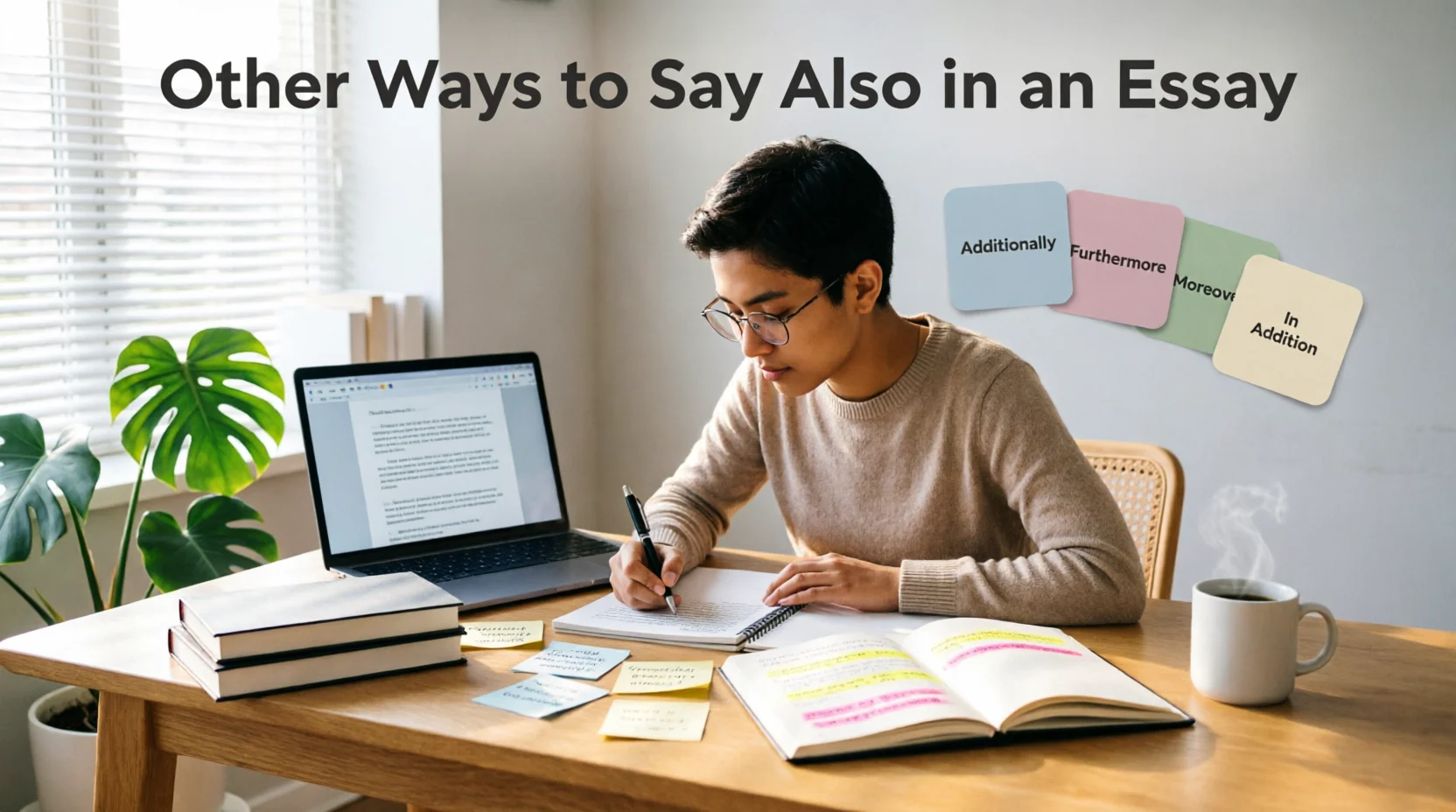
When writing an essay, you can replace “also” with more precise transition words and phrases. The best choices include additionally, furthermore, moreover, in addition, and another point is.
Top Alternative: Additionally is a clear, formal, and natural choice for academic essays.
The word also is commonly used to add another idea, supporting point, or piece of information to an essay. Although it is grammatically correct, repeating it throughout academic writing can make your paragraphs sound predictable. Learning different expressions can help you connect ideas more smoothly and create stronger transitions between sentences. Understanding the alternatives to also in an essay is especially useful for students, professionals, and English learners who want their writing to sound polished. Words such as “furthermore,” “moreover,” and “additionally” can create a more formal academic tone. In other situations, simple phrases may work better.
These choices can even help you express excitement in English when discussing positive findings or important ideas. Good academic writing is not about replacing every simple word with a complicated one. Instead, effective writers choose transitions based on meaning, context, and the relationship between ideas. The following list provides practical examples to help you write with greater variety and confidence.
Formal Alternatives to “Also in an Essay”
Additionally
This is one of the most useful formal alternatives for adding supporting information.
Furthermore
Use this when introducing another point that strengthens the previous argument.
Moreover
This works well when the new information adds further importance or support.
In Addition
This phrase clearly signals that another relevant point is coming.
Pro Tip: In academic writing, use formal transitions when they genuinely clarify the relationship between your ideas.
Casual Alternatives
Plus
Useful in conversational or less formal writing.
As Well
A natural expression for adding another fact or detail.
On Top of That
Best suited to informal communication rather than academic essays.
Another Point Is
A simple way to introduce an additional idea without sounding overly formal.
Pro Tip: Avoid casual transitions when your essay requires a consistently formal academic tone.
Professional Alternatives
Additionally
A flexible choice for reports, essays, and professional documents.
Furthermore
Useful when the additional point directly supports an argument.
In Addition
Works well in structured professional writing.
Another Important Factor Is
Useful when introducing another significant consideration.
Pro Tip: Choose professional transitions based on the relationship between ideas, not simply because they sound formal.
Informal Expressions
Also
The original word remains completely acceptable in many contexts.
Plus
Suitable for casual writing and conversations.
Besides
Can introduce another reason, fact, or consideration.
Not Only That
Useful for conversational emphasis, but less suitable for formal essays.
Pro Tip: Save informal expressions for personal writing, conversations, and situations where a relaxed tone is appropriate.
“The best transition is the one that shows exactly how your ideas connect.”
Common Mistakes When Using “Also in an Essay”
1. Repeating “also” too often
Mistake: Using “also” in every paragraph.
Example: Also, education is important. Also, it improves communication. Also, it creates opportunities.
Better: Furthermore, education improves communication and creates new opportunities.
2. Using informal expressions in academic writing
Mistake: Choosing conversational phrases in a formal essay.
Example: On top of that, technology improves education.
Better: Additionally, technology improves education.
3. Using “moreover” without a supporting relationship
Mistake: Adding “moreover” when the second idea does not strengthen the first.
Example: The library is closed today. Moreover, I bought a new notebook.
These ideas are unrelated, so “moreover” is inappropriate.
4. Using “besides” when a formal transition is needed
Mistake: Using “besides” repeatedly in academic writing.
Example: Besides, the research has several limitations.
Better: Furthermore, the research has several limitations.
5. Adding transitions unnecessarily
Mistake: Using a transition before every sentence.
Example: Additionally, students need support. Furthermore, teachers need resources. Moreover, schools need funding.
Better: Use transitions only when they help readers understand the connection between ideas.
What Does “Also in an Essay” Mean?
“Also” means in addition to something already mentioned. In an essay, it helps introduce another idea, fact, reason, example, or supporting point.
“Also” can appear in different positions within a sentence.
Example: Students also benefit from practical learning.
It can also appear at the beginning of a sentence:
Example: Also, practical learning improves confidence.
For formal essays, however, writers often use more specific transitions such as additionally, furthermore, or in addition.
When to Use “Also in an Essay”
Use “also” or its alternatives when:
- Adding another supporting argument
- Introducing another example
- Providing additional evidence
- Expanding on an existing idea
- Connecting related information
- Supporting a previous claim
- Adding another benefit or disadvantage
Spoken vs Written
Spoken: The course is affordable, and it is also flexible.
Written: Additionally, the course offers flexible scheduling.
Formal vs Informal
Formal: Furthermore, the findings support the original hypothesis.
Informal: Plus, the results support the original idea.
“Academic transitions should improve clarity, not simply make writing sound complicated.”
Is It Professional or Polite to Say “Also in an Essay”?
Polite? Yes
Professional? No in most cases when discussing formal academic style.
The word “also” itself is not unprofessional or incorrect. However, academic and professional writing often benefits from more precise transitions when adding important information.
Business Example:
Additionally, the proposed strategy could reduce operational costs.
This sounds more structured than repeatedly using “also” in a formal report.
Pros and Cons of Using “Also in an Essay”
Pros
- Simple and natural
- Friendly tone
- Common usage
- Easy to understand
Cons
- Too informal for some academic contexts
- Can become overused
- Limited emotional range
- Not always suitable for formal writing
Other Ways to Say “Also in an Essay” With Examples
These alternatives will help you sound more fluent, confident, and natural in different writing situations.
Use them according to tone, context, and audience to express excitement, admiration, or approval when appropriate.
1. Phrase: Additionally
Meaning: Adds another related point or fact.
Explanation: “Additionally” is one of the most versatile formal alternatives to “also.”
Example Sentence: Additionally, the study provides useful evidence for future research.
Best Use: Academic writing
Worst Use: Casual conversation
Tone: Formal, clear, professional
Context Variability: Casual: Medium | Professional: High | Spoken: Medium
2. Phrase: Furthermore
Meaning: Introduces another point that strengthens an argument.
Explanation: It is particularly useful when the additional information supports the previous statement.
Example Sentence: Furthermore, regular exercise can improve concentration.
Best Use: Academic arguments
Worst Use: Casual chats
Tone: Formal, academic, persuasive
Context Variability: Casual: Low | Professional: High | Spoken: Medium
3. Phrase: Moreover
Meaning: Adds information that provides further support or importance.
Explanation: “Moreover” is common in formal essays and persuasive writing.
Example Sentence: Moreover, the policy could benefit low income families.
Best Use: Formal arguments
Worst Use: Friendly messages
Tone: Formal, academic, authoritative
Context Variability: Casual: Low | Professional: High | Spoken: Medium
4. Phrase: In Addition
Meaning: Introduces another related point.
Explanation: This phrase is clear and natural in academic and professional writing.
Example Sentence: In addition, the program offers practical training.
Best Use: Formal essays
Worst Use: Casual speech
Tone: Formal, neutral, clear
Context Variability: Casual: Medium | Professional: High | Spoken: Medium
5. Phrase: As Well
Meaning: Indicates that something is true in addition to another fact.
Explanation: “As well” sounds natural in everyday and moderately formal writing.
Example Sentence: The course improves writing skills and develops research abilities as well.
Best Use: General writing
Worst Use: Formal arguments
Tone: Natural, neutral, friendly
Context Variability: Casual: High | Professional: Medium | Spoken: High
6. Phrase: Besides
Meaning: Introduces another reason, fact, or consideration.
Explanation: It can be useful when the additional point has a noticeable connection to the previous one.
Example Sentence: Besides improving productivity, the system reduces operating costs.
Best Use: Supporting points
Worst Use: Formal reports
Tone: Neutral, conversational, direct
Context Variability: Casual: High | Professional: Medium | Spoken: High
7. Phrase: Another Point Is
Meaning: Introduces an additional idea or argument.
Explanation: This simple phrase is useful when presenting several points in an organized way.
Example Sentence: Another point is that the policy may affect small businesses.
Best Use: Structured essays
Worst Use: Casual chats
Tone: Clear, neutral, organized
Context Variability: Casual: Medium | Professional: High | Spoken: High
8. Phrase: Another Important Factor Is
Meaning: Introduces another significant consideration.
Explanation: It is useful when the next point has particular importance.
Example Sentence: Another important factor is the cost of implementation.
Best Use: Analytical writing
Worst Use: Casual messages
Tone: Professional, analytical, formal
Context Variability: Casual: Low | Professional: High | Spoken: Medium
9. Phrase: In Addition To This
Meaning: Adds another related point to the previous statement.
Explanation: This phrase explicitly connects the new information to what was already discussed.
Example Sentence: In addition to this, the project requires careful planning.
Best Use: Formal writing
Worst Use: Informal chats
Tone: Formal, clear, structured
Context Variability: Casual: Medium | Professional: High | Spoken: Medium
10. Phrase: Not Only That
Meaning: Adds another point with emphasis.
Explanation: This expression is more conversational and works best when the second point deserves attention.
Example Sentence: The program saves time. Not only that, it also reduces costs.
Best Use: Informal writing
Worst Use: Academic essays
Tone: Conversational, emphatic, friendly
Context Variability: Casual: High | Professional: Medium | Spoken: High
“Do not replace ‘also’ automatically. Replace it when another transition communicates your meaning more precisely.”
11. Phrase: Plus
Meaning: Adds another fact, benefit, or reason.
Explanation: “Plus” is simple but generally informal.
Example Sentence: The course is affordable, plus it offers flexible schedules.
Best Use: Casual writing
Worst Use: Academic essays
Tone: Casual, friendly, direct
Context Variability: Casual: High | Professional: Low | Spoken: High
12. Phrase: What Is More
Meaning: Adds another significant point.
Explanation: This expression can emphasize the importance of additional information.
Example Sentence: The approach is cost effective. What is more, it improves efficiency.
Best Use: Formal arguments
Worst Use: Casual chats
Tone: Formal, emphatic, polished
Context Variability: Casual: Low | Professional: High | Spoken: Medium
13. Phrase: Equally Important
Meaning: Introduces another point with similar importance.
Explanation: It works well when two ideas deserve comparable attention.
Example Sentence: Equally important, the strategy improves long term sustainability.
Best Use: Analytical essays
Worst Use: Casual writing
Tone: Formal, analytical, balanced
Context Variability: Casual: Low | Professional: High | Spoken: Medium
14. Phrase: Along With This
Meaning: Adds another related idea.
Explanation: It connects additional information to a previously mentioned point.
Example Sentence: Along with this, students receive practical experience.
Best Use: Explanatory writing
Worst Use: Formal research
Tone: Neutral, clear, natural
Context Variability: Casual: High | Professional: Medium | Spoken: High
15. Phrase: Coupled With This
Meaning: Indicates that two factors work together.
Explanation: This expression is useful when the second point combines with the first.
Example Sentence: Coupled with this, improved training can increase employee performance.
Best Use: Analytical writing
Worst Use: Casual conversation
Tone: Formal, analytical, professional
Context Variability: Casual: Low | Professional: High | Spoken: Low
16. Phrase: Similarly
Meaning: Introduces an idea that is similar to the previous one.
Explanation: Use it when you are adding a related comparison rather than simply another point.
Example Sentence: Similarly, younger employees may benefit from flexible working arrangements.
Best Use: Comparisons
Worst Use: Unrelated ideas
Tone: Formal, analytical, clear
Context Variability: Casual: Medium | Professional: High | Spoken: Medium
17. Phrase: Likewise
Meaning: Indicates that a similar point applies.
Explanation: “Likewise” is useful when connecting comparable ideas.
Example Sentence: Likewise, small businesses can benefit from digital marketing.
Best Use: Comparative writing
Worst Use: Unrelated points
Tone: Formal, concise, academic
Context Variability: Casual: Medium | Professional: High | Spoken: Medium
18. Phrase: Beyond That
Meaning: Introduces information that goes beyond the previous point.
Explanation: It can work in semi formal and conversational writing.
Example Sentence: Beyond that, the project offers opportunities for professional development.
Best Use: Extended arguments
Worst Use: Formal research
Tone: Neutral, conversational, clear
Context Variability: Casual: High | Professional: Medium | Spoken: High
19. Phrase: On Top of That
Meaning: Adds another point, usually with emphasis.
Explanation: It is natural in conversation but usually too informal for academic essays.
Example Sentence: The service is affordable, and on top of that, it is easy to use.
Best Use: Casual communication
Worst Use: Academic essays
Tone: Informal, emphatic, friendly
Context Variability: Casual: High | Professional: Low | Spoken: High
20. Phrase: There Is Also
Meaning: Introduces another existing fact or option.
Explanation: This simple structure works naturally when presenting additional information.
Example Sentence: There is also evidence supporting the proposed solution.
Best Use: General writing
Worst Use: Highly formal arguments
Tone: Neutral, simple, natural
Context Variability: Casual: High | Professional: High | Spoken: High
21. Phrase: It Is Also Worth Noting
Meaning: Highlights another point that deserves attention.
Explanation: This phrase is useful for introducing relevant supporting information.
Example Sentence: It is also worth noting that the results varied by age group.
Best Use: Academic analysis
Worst Use: Casual speech
Tone: Formal, thoughtful, analytical
Context Variability: Casual: Low | Professional: High | Spoken: Medium
22. Phrase: An Additional Point Is
Meaning: Introduces another supporting idea.
Explanation: It clearly signals that another argument or observation follows.
Example Sentence: An additional point is the impact of rising production costs.
Best Use: Academic writing
Worst Use: Casual conversation
Tone: Formal, structured, professional
Context Variability: Casual: Low | Professional: High | Spoken: Medium
23. Phrase: An Additional Benefit Is
Meaning: Introduces another advantage.
Explanation: This phrase is particularly useful when discussing benefits or positive outcomes.
Example Sentence: An additional benefit is improved access to educational resources.
Best Use: Benefit analysis
Worst Use: Casual chats
Tone: Professional, clear, positive
Context Variability: Casual: Medium | Professional: High | Spoken: Medium
24. Phrase: An Additional Concern Is
Meaning: Introduces another problem or concern.
Explanation: It is useful for presenting balanced arguments and limitations.
Example Sentence: An additional concern is the lack of available funding.
Best Use: Critical analysis
Worst Use: Casual writing
Tone: Formal, analytical, objective
Context Variability: Casual: Medium | Professional: High | Spoken: Medium
25. Phrase: Alongside This
Meaning: Adds information that exists together with the previous point.
Explanation: It works well when discussing related developments or factors.
Example Sentence: Alongside this, the organization introduced new training programs.
Best Use: Professional writing
Worst Use: Very casual speech
Tone: Professional, formal, smooth
Context Variability: Casual: Medium | Professional: High | Spoken: Medium
26. Phrase: Together With This
Meaning: Indicates that another factor exists with the first.
Explanation: It emphasizes the connection between two related factors.
Example Sentence: Together with this, better communication can improve team performance.
Best Use: Explanatory writing
Worst Use: Short answers
Tone: Neutral, clear, professional
Context Variability: Casual: Medium | Professional: High | Spoken: Medium
27. Phrase: Beyond This
Meaning: Introduces another consideration after the previous point.
Explanation: It works well when developing an argument step by step.
Example Sentence: Beyond this, policymakers must consider the long term effects.
Best Use: Analytical essays
Worst Use: Casual chats
Tone: Formal, analytical, structured
Context Variability: Casual: Low | Professional: High | Spoken: Medium
28. Phrase: Another Consideration Is
Meaning: Introduces another factor that should be considered.
Explanation: This is particularly useful for balanced or analytical essays.
Example Sentence: Another consideration is the effect on smaller organizations.
Best Use: Critical essays
Worst Use: Informal messages
Tone: Formal, analytical, professional
Context Variability: Casual: Low | Professional: High | Spoken: Medium
29. Phrase: It Is Important to Add
Meaning: Introduces information that deserves inclusion.
Explanation: It can emphasize the relevance of the next point.
Example Sentence: It is important to add that these results were based on a small sample.
Best Use: Academic analysis
Worst Use: Casual writing
Tone: Formal, precise, academic
Context Variability: Casual: Low | Professional: High | Spoken: Medium
30. Phrase: To Add to This
Meaning: Introduces another connected point.
Explanation: This phrase smoothly extends an existing argument.
Example Sentence: To add to this, the research highlights several practical challenges.
Best Use: Essay development
Worst Use: Casual chats
Tone: Neutral, formal, connected
Context Variability: Casual: Medium | Professional: High | Spoken: Medium
Mini Quiz and Self Check
1. Which option is most appropriate for a formal academic essay?
A. Plus
B. On top of that
C. Furthermore
D. Not only that
Answer: C. Furthermore
2. Which sentence uses “moreover” correctly?
A. The ideas are unrelated. Moreover, I bought a book.
B. The solution is affordable. Moreover, it is environmentally friendly.
C. I attended the event. Moreover, I arrived at 9 AM.
D. Moreover is used only in questions.
Answer: B.
3. You are writing a casual message. Which expression sounds most natural?
A. Plus
B. Furthermore
C. Equally important
D. An additional consideration is
Answer: A. Plus
4. You want to introduce another important factor in an analytical essay. Which option works best?
A. Another consideration is
B. Plus
C. On top of that
D. Come to think of it
Answer: A. Another consideration is
“Fluent writers do not memorize one perfect synonym. They learn how each transition changes the tone.”
Comparison Table: Top Alternatives
| Phrase | Tone | Best Use |
|---|---|---|
| Additionally | Formal | Academic essays |
| Furthermore | Formal | Supporting arguments |
| Moreover | Formal | Persuasive writing |
| In addition | Professional | Reports and essays |
| Another point is | Neutral | Structured writing |
| Another consideration is | Formal | Analytical essays |
| It is also worth noting | Academic | Research writing |
| As well | Neutral | General writing |
| Besides | Conversational | Supporting ideas |
| Plus | Casual | Informal writing |
FAQs
What are the best alternatives to “also in an essay”?
The strongest academic choices include additionally, furthermore, moreover, in addition, and another point is.
What is a formal way to say “also” in an essay?
Additionally, furthermore, moreover, and in addition are common formal alternatives for academic writing.
Can I use “also” in an academic essay?
Yes. “Also” is grammatically correct and acceptable, but repeating it too often can make your writing sound less varied.
Is “moreover” better than “also” in an essay?
Not necessarily. “Moreover” is more formal and emphasizes an additional supporting point, while “also” is simpler and more neutral.
What can I use instead of “also” at the beginning of a sentence?
You can use additionally, furthermore, moreover, in addition, or another important point is, depending on the relationship between your ideas.
Conclusion
Learning other ways to say also in an essay can make your academic writing more varied, precise, and engaging. Words such as “additionally,” “furthermore,” and “moreover” are useful when you want to create a formal and organized flow between ideas.
The key is to practice each expression in context rather than replacing “also” automatically. Pay attention to tone, meaning, and the relationship between sentences. With regular practice, you can use these transitions naturally in essays, reports, and professional writing.
Which alternative do you use most often? Share your favorite transition and an example sentence.