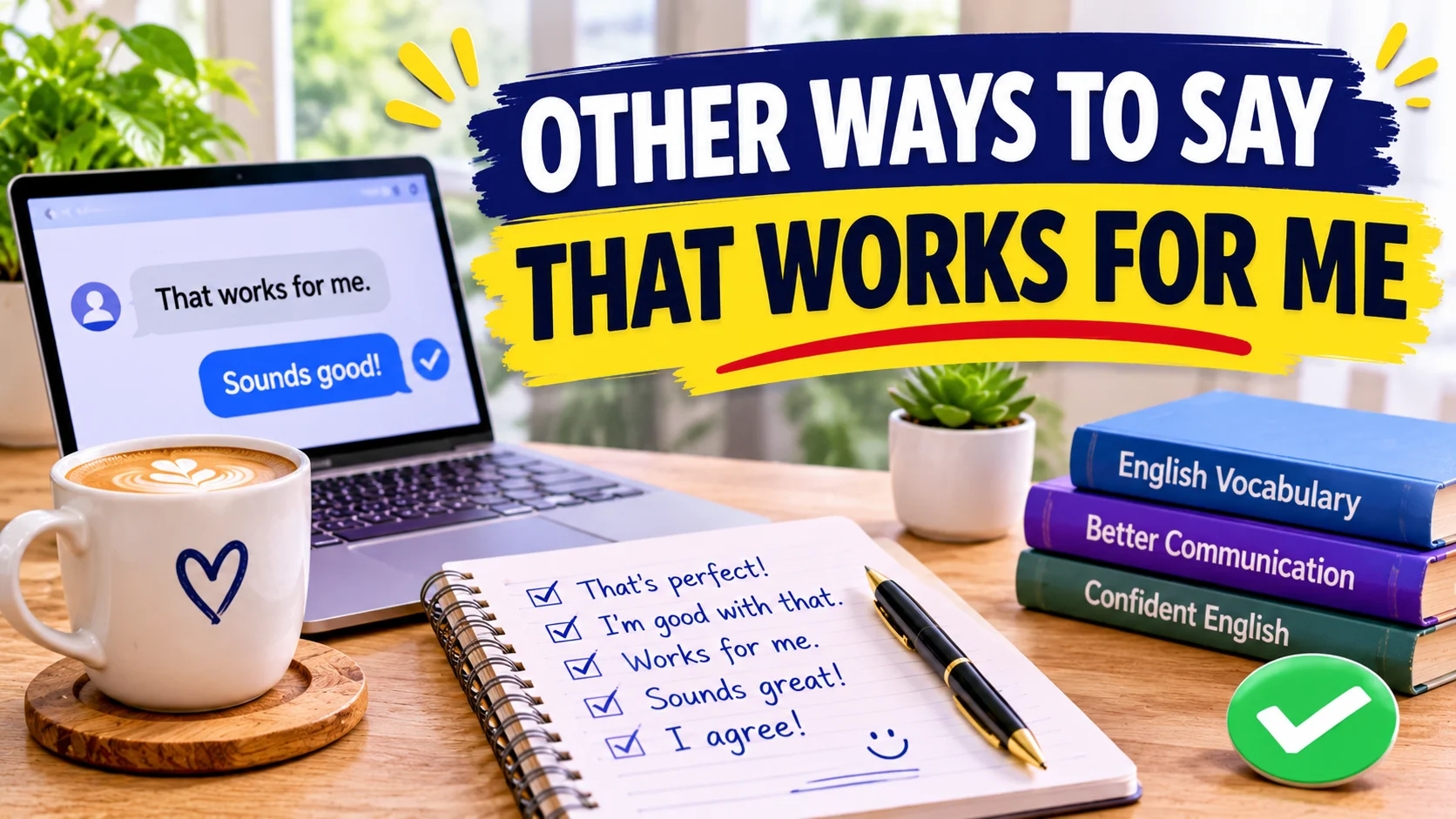
If you want to express agreement, approval, or acceptance more naturally, there are several alternatives to “that works for me.” Popular options include Sounds good to me, I’m happy with that, That suits me, I’m fine with that, and That sounds perfect.
Introduction
The phrase “that works for me” is a common English expression used to show agreement, acceptance, or satisfaction with a suggestion, arrangement, or decision. People often use it when confirming meeting times, accepting invitations, discussing plans, or responding to workplace suggestions.
Although the expression sounds natural and friendly, repeating it in every conversation can make your communication feel predictable. Learning alternatives to “that works for me” helps you express agreement with greater variety, confidence, and precision.
Whether you are speaking with friends, replying to colleagues, or writing professional emails, choosing the right expression can improve your communication skills. These alternatives also help you express excitement in English, show enthusiasm, and communicate approval without sounding repetitive.
In this guide, you will discover 30 useful expressions, their meanings, natural examples, and the situations where each one works best.
Quick Categories: Different Ways to Express Agreement
Formal alternatives to “that works for me”
- That arrangement is acceptable to me.
- I find that suitable.
- I am agreeable to that.
- That would be perfectly acceptable.
Pro Tip: Use these expressions when communicating with clients, senior colleagues, or people you do not know well. They communicate acceptance without sounding overly casual.
Casual alternatives
- Sounds good to me.
- I’m happy with that.
- That sounds perfect.
- I’m good with that.
Pro Tip: These expressions are ideal for everyday conversations. They sound friendly, natural, and comfortable.
Professional alternatives
- That aligns with my schedule.
- I can accommodate that.
- That fits my availability.
- I am comfortable with that approach.
Pro Tip: Choose professional reaction phrases that explain why you agree, especially when discussing deadlines, meetings, and business arrangements.
Informal expressions
- Works for me.
- I’m in.
- Count me in.
- No problem on my end.
Pro Tip: These informal expressions in English work well with friends, teammates, and familiar colleagues. Avoid overly relaxed expressions in formal business correspondence.
“Good communication is not just about agreeing. It is about expressing agreement in the right way.”
Common Mistakes When Using “That Works for Me”
Although this expression is simple, learners sometimes use it incorrectly or in situations where another phrase would communicate their meaning better.
Here are five common mistakes to avoid.
1. Using it when you do not actually agree
Incorrect: That works for me, although I cannot attend.
Why it is a mistake: The statement contradicts itself.
Better: Unfortunately, that timing does not work for me.
2. Using it in overly formal correspondence
Incorrect: That works for me, Your Honor.
Why it is a mistake: The expression may sound too conversational for a highly formal setting.
Better: I find that arrangement acceptable.
3. Confusing agreement with enthusiasm
Incorrect: That works for me! I am extremely excited about this opportunity!
Why it is a mistake: The first expression communicates acceptance, not necessarily excitement.
Better: That sounds fantastic! I’m looking forward to it.
4. Repeating it in every professional email
Incorrect: That works for me. That works for me next week, too.
Why it is a mistake: Repetition makes your writing less engaging.
Better: Tuesday would be ideal. I can also accommodate Thursday.
5. Using it without considering the context
Incorrect: That works for me when responding to an important business proposal without reviewing its details.
Why it is a mistake: Agreeing too quickly can communicate approval before you have considered the proposal.
Better: That approach sounds reasonable. Let me review the details before confirming.
What Does “That Works for Me” Mean?
“That works for me” means that you agree with a suggestion, find an arrangement suitable, or are comfortable accepting a particular plan.
It is commonly used to communicate that something meets your needs, preferences, availability, or expectations.
Grammar explanation
The phrase follows this basic structure:
- That: A demonstrative pronoun referring to a suggestion, arrangement, or idea.
- Works: The present-tense form of the verb work, meaning to be suitable or effective.
- For me: Identifies the person for whom the arrangement is acceptable.
Example: Meeting at 3 p.m. works for me because I will be available by then.
The expression is particularly useful because it communicates agreement without requiring a lengthy explanation.
When to Use “That Works for Me”
You can use this phrase in different situations where you want to communicate acceptance or agreement.
Common contexts
- Scheduling meetings: Agreeing to a suggested meeting time.
- Making plans: Accepting an invitation or proposed arrangement.
- Workplace discussions: Approving a suggested approach.
- Group conversations: Showing agreement with a shared decision.
- Personal arrangements: Confirming plans with friends or family.
- Business communication: Indicating that a proposed schedule is suitable.
Spoken vs. written English
| Context | Example |
|---|---|
| Spoken | Sounds good to me. |
| Text message | That works for me! |
| Professional email | That timing fits my schedule. |
| Formal writing | I find the proposed arrangement acceptable. |
Formal vs. informal usage
In formal communication, choose expressions such as “I find that suitable” or “That arrangement is acceptable to me.”
In informal conversations, “Sounds good to me” and “I’m good with that” are more natural.
“A simple change in wording can make the difference between sounding casual, confident, and professional.”
Is “That Works for Me” Professional or Polite to Say?
Yes. “That works for me” is generally polite, friendly, and appropriate in everyday professional communication. However, it is not the most formal expression available.
It works particularly well when communicating with colleagues, teammates, managers, and clients with whom you have an established working relationship.
Business-style example:
“Thank you for suggesting Thursday afternoon. That works for me, and I look forward to discussing the project.”
Polite? ✔️ Yes
Professional? ❌ No (in most cases, when a more formal register is required)
For highly formal emails, consider using:
- I find that arrangement acceptable.
- That timing would be suitable.
- I can accommodate the proposed schedule.
Pros and Cons of Using “That Works for Me”
Understanding the strengths and limitations of this expression helps you decide when to use it.
Pros
- Simple and natural: Easy to use in everyday conversations.
- Friendly tone: Communicates agreement without sounding demanding.
- Common usage: Widely understood by English speakers.
- Easy to understand: Clearly communicates acceptance.
Cons
- Too informal for work: May not suit highly formal correspondence.
- Overused: Repeating it can make communication predictable.
- Limited emotional range: Does not always communicate enthusiasm or excitement.
- Not suitable for formal writing: More polished expressions may be preferable in official documents.
Other Ways to Say “That Works for Me” (With Examples)
The following alternatives will help you sound more fluent, confident, and natural in different situations.
Use them according to tone, context, and audience to communicate agreement, express excitement, and show approval.
30 Useful Alternatives With Meanings and Examples
1. Sounds Good to Me
Meaning: Expresses agreement with a suggestion or proposal.
Explanation: It is a friendly way to show that you are happy with an arrangement.
Example Sentence: Meeting at 10 a.m. sounds good to me.
Best Use: Everyday conversations
Worst Use: Legal documents
Tone: Friendly, relaxed, positive
Context Variability: Casual: Sounds good to me! Professional: That sounds good to me. Spoken: Sounds good.
2. I’m Happy With That
Meaning: Communicates satisfaction with a suggested arrangement.
Explanation: It shows that you are comfortable with the proposed decision.
Example Sentence: I’m happy with that schedule for next week.
Best Use: General agreement
Worst Use: Serious objections
Tone: Positive, friendly, agreeable
Context Variability: Casual: I’m happy with that. Professional: I’m happy with the proposed arrangement. Spoken: Yes, I’m happy with it.
3. That Suits Me
Meaning: Indicates that something matches your needs or preferences.
Explanation: It is a concise way to accept a plan or suggested time.
Example Sentence: Friday afternoon suits me perfectly.
Best Use: Scheduling arrangements
Worst Use: Emotional discussions
Tone: Neutral, polite, confident
Context Variability: Casual: That suits me. Professional: Friday would suit me well. Spoken: Friday suits me fine.
4. I’m Fine With That
Meaning: Shows that you have no objection to a particular suggestion.
Explanation: It communicates acceptance without necessarily expressing excitement.
Example Sentence: If everyone prefers the earlier meeting, I’m fine with that.
Best Use: Everyday agreement
Worst Use: Enthusiastic announcements
Tone: Neutral, relaxed, agreeable
Context Variability: Casual: I’m fine with that. Professional: I’m comfortable with that arrangement. Spoken: That’s fine with me.
5. That Sounds Perfect
Meaning: Expresses strong approval of an idea or arrangement.
Explanation: Use it when a suggestion meets your expectations particularly well.
Example Sentence: A video call at noon? That sounds perfect!
Best Use: Positive responses
Worst Use: Serious negotiations
Tone: Enthusiastic, warm, positive
Context Variability: Casual: Sounds perfect! Professional: That sounds like an excellent arrangement. Spoken: Perfect, let’s do that.
6. I Can Accommodate That
Meaning: Indicates that you can adjust your schedule or arrangements accordingly.
Explanation: This expression is useful when accepting a professional request.
Example Sentence: I can accommodate the revised meeting time.
Best Use: Workplace scheduling
Worst Use: Casual invitations
Tone: Professional, cooperative, courteous
Context Variability: Casual: I can make that work. Professional: I can accommodate that request. Spoken: I can adjust my schedule.
7. That Fits My Schedule
Meaning: Indicates that a proposed time matches your availability.
Explanation: It is a practical alternative when discussing appointments or meetings.
Example Sentence: Wednesday morning fits my schedule perfectly.
Best Use: Meeting arrangements
Worst Use: General opinions
Tone: Professional, clear, neutral
Context Variability: Casual: That fits my schedule. Professional: Wednesday morning fits my availability. Spoken: Wednesday works with my schedule.
8. I’m Good With That
Meaning: Shows that you accept and approve a suggestion.
Explanation: It is a relaxed expression commonly used in everyday conversations.
Example Sentence: If we leave after lunch, I’m good with that.
Best Use: Friendly discussions
Worst Use: Formal letters
Tone: Casual, relaxed, agreeable
Context Variability: Casual: I’m good with that. Professional: I’m comfortable with that option. Spoken: Yeah, I’m good with it.
9. That Would Be Fine
Meaning: Communicates that a suggested arrangement is acceptable.
Explanation: It is a polite response when you want to express agreement without sounding overly enthusiastic.
Example Sentence: An online meeting instead of an in-person one would be fine.
Best Use: Polite responses
Worst Use: Exciting announcements
Tone: Polite, neutral, reserved
Context Variability: Casual: That would be fine. Professional: That arrangement would be acceptable. Spoken: Yes, that would be fine.
10. I Agree With That
Meaning: Expresses agreement with an idea, opinion, or decision.
Explanation: It focuses more on agreement with an idea than on scheduling or availability.
Example Sentence: I agree with that approach because it will save time.
Best Use: Discussions and decisions
Worst Use: Simple invitations
Tone: Direct, confident, professional
Context Variability: Casual: I agree with that. Professional: I agree with the proposed approach. Spoken: Yes, I agree.
11. That Is Acceptable to Me
Meaning: Indicates that a particular arrangement meets your requirements.
Explanation: It is a more formal way to communicate acceptance.
Example Sentence: The revised deadline is acceptable to me.
Best Use: Formal arrangements
Worst Use: Friendly chats
Tone: Formal, neutral, composed
Context Variability: Casual: That’s okay with me. Professional: That is acceptable to me. Spoken: That’s acceptable.
12. I’m Comfortable With That
Meaning: Shows that you feel satisfied with a particular decision or proposal.
Explanation: It is useful when confirming that an arrangement meets your expectations.
Example Sentence: I’m comfortable with the proposed changes to the schedule.
Best Use: Workplace decisions
Worst Use: Highly enthusiastic occasions
Tone: Reassuring, professional, neutral
Context Variability: Casual: I’m comfortable with that. Professional: I’m comfortable proceeding with this approach. Spoken: That feels fine to me.
13. That Works Perfectly
Meaning: Expresses complete satisfaction with a suggested arrangement.
Explanation: It is a slightly more enthusiastic variation of the original expression.
Example Sentence: A quick call at 4 p.m. works perfectly.
Best Use: Scheduling confirmation
Worst Use: Formal complaints
Tone: Positive, confident, friendly
Context Variability: Casual: That works perfectly! Professional: That timing works perfectly for me. Spoken: Perfect, that works.
14. I’m On Board With That
Meaning: Shows support for a suggestion, idea, or plan.
Explanation: It communicates that you are willing to participate or support a decision.
Example Sentence: I’m on board with that strategy for the upcoming campaign.
Best Use: Team discussions
Worst Use: Official legal writing
Tone: Supportive, collaborative, confident
Context Variability: Casual: I’m on board. Professional: I’m fully on board with this proposal. Spoken: Yes, I’m on board.
15. That Meets My Needs
Meaning: Indicates that a proposal satisfies your requirements.
Explanation: It is useful when evaluating practical arrangements or professional solutions.
Example Sentence: The updated delivery schedule meets my needs.
Best Use: Business arrangements
Worst Use: Social invitations
Tone: Practical, professional, direct
Context Variability: Casual: That works for what I need. Professional: That meets my requirements. Spoken: Yes, that meets my needs.
16. I Have No Objection
Meaning: Indicates that you do not oppose a particular suggestion.
Explanation: This expression communicates formal acceptance without necessarily showing enthusiasm.
Example Sentence: I have no objection to moving the presentation to Friday.
Best Use: Formal discussions
Worst Use: Friendly celebrations
Tone: Formal, restrained, neutral
Context Variability: Casual: I don’t mind. Professional: I have no objection to the proposed change. Spoken: I have no issue with that.
17. That Sounds Reasonable
Meaning: Shows that an idea seems fair, practical, or sensible.
Explanation: It is particularly helpful when responding to proposals that require consideration.
Example Sentence: That sounds reasonable, and I think we can move forward.
Best Use: Business negotiations
Worst Use: Exciting invitations
Tone: Thoughtful, professional, measured
Context Variability: Casual: Sounds reasonable. Professional: That sounds like a reasonable approach. Spoken: Yes, that seems fair.
18. I’m All for It
Meaning: Expresses enthusiastic support for an idea or activity.
Explanation: Use this phrase when you want to show more excitement than simple agreement.
Example Sentence: A team-building event next month? I’m all for it!
Best Use: Group activities
Worst Use: Formal approvals
Tone: Enthusiastic, supportive, upbeat
Context Variability: Casual: I’m all for it! Professional: I strongly support that initiative. Spoken: Absolutely, I’m all for it.
19. Let’s Go With That
Meaning: Indicates that you are ready to accept and proceed with a suggestion.
Explanation: It is useful when a group needs to finalize a decision.
Example Sentence: The second design looks better. Let’s go with that.
Best Use: Final decisions
Worst Use: Unresolved disputes
Tone: Decisive, collaborative, confident
Context Variability: Casual: Let’s go with that. Professional: I suggest we proceed with that option. Spoken: Okay, let’s do that.
20. That Is Suitable for Me
Meaning: Communicates that a proposed arrangement meets your preferences.
Explanation: It is a polite expression that works in relatively formal conversations.
Example Sentence: The proposed interview time is suitable for me.
Best Use: Formal scheduling
Worst Use: Casual texting
Tone: Polite, formal, neutral
Context Variability: Casual: That suits me. Professional: That time is suitable for me. Spoken: Yes, that time is suitable.
21. Count Me In
Meaning: Shows that you want to participate in a suggested activity.
Explanation: It communicates enthusiasm and willingness to join.
Example Sentence: If you’re organizing a group dinner, count me in!
Best Use: Social activities
Worst Use: Formal approvals
Tone: Enthusiastic, friendly, informal
Context Variability: Casual: Count me in! Professional: I’d be happy to participate. Spoken: Yes, I’m in.
22. No Problem on My End
Meaning: Indicates that a proposed arrangement does not create any difficulty for you.
Explanation: It is commonly used to confirm availability or acceptance.
Example Sentence: Moving the deadline to Monday is no problem on my end.
Best Use: Workplace conversations
Worst Use: Formal reports
Tone: Relaxed, cooperative, reassuring
Context Variability: Casual: No problem on my end. Professional: I have no concerns with that change. Spoken: No problem for me.
23. I’m Flexible With That
Meaning: Communicates your willingness to adjust to a particular arrangement.
Explanation: It suggests that you are open to different options.
Example Sentence: I’m flexible with the meeting time, so choose whatever works best.
Best Use: Scheduling discussions
Worst Use: Final approvals
Tone: Accommodating, friendly, adaptable
Context Variability: Casual: I’m flexible. Professional: I can be flexible with the schedule. Spoken: Either time is fine.
24. That Aligns With My Plans
Meaning: Indicates that a suggestion matches your existing arrangements or objectives.
Explanation: It is a polished alternative for professional and personal planning.
Example Sentence: The proposed travel dates align with my plans.
Best Use: Professional planning
Worst Use: Casual reactions
Tone: Polished, professional, confident
Context Variability: Casual: That fits my plans. Professional: That aligns with my current schedule. Spoken: That matches what I had planned.
25. I’m Glad That Works Out
Meaning: Expresses satisfaction that an arrangement is convenient or successful.
Explanation: It is useful when responding positively to a confirmed plan.
Example Sentence: I’m glad that works out for everyone involved.
Best Use: Positive confirmations
Worst Use: Serious disagreements
Tone: Warm, positive, considerate
Context Variability: Casual: Glad that works out! Professional: I’m pleased that the arrangement works out. Spoken: Great, glad it works.
26. That Is Perfectly Fine With Me
Meaning: Shows that you completely accept a proposed arrangement.
Explanation: It adds politeness and reassurance to a simple agreement.
Example Sentence: If we postpone the discussion until Monday, that’s perfectly fine with me.
Best Use: Polite acceptance
Worst Use: Urgent decisions
Tone: Courteous, reassuring, friendly
Context Variability: Casual: Perfectly fine with me. Professional: That arrangement is perfectly acceptable. Spoken: That’s absolutely fine.
27. I Can Make That Work
Meaning: Indicates that you are willing and able to adjust to an arrangement.
Explanation: It communicates flexibility, especially when something requires minor adjustments.
Example Sentence: The earlier deadline is challenging, but I can make that work.
Best Use: Workplace flexibility
Worst Use: Impossible requests
Tone: Cooperative, confident, practical
Context Variability: Casual: I can make that work. Professional: I can adjust my schedule accordingly. Spoken: Sure, I can make it work.
28. That Is a Good Fit
Meaning: Indicates that an option is appropriate for your needs or circumstances.
Explanation: It works well when evaluating opportunities, arrangements, or proposed solutions.
Example Sentence: The revised schedule is a good fit for our team’s availability.
Best Use: Evaluating options
Worst Use: Simple greetings
Tone: Positive, professional, thoughtful
Context Variability: Casual: That’s a good fit. Professional: This arrangement is a good fit for our requirements. Spoken: Yes, that fits well.
29. I Would Be Happy to Proceed
Meaning: Expresses willingness and agreement to move forward with a proposal.
Explanation: It is a polished expression for confirming a professional decision.
Example Sentence: I have reviewed the proposal and would be happy to proceed.
Best Use: Business correspondence
Worst Use: Casual invitations
Tone: Professional, courteous, positive
Context Variability: Casual: I’m happy to go ahead. Professional: I would be happy to proceed with the arrangement. Spoken: Yes, let’s move forward.
30. Absolutely, Let’s Do That
Meaning: Shows enthusiastic agreement and readiness to take action.
Explanation: It is an energetic alternative when you want to accept a suggestion immediately.
Example Sentence: Would you like to schedule the presentation for Thursday? Absolutely, let’s do that.
Best Use: Positive decisions
Worst Use: Formal negotiations
Tone: Enthusiastic, confident, friendly
Context Variability: Casual: Absolutely, let’s do that! Professional: I agree. Let’s proceed with that option. Spoken: Absolutely, sounds great.
Pull Quotes: Remember These Expressions
“Agreement sounds more natural when your words match the situation.”
“Professional communication is about being clear, courteous, and confident.”
“Use enthusiasm when you are excited, and neutral language when you simply agree.”
Mini Quiz: Test Your Understanding
Check whether you can choose the right expression for different situations.
English Usage Challenge
0/4 answered
1. Your manager suggests moving a meeting to Wednesday. You are available. Which response is most professional?Count me in!Wednesday fits my schedule.I’m all for it!
2. Your friend invites you to a weekend picnic. You are excited to join. What should you say?I have no objection.That is acceptable to me.Count me in!
3. A colleague proposes a practical solution during a meeting. Which response shows thoughtful agreement?That sounds reasonable.Whatever.I’m in!
4. You want to tell a client that the proposed arrangement is acceptable in formal language. Which is best?I’m good with that.That arrangement is acceptable to me.Sounds perfect!
Check My Answers
Comparison Table: Top 10 Alternatives
Here is a quick comparison of the most useful expressions and the situations where they work best.
| Phrase | Tone | Best Use |
|---|---|---|
| Sounds good to me | Friendly | Everyday agreement |
| I’m happy with that | Positive | General acceptance |
| That suits me | Neutral | Scheduling |
| I can accommodate that | Professional | Workplace requests |
| That sounds perfect | Enthusiastic | Positive responses |
| I’m comfortable with that | Reassuring | Business decisions |
| That is acceptable to me | Formal | Official arrangements |
| That sounds reasonable | Thoughtful | Professional discussions |
| Count me in | Informal | Social activities |
| I would be happy to proceed | Professional | Business correspondence |
See Also: Improve Your English Communication
Explore these related topics to build a stronger vocabulary and communicate more naturally:
- See also: Other Ways to Say “I Agree” (30+ Examples)
- See also: Professional English Phrases for Workplace Communication
Frequently Asked Questions
1. What is another way to say “that works for me”?
You can say “Sounds good to me,” “I’m happy with that,” “That suits me,” or “I’m comfortable with that.” The best alternative depends on your tone and situation.
2. What is a more professional way to say “that works for me”?
Try “That aligns with my schedule,” “I can accommodate that,” or “I would be happy to proceed.” These expressions sound polished in workplace communication.
3. Is “that works for me” formal or informal?
It is generally considered neutral to informal. It is perfectly acceptable in everyday workplace conversations but may be too casual for highly formal business correspondence.
4. Can I use “sounds good to me” in a professional email?
Yes. It is suitable for friendly workplace emails and routine communication. For more formal messages, consider “That sounds suitable” or “I agree with the proposed arrangement.”
5. How do I respond positively without saying “that works for me”?
You can use expressions such as “Absolutely,” “That sounds perfect,” “I’m happy to proceed,” or “That fits my schedule.” Choose one that reflects your actual level of agreement.
Conclusion
Learning different ways to express agreement helps you communicate more naturally in personal conversations and professional situations. Expressions such as “Sounds good to me,” “That suits me,” and “I can accommodate that” allow you to respond confidently without repeating the same phrase.
The key is understanding tone and context. Practice these alternatives in everyday conversations, text messages, and professional emails. Over time, you will develop a more flexible vocabulary and become better at expressing agreement, approval, and enthusiasm in English.
Which of these 30 expressions do you use most often? Share your favorite in the comments!