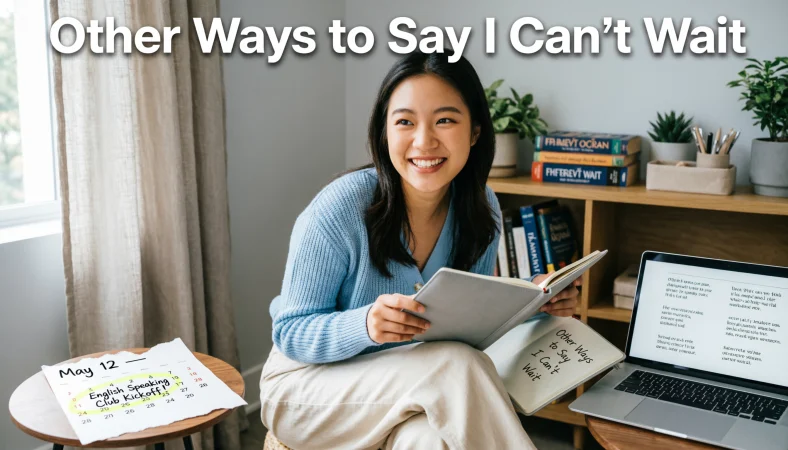
There are many natural ways to communicate anticipation besides “I can’t wait.” The best choice depends on whether you are speaking casually, professionally, or expressing strong excitement.
Top alternatives: I’m looking forward to it, I’m excited about it, I’m eager to, I’m anticipating it, I’m really looking forward to it.
“I can’t wait” is a common English expression used to show strong excitement or anticipation about something that is going to happen. People use it when talking about upcoming events, meetings, holidays, opportunities, plans, conversations, or experiences. Although it sounds natural and friendly, it may be too casual for some professional or formal situations. Learning alternatives to I can’t wait helps English learners express anticipation in ways that better suit different contexts.
Understanding different ways to express excitement in English can make your spoken and written communication more flexible and natural. Instead of repeating “I can’t wait,” you can choose an expression that matches your relationship with the listener, the setting, and the level of excitement you want to communicate. These alternatives are especially useful for professionals, students, and advanced English learners who want to sound enthusiastic without being repetitive or overly informal.
Formal Alternatives to “I Can’t Wait”
Formal situations often require more polished language. Consider these options:
- I am looking forward to it
- I eagerly anticipate it
- I am anticipating it
- I am very much looking forward to it
Pro Tip
In formal writing, “I am looking forward to it” is usually the safest choice because it sounds positive, respectful, and professional.
Casual Alternatives
For friends, family members, and familiar colleagues, these expressions sound natural:
- I’m really looking forward to it
- I’m excited about it
- I’m so excited
- I’m really excited for it
Pro Tip
Use casual expressions when the relationship is comfortable and the situation does not require formal language.
Professional Alternatives
In workplace communication, choose phrases that communicate enthusiasm without sounding overly emotional:
- I’m looking forward to our meeting
- I’m eager to get started
- I’m excited to collaborate
- I look forward to discussing this
Pro Tip
For emails and business messages, connect your anticipation to a specific professional activity whenever possible.
Informal Expressions
These informal expressions work well in everyday conversations:
- I’m so excited
- I’m counting down the days
- I’m really excited about it
- I’m eager to see what happens
Pro Tip
Informal expressions in English are most effective when speaking with people you already know well.
“The strongest alternative is not always the most enthusiastic one. It is the one that fits the situation.”
Common Mistakes
1. Using It in Every Situation
“I can’t wait” is natural, but repeating it constantly can make your vocabulary sound limited.
Example: “I can’t wait for the meeting. I can’t wait for lunch. I can’t wait for the weekend.”
2. Using “Can’t Wait” in Highly Formal Writing
The phrase can sound conversational in formal reports or official correspondence.
Example: “I can’t wait to receive your decision.”
Better: “I look forward to receiving your decision.”
3. Confusing “Look Forward To” With “Look Forward For”
The correct preposition is to.
Example: “I look forward to meeting you.”
4. Using the Wrong Verb After “Look Forward To”
“Look forward to” is followed by a noun or gerund, not the base form of a verb.
Example: “I look forward to meeting you.”
Incorrect: “I look forward to meet you.”
5. Expressing Too Much Excitement in Professional Situations
Strong emotional language may not fit every business context.
Example: “I’m absolutely thrilled beyond words about tomorrow’s meeting!”
Better: “I’m looking forward to tomorrow’s meeting.”
What Does “I Can’t Wait” Mean?
“I can’t wait” means you are very excited or eager for something to happen. It does not usually mean that you literally cannot wait.
Grammatically, it is a negative construction using can’t + wait, but the expression communicates positive anticipation.
Example: “I can’t wait to see you tomorrow.”
When to Use “I Can’t Wait”
You can use this expression when:
- Talking about an upcoming event
- Showing excitement about a trip
- Discussing future plans
- Anticipating a personal meeting
- Reacting enthusiastically to good news
- Speaking with friends or familiar colleagues
- Writing informal messages or social posts
Spoken vs. Written
“I can’t wait” is especially common in spoken English and informal writing such as text messages and social media posts.
Formal vs. Informal
It is generally informal to neutral. In professional writing, “I look forward to” is usually a better choice.
“Professional English does not mean removing enthusiasm. It means expressing enthusiasm appropriately.”
Is “I Can’t Wait” Professional or Polite to Say?
“I can’t wait” is polite, but it is not usually the most professional expression for formal workplace communication.
For professional situations, expressions such as “I look forward to,” “I’m eager to,” and “I’m looking forward to discussing this” are more polished.
Business example:
“I look forward to discussing the proposal with you next week.”
Polite? Yes
Professional? No, in most formal cases
Pros and Cons of Using “I Can’t Wait”
Pros
- Simple and natural
- Friendly tone
- Common usage
- Easy to understand
Cons
- Too informal for work
- Can become overused
- Limited emotional range
- Not suitable for formal writing
Other Ways to Say “I Can’t Wait” With Examples
These alternatives will help you sound more fluent, confident, and natural in different situations.
Use them according to tone, context, and audience to express excitement, admiration, or approval.
1. Phrase: I’m Looking Forward to It
Meaning: You are pleased and excited about something that will happen.
Explanation: This is one of the most versatile alternatives and works in both personal and professional communication.
Example Sentence: “I’m looking forward to our conversation next week.”
Best Use: Professional communication
Worst Use: Extreme excitement
Tone: Polite, positive, professional
Context Variability: Casual: “I’m looking forward to the trip.” Professional: “I’m looking forward to meeting you.” Spoken: “I’m really looking forward to it.”
2. Phrase: I’m Really Looking Forward to It
Meaning: You are especially excited about a future event.
Explanation: Adding “really” makes the expression warmer and more enthusiastic.
Example Sentence: “I’m really looking forward to seeing everyone again.”
Best Use: Friendly situations
Worst Use: Formal reports
Tone: Warm, enthusiastic, natural
Context Variability: Casual: “I’m really looking forward to Saturday.” Professional: “I’m really looking forward to the presentation.” Spoken: “I’m really looking forward to it.”
3. Phrase: I’m Excited About It
Meaning: You feel enthusiastic about something upcoming.
Explanation: This direct expression clearly communicates positive anticipation.
Example Sentence: “I’m excited about the new project.”
Best Use: Everyday communication
Worst Use: Formal reports
Tone: Positive, energetic, friendly
Context Variability: Casual: “I’m excited about the party.” Professional: “I’m excited about this opportunity.” Spoken: “I’m excited about it.”
4. Phrase: I’m Eager to
Meaning: You strongly want to do or experience something.
Explanation: “Eager to” is especially useful when you want to sound enthusiastic and purposeful.
Example Sentence: “I’m eager to learn more about the position.”
Best Use: Professional settings
Worst Use: Casual reactions
Tone: Confident, positive, professional
Context Variability: Casual: “I’m eager to try it.” Professional: “I’m eager to contribute.” Spoken: “I’m eager to get started.”
5. Phrase: I’m Excited for It
Meaning: You are looking forward to an upcoming event or experience.
Explanation: This conversational phrase is common in everyday spoken English.
Example Sentence: “The concert is next week, and I’m excited for it.”
Best Use: Casual conversation
Worst Use: Formal email
Tone: Casual, enthusiastic, friendly
Context Variability: Casual: “I’m excited for the weekend.” Professional: Limited use. Spoken: “I’m excited for it.”
6. Phrase: I’m Anticipating It
Meaning: You expect something and are thinking about its arrival.
Explanation: This expression sounds more formal and measured than “I can’t wait.”
Example Sentence: “We are anticipating a successful launch.”
Best Use: Formal communication
Worst Use: Casual texting
Tone: Formal, measured, professional
Context Variability: Casual: Less common. Professional: “We are anticipating strong demand.” Spoken: “We’re anticipating some changes.”
7. Phrase: I Eagerly Anticipate It
Meaning: You are strongly looking forward to something.
Explanation: This phrase emphasizes enthusiasm while maintaining a formal tone.
Example Sentence: “I eagerly anticipate the opportunity to work with your team.”
Best Use: Formal writing
Worst Use: Casual conversation
Tone: Formal, enthusiastic, polished
Context Variability: Casual: Uncommon. Professional: Suitable for formal correspondence. Spoken: Formal presentations.
8. Phrase: I’m Excited to
Meaning: You are enthusiastic about doing something.
Explanation: This phrase naturally introduces an action or future activity.
Example Sentence: “I’m excited to join the team.”
Best Use: Professional announcements
Worst Use: Serious formal notices
Tone: Positive, confident, energetic
Context Variability: Casual: “I’m excited to see you.” Professional: “I’m excited to begin this role.” Spoken: Very natural.
9. Phrase: I’m Thrilled About It
Meaning: You are extremely happy or excited about something.
Explanation: “Thrilled” communicates stronger emotion than “excited.”
Example Sentence: “I’m thrilled about the opportunity to participate.”
Best Use: Positive announcements
Worst Use: Serious business matters
Tone: Enthusiastic, warm, expressive
Context Variability: Casual: “I’m thrilled about the trip.” Professional: “I’m thrilled about this opportunity.” Spoken: Natural with familiar colleagues.
10. Phrase: I’m Excited to See What Happens
Meaning: You are looking forward to discovering the outcome.
Explanation: This phrase is useful when the future result is uncertain.
Example Sentence: “I’m excited to see what happens during the competition.”
Best Use: Future outcomes
Worst Use: Formal reports
Tone: Curious, enthusiastic, conversational
Context Variability: Casual: Common. Professional: Suitable for collaborative projects. Spoken: Very natural.
11. Phrase: I’m Counting Down the Days
Meaning: You are extremely excited about an upcoming event.
Explanation: It emphasizes strong anticipation, often for a specific date.
Example Sentence: “I’m counting down the days until my vacation.”
Best Use: Personal events
Worst Use: Formal emails
Tone: Excited, informal, expressive
Context Variability: Casual: Very common. Professional: Limited. Spoken: Natural among friends.
12. Phrase: I’m Looking Forward to Seeing You
Meaning: You are pleased about meeting someone in the future.
Explanation: This is a warm and polite way to communicate anticipation.
Example Sentence: “I’m looking forward to seeing you at the conference.”
Best Use: Personal meetings
Worst Use: Very formal reports
Tone: Warm, polite, professional
Context Variability: Casual: “Looking forward to seeing you.” Professional: “I’m looking forward to seeing you at the conference.” Spoken: Natural.
13. Phrase: I’m Looking Forward to Meeting You
Meaning: You are pleased about meeting someone for the first time or again.
Explanation: This is a standard professional expression for appointments and introductions.
Example Sentence: “I’m looking forward to meeting you on Monday.”
Best Use: Business correspondence
Worst Use: Casual excitement
Tone: Polite, professional, respectful
Context Variability: Casual: Acceptable. Professional: Excellent. Spoken: Natural in introductions.
14. Phrase: I’m Excited to Meet You
Meaning: You feel enthusiastic about meeting someone.
Explanation: It sounds warmer and more emotionally expressive than “I look forward to meeting you.”
Example Sentence: “I’m excited to meet you and learn more about your work.”
Best Use: Friendly introductions
Worst Use: Highly formal letters
Tone: Warm, enthusiastic, friendly
Context Variability: Casual: Very natural. Professional: Suitable for friendly workplaces. Spoken: Natural.
15. Phrase: I’m Eager to Get Started
Meaning: You strongly want to begin something.
Explanation: This phrase communicates motivation as well as anticipation.
Example Sentence: “I’m eager to get started on the new project.”
Best Use: Workplace settings
Worst Use: Passive situations
Tone: Motivated, confident, professional
Context Variability: Casual: “I’m eager to get started.” Professional: Excellent. Spoken: Common.
16. Phrase: I’m Excited to Get Started
Meaning: You feel enthusiastic about beginning something.
Explanation: It is a friendly professional reaction phrase that shows positive energy.
Example Sentence: “I’m excited to get started with the team.”
Best Use: New opportunities
Worst Use: Formal reports
Tone: Energetic, positive, confident
Context Variability: Casual: Natural. Professional: Very useful. Spoken: Common.
17. Phrase: I’m Keen to
Meaning: You are enthusiastic and willing to do something.
Explanation: “Keen to” is particularly common in British English and professional contexts.
Example Sentence: “I’m keen to discuss the next steps.”
Best Use: Professional conversation
Worst Use: Highly formal writing
Tone: Positive, professional, natural
Context Variability: Casual: Common in British English. Professional: Useful. Spoken: Very natural.
18. Phrase: I’m Delighted About It
Meaning: You feel very happy about something.
Explanation: “Delighted” communicates positive emotion in a more polished way.
Example Sentence: “I’m delighted about the opportunity to join the project.”
Best Use: Positive news
Worst Use: Casual excitement
Tone: Polished, positive, warm
Context Variability: Casual: Somewhat formal. Professional: Excellent. Spoken: Polite and confident.
19. Phrase: I’m Really Excited About This
Meaning: You feel strong enthusiasm about a particular situation.
Explanation: “This” makes the expression immediate and conversational.
Example Sentence: “I’m really excited about this new opportunity.”
Best Use: Positive announcements
Worst Use: Formal reports
Tone: Energetic, friendly, enthusiastic
Context Variability: Casual: Very natural. Professional: Suitable in team communication. Spoken: Common.
20. Phrase: I’m Looking Forward to What’s Ahead
Meaning: You are optimistic about the future.
Explanation: This expression focuses on future possibilities rather than one specific event.
Example Sentence: “I’m looking forward to what’s ahead for the company.”
Best Use: Future plans
Worst Use: Immediate requests
Tone: Optimistic, professional, positive
Context Variability: Casual: Natural. Professional: Excellent. Spoken: Confident.
21. Phrase: I’m Excited About What’s Coming
Meaning: You feel enthusiastic about upcoming developments.
Explanation: It works well when several future events or changes are expected.
Example Sentence: “We’re excited about what’s coming next.”
Best Use: Future developments
Worst Use: Formal reports
Tone: Optimistic, energetic, conversational
Context Variability: Casual: Common. Professional: Useful for announcements. Spoken: Natural.
22. Phrase: I’m Very Much Looking Forward to It
Meaning: You are particularly pleased about something upcoming.
Explanation: “Very much” adds emphasis while keeping the phrase professional.
Example Sentence: “I’m very much looking forward to our discussion.”
Best Use: Professional emails
Worst Use: Casual texting
Tone: Polite, warm, professional
Context Variability: Casual: Slightly formal. Professional: Excellent. Spoken: Polished.
23. Phrase: I’m Enthusiastic About It
Meaning: You have strong positive feelings about something.
Explanation: This expression directly communicates enthusiasm without sounding overly casual.
Example Sentence: “I’m enthusiastic about the direction of the project.”
Best Use: Workplace communication
Worst Use: Casual invitations
Tone: Professional, positive, confident
Context Variability: Casual: Somewhat formal. Professional: Excellent. Spoken: Clear.
24. Phrase: I’m Excited About the Opportunity
Meaning: You feel enthusiastic about a possibility or chance.
Explanation: This is especially useful when discussing jobs, projects, partnerships, or career opportunities.
Example Sentence: “I’m excited about the opportunity to contribute to the team.”
Best Use: Career communication
Worst Use: Casual plans
Tone: Professional, confident, enthusiastic
Context Variability: Casual: Less common. Professional: Excellent. Spoken: Natural.
25. Phrase: I’m Looking Forward to Our Next Steps
Meaning: You are positive about continuing a process.
Explanation: This is a useful professional expression after a meeting, interview, or discussion.
Example Sentence: “I’m looking forward to our next steps.”
Best Use: Business communication
Worst Use: Personal plans
Tone: Professional, positive, confident
Context Variability: Casual: Less common. Professional: Excellent. Spoken: Natural at work.
26. Phrase: I’m Excited to Find Out
Meaning: You are eager to discover information or a result.
Explanation: This expression works especially well when the outcome is unknown.
Example Sentence: “I’m excited to find out who won the competition.”
Best Use: Unknown outcomes
Worst Use: Formal correspondence
Tone: Curious, enthusiastic, conversational
Context Variability: Casual: Very natural. Professional: Suitable in informal team settings. Spoken: Common.
27. Phrase: I’m Eagerly Awaiting It
Meaning: You are strongly anticipating something.
Explanation: This is a more formal expression that emphasizes expectation.
Example Sentence: “We are eagerly awaiting the final decision.”
Best Use: Formal communication
Worst Use: Casual texting
Tone: Formal, expectant, polished
Context Variability: Casual: Uncommon. Professional: Useful. Spoken: Formal.
28. Phrase: I’m Excited to Experience It
Meaning: You are enthusiastic about experiencing something personally.
Explanation: This phrase is useful for travel, events, activities, and new experiences.
Example Sentence: “I’m excited to experience the city for the first time.”
Best Use: New experiences
Worst Use: Formal reports
Tone: Enthusiastic, positive, expressive
Context Variability: Casual: Natural. Professional: Suitable for travel or event contexts. Spoken: Natural.
29. Phrase: I’m Really Eager to
Meaning: You are especially interested in doing something soon.
Explanation: “Really” strengthens the sense of motivation and anticipation.
Example Sentence: “I’m really eager to hear your thoughts.”
Best Use: Friendly professionalism
Worst Use: Legal documents
Tone: Warm, motivated, professional
Context Variability: Casual: Natural. Professional: Useful. Spoken: Very natural.
30. Phrase: I’m Excited for What’s Next
Meaning: You are enthusiastic about future events or opportunities.
Explanation: This expression communicates optimism without focusing on one specific event.
Example Sentence: “I’m excited for what’s next in my career.”
Best Use: Future opportunities
Worst Use: Formal reports
Tone: Optimistic, enthusiastic, conversational
Context Variability: Casual: Very natural. Professional: Suitable for personal statements or team communication. Spoken: Common.
“Fluent English is about more than knowing synonyms. It is about knowing which expression belongs in each context.”
Mini Quiz and Self-Check
1. Which phrase is best for a formal business email?
A. I can’t wait!
B. I’m counting down the days.
C. I look forward to discussing this with you.
D. I’m super excited!
Answer: C
2. Which expression is most casual?
A. I eagerly anticipate it.
B. I’m counting down the days.
C. I look forward to it.
D. I’m eagerly awaiting it.
Answer: B
3. Which sentence is grammatically correct?
A. I look forward to meet you.
B. I look forward for meeting you.
C. I look forward to meeting you.
D. I look forward meeting you.
Answer: C
4. You are starting an exciting new project at work. Which phrase works best?
A. I’m eager to get started.
B. I can’t wait!!!
C. I’m counting down the days.
D. I’m so excited, honestly!
Answer: A
Comparison Table: Top Alternatives
| Phrase | Tone | Best Use |
| I’m looking forward to it | Professional, polite | Business communication |
| I’m really looking forward to it | Warm, enthusiastic | Friendly situations |
| I’m excited about it | Positive, casual | Everyday conversation |
| I’m eager to | Confident, professional | Workplace communication |
| I’m anticipating it | Formal, measured | Formal writing |
| I’m thrilled about it | Strong, expressive | Good news |
| I’m excited to get started | Energetic, positive | New projects |
| I’m counting down the days | Informal, enthusiastic | Personal events |
| I’m very much looking forward to it | Polished, warm | Professional emails |
| I’m enthusiastic about it | Confident, professional | Workplace discussions |
FAQs
What are the best alternatives to “I can’t wait”?
The most versatile options include “I’m looking forward to it,” “I’m excited about it,” “I’m eager to,” and “I’m really looking forward to it.”
What is a professional way to say “I can’t wait”?
“I’m looking forward to it” is one of the safest professional alternatives. You can also say “I’m eager to get started” or “I look forward to discussing this.”
Is “I can’t wait” formal or informal?
“I can’t wait” is generally informal to neutral. It is common in conversation but may sound too casual for formal business writing.
How can I say “I can’t wait” in an email?
Use “I look forward to it,” “I’m looking forward to our meeting,” or “I’m eager to discuss this further” depending on the context.
What is the difference between “I can’t wait” and “I’m looking forward to it”?
Both communicate anticipation, but “I can’t wait” is more conversational and enthusiastic, while “I’m looking forward to it” is more versatile and professional.
Conclusion
Learning different ways to communicate anticipation can make your English more natural, expressive, and contextually appropriate. While “I can’t wait” is simple and friendly, alternatives such as “I’m looking forward to it,” “I’m eager to,” and “I’m excited about it” give you greater control over your tone.
Practice replacing the same phrase with different expressions each day. Pay attention to whether you are speaking with a friend, writing to a colleague, or communicating in a formal setting. Tone awareness is one of the key differences between basic English and confident, fluent communication.
CTA: Which alternative do you use most often? Share your favorite expression and practice using it in a sentence.