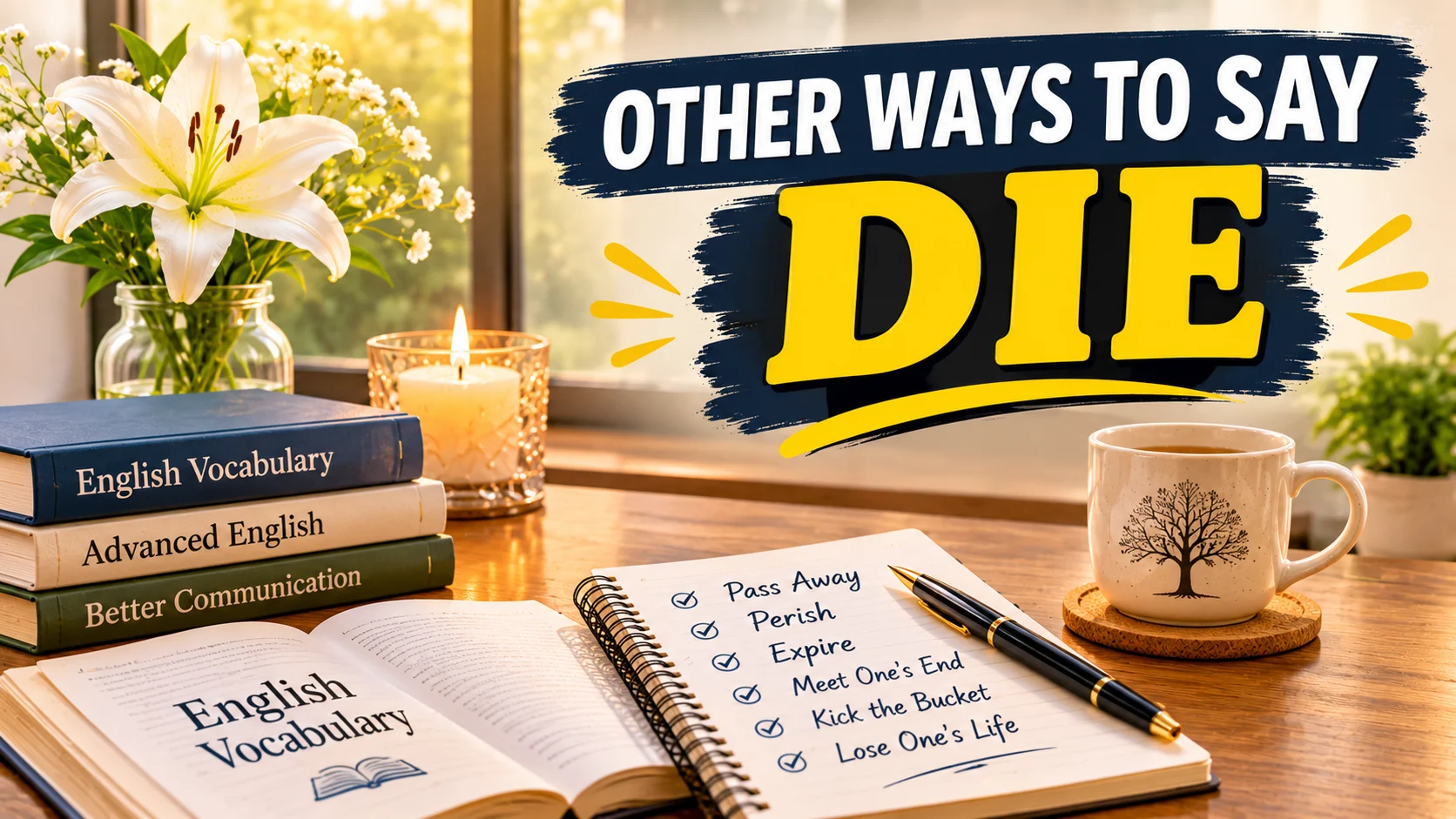
There are several ways to say die, depending on the situation, audience, and tone. Some alternatives sound gentle and respectful, while others are formal, literary, medical, or informal.
Top 5 alternatives: Pass away, lose one’s life, perish, succumb, meet one’s end.
Introduction
The word die describes the end of a person’s or living creature’s life. Although it is direct and widely understood, it can sometimes sound too blunt, especially when discussing someone’s death, expressing sympathy, or writing about a sensitive situation.
Learning different alternatives to die helps you communicate more thoughtfully and accurately. Expressions such as pass away sound gentle and respectful, while perish is more commonly associated with disasters, accidents, and tragic events. Other expressions, such as succumb to an illness, are appropriate for formal writing and news reporting.
Understanding other ways to say die also improves your vocabulary, writing fluency, and conversational confidence. Whether you are an English learner, a professional writer, or someone looking for a more considerate expression, choosing the right phrase makes a meaningful difference.
In this guide, you will discover 30 alternatives, their meanings, natural examples, and the situations where each expression works best.
Quick Categories: Formal, Casual, and Professional Alternatives
Choosing the right expression depends on how sensitive the situation is and how you want your message to sound.
Formal alternatives to “die”
- Decease
- Pass away
- Perish
- Succumb
These expressions are useful in formal documents, news reports, literature, and sensitive conversations.
Pro Tip: Use decease primarily in legal or administrative contexts. For respectful everyday communication, pass away is generally more natural.
Casual alternatives
- Pass on
- Be gone
- Meet one’s end
- Leave this world
These expressions are more conversational or figurative, although some can sound poetic rather than casual.
Pro Tip: Consider your relationship with the listener before using casual expressions about someone’s death. A gentle expression is usually safer in sensitive conversations.
Professional alternatives
- Lose one’s life
- Be pronounced dead
- Succumb to an illness
- Die from complications
These expressions are suitable for journalism, medical communication, reports, and professional writing.
Pro Tip: Choose precise wording in professional documents. Avoid euphemisms when readers need clear factual information.
Informal expressions
- Kick the bucket
- Bite the dust
- Croak
- Buy the farm
These expressions are generally humorous, idiomatic, or slang-based. They are not suitable for serious discussions about someone’s death.
Pro Tip: Informal expressions can be entertaining in fictional or humorous situations, but avoid them when expressing condolences.
“Good vocabulary is not just about knowing more words. It is about knowing which words belong in each situation.”
Common Mistakes When Using “Die”
Even advanced English learners sometimes confuse death-related expressions or use them in inappropriate situations.
Here are five common mistakes to avoid.
1. Using “Pass Away” in Every Situation
Pass away is a gentle expression, but it does not always communicate the seriousness or circumstances of a death.
Incorrect: Several people passed away in the explosion, according to the emergency report.
Better: Several people lost their lives in the explosion, according to the emergency report.
2. Using “Succumb” Without a Cause
The verb succumb commonly appears with to when identifying the condition, illness, or force that someone could not overcome.
Incorrect: He succumbed after a long illness.
Better: He succumbed to cancer after a long illness.
3. Confusing “Deceased” With “Decease”
Deceased is commonly used as an adjective or noun referring to someone who has died. Decease is a formal noun or verb.
Incorrect: The deceased of the patient was confirmed yesterday.
Better: The patient’s death was confirmed yesterday.
4. Using Slang in Formal Communication
Expressions such as kick the bucket and croak are inappropriate in most professional or condolence messages.
Incorrect: We are sorry that your grandfather kicked the bucket.
Better: We are deeply sorry for the loss of your grandfather.
5. Using “Be Killed” and “Die” Interchangeably
Die does not always explain how someone died. Be killed specifically indicates that an external person, event, or force caused the death.
Incorrect: He was killed peacefully in his sleep.
Better: He died peacefully in his sleep.
What Does “Die” Mean?
The word die means to stop living. It describes the permanent end of life in humans, animals, plants, and other living organisms.
It is a common English verb used in everyday conversations, literature, journalism, medical communication, and educational writing.
Example: The old tree began to die after years of drought.
Grammar Explanation
Die is an intransitive verb, meaning it normally does not take a direct object.
Its common grammatical forms are:
| Form | Word |
|---|---|
| Base form | Die |
| Third-person singular | Dies |
| Past tense | Died |
| Past participle | Died |
| Present participle | Dying |
Example sentences:
- Present: Some plants die without enough sunlight.
- Past: The patient died peacefully.
- Present continuous: The flowers are dying because of the heat.
- Present perfect: Several trees have died during the drought.
Important: The adjective dead describes someone or something that is no longer alive, while die describes the process or event.
When to Use “Die”
The word die is appropriate in many situations, but the best alternative depends on the purpose of your communication.
Common contexts
- Everyday conversations: Discussing death directly.
- News reporting: Describing fatalities and tragic incidents.
- Medical communication: Explaining a patient’s death.
- Literature: Creating emotional or dramatic descriptions.
- Historical writing: Describing the deaths of historical figures.
- Scientific writing: Discussing the life cycle of organisms.
Spoken vs. Written English
Spoken English: People often use die, pass away, and lose one’s life in everyday conversations.
Written English: Writers may choose perish, succumb, decease, or be pronounced dead, depending on the subject and level of formality.
Formal vs. Informal English
| Situation | Recommended Expression |
|---|---|
| Condolence message | Pass away |
| Legal document | Decease |
| News report | Lose one’s life |
| Medical report | Be pronounced dead |
| Literary writing | Depart this life |
| Humorous conversation | Kick the bucket |
Is It Professional or Polite to Say “Die”?
Yes. The word die is grammatically correct, professional in many factual contexts, and generally understandable. However, it can sound direct or emotionally harsh when discussing someone’s personal loss.
For example, a journalist can write:
“The passenger died at the scene of the accident.”
This is clear and appropriate factual reporting.
However, when communicating with a grieving person, a gentler expression is often preferable.
Business-style example:
“We regret to inform you that our former colleague passed away following a prolonged illness.”
Polite? Yes, when used respectfully and with sensitivity.
Professional? Yes, in factual and appropriate contexts, although gentler alternatives may be preferable when communicating condolences.
Pros and Cons of Using “Die”
Understanding the advantages and disadvantages of this word helps you decide when to use it.
Pros
- Simple and natural: It communicates the end of life directly.
- Friendly tone: In neutral contexts, it can sound straightforward rather than unnecessarily formal.
- Common usage: Most English speakers understand it immediately.
- Easy to understand: It avoids confusion when factual clarity matters.
Cons
- Too direct for sensitive situations: It may sound harsh when discussing personal loss.
- Overused: Repeating it can make writing less varied.
- Limited emotional range: It does not always communicate sympathy or sensitivity.
- Not suitable for every formal context: Certain documents and conversations benefit from more precise or respectful expressions.
“A direct word is not necessarily an impolite word. Context determines whether it is appropriate.”
Other Ways to Say “Die” (With Examples)
The following 30 expressions will help you expand your vocabulary and communicate more naturally in different situations.
Use each expression according to its meaning, tone, context, and audience. Remember that some alternatives are gentle euphemisms, while others are specific to medical, factual, literary, or informal communication.
1. Pass Away
Meaning: To die, expressed in a gentle and respectful way.
Explanation: This is one of the most widely used euphemisms for death, especially when discussing someone’s personal loss.
Example Sentence: My neighbor’s grandfather passed away peacefully last night.
Best Use: Condolences, conversations
Worst Use: Technical reports
Tone: Gentle, respectful, compassionate
Context Variability:
- Casual: Her uncle passed away last year.
- Professional: Our former director passed away on Monday.
- Spoken: I heard that your grandfather passed away.
2. Lose One’s Life
Meaning: To die, particularly because of an accident, illness, disaster, or dangerous situation.
Explanation: This expression is common in journalism and formal reporting because it communicates the seriousness of an event.
Example Sentence: Several passengers lost their lives in the tragic accident.
Best Use: News reporting, formal writing
Worst Use: Lighthearted conversations
Tone: Serious, factual, respectful
Context Variability:
- Casual: He lost his life in a terrible accident.
- Professional: Three workers lost their lives during the incident.
- Spoken: Sadly, she lost her life in the fire.
3. Perish
Meaning: To die, especially because of dangerous conditions, violence, or extreme circumstances.
Explanation: Perish is more formal and dramatic than die and frequently appears in news reports and literature.
Example Sentence: Many people perished during the devastating earthquake.
Best Use: Historical writing, disasters
Worst Use: Casual condolences
Tone: Formal, serious, dramatic
Context Variability:
- Casual: The explorers perished in the wilderness.
- Professional: Several residents perished in the disaster.
- Spoken: The entire expedition perished in the storm.
4. Succumb
Meaning: To die after failing to overcome an illness, injury, or another serious condition.
Explanation: This expression is generally followed by to and the cause of death.
Example Sentence: The patient succumbed to complications following surgery.
Best Use: Medical writing, news
Worst Use: Informal greetings
Tone: Formal, clinical, serious
Context Variability:
- Casual: He eventually succumbed to the disease.
- Professional: The patient succumbed to severe complications.
- Spoken: She succumbed to her illness after a long struggle.
5. Decease
Meaning: To die, or the formal event of someone’s death.
Explanation: Decease is primarily associated with legal, administrative, and formal language.
Example Sentence: The legal proceedings began following the decease of the property owner.
Best Use: Legal documents, administration
Worst Use: Everyday conversation
Tone: Formal, legal, technical
Context Variability:
- Casual: His decease was difficult for the family.
- Professional: The date of decease was recorded in the official document.
- Spoken: The term is uncommon in ordinary speech.
6. Depart This Life
Meaning: To die, expressed in a poetic or traditional way.
Explanation: This expression is often found in literature, religious contexts, and formal tributes.
Example Sentence: The respected author departed this life surrounded by loved ones.
Best Use: Tributes, literature
Worst Use: Medical reports
Tone: Poetic, respectful, traditional
Context Variability:
- Casual: He departed this life after a long journey.
- Professional: The memorial noted that she had departed this life peacefully.
- Spoken: It is a traditional expression used in remembrance.
7. Pass On
Meaning: To die, expressed in a softer and less direct way.
Explanation: This is a familiar euphemism that can be appropriate in personal conversations.
Example Sentence: Her beloved grandmother passed on several years ago.
Best Use: Personal conversations
Worst Use: Precise legal documents
Tone: Gentle, conversational, sympathetic
Context Variability:
- Casual: My old teacher passed on last winter.
- Professional: The family confirmed that their relative had passed on.
- Spoken: I am sorry to hear that your father passed on.
8. Meet One’s End
Meaning: To die, especially in a particular or dramatic way.
Explanation: This expression is often used in storytelling, historical accounts, and dramatic descriptions.
Example Sentence: The villain finally met his end during the final battle.
Best Use: Fiction, storytelling
Worst Use: Condolence messages
Tone: Dramatic, literary, serious
Context Variability:
- Casual: The character met his end in the final scene.
- Professional: The historical figure met his end during the conflict.
- Spoken: He met his end during the battle.
9. Be No More
Meaning: To no longer be alive or exist.
Explanation: This expression is indirect and often appears in poetic, literary, or emotional writing.
Example Sentence: The legendary musician was no more, but his music continued to inspire millions.
Best Use: Literature, tributes
Worst Use: Medical documentation
Tone: Poetic, emotional, reflective
Context Variability:
- Casual: The old legend was no more.
- Professional: The report stated that the individual was no longer alive.
- Spoken: She is no longer with us.
10. Expire
Meaning: To die, particularly in medical or clinical language.
Explanation: This term can sound impersonal when referring to a human being, so it should be used carefully.
Example Sentence: The patient expired shortly after arriving at the hospital.
Best Use: Clinical documentation
Worst Use: Condolences
Tone: Clinical, formal, impersonal
Context Variability:
- Casual: The expression can sound cold in personal conversation.
- Professional: The patient expired at 8:30 p.m.
- Spoken: Medical professionals may use it in clinical settings.
11. Be Killed
Meaning: To die because of an external action, person, or event.
Explanation: This expression emphasizes that something or someone caused the death.
Example Sentence: The firefighter was killed while rescuing people from the building.
Best Use: News, factual reporting
Worst Use: Peaceful death descriptions
Tone: Direct, serious, factual
Context Variability:
- Casual: He was killed in the accident.
- Professional: The employee was killed during the industrial incident.
- Spoken: Several people were killed in the crash.
12. Be Pronounced Dead
Meaning: To be officially declared dead by an authorized medical professional.
Explanation: This phrase refers to the formal confirmation of death rather than the exact moment a person died.
Example Sentence: The patient was pronounced dead at the hospital.
Best Use: Medical reports, news
Worst Use: Casual conversation
Tone: Clinical, official, factual
Context Variability:
- Casual: He was pronounced dead after reaching the hospital.
- Professional: The patient was pronounced dead at 11:15 a.m.
- Spoken: The doctor pronounced him dead.
13. Die Peacefully
Meaning: To die without apparent distress or struggle.
Explanation: This expression emphasizes the circumstances surrounding someone’s death rather than replacing the meaning of die entirely.
Example Sentence: Her grandmother died peacefully in her sleep.
Best Use: Family tributes
Worst Use: Violent death descriptions
Tone: Gentle, reassuring, respectful
Context Variability:
- Casual: He died peacefully at home.
- Professional: The resident died peacefully under hospice care.
- Spoken: She died peacefully, surrounded by family.
14. Give Up the Ghost
Meaning: To die, or for something to stop working completely.
Explanation: This idiomatic expression can refer to a person’s death or a machine that has stopped functioning.
Example Sentence: The old engine finally gave up the ghost after decades of use.
Best Use: Idioms, storytelling
Worst Use: Formal condolences
Tone: Idiomatic, informal, humorous
Context Variability:
- Casual: The old computer finally gave up the ghost.
- Professional: The expression is generally avoided in formal reports.
- Spoken: His grandfather’s old car finally gave up the ghost.
15. Kick the Bucket
Meaning: To die, expressed through an informal and often humorous idiom.
Explanation: This phrase is commonly used in jokes and casual conversations, but it can sound disrespectful when discussing someone’s actual death.
Example Sentence: In the comedy, the elderly millionaire jokes that he might kick the bucket someday.
Best Use: Humor, fiction
Worst Use: Sympathy messages
Tone: Humorous, informal, blunt
Context Variability:
- Casual: He joked that he would kick the bucket one day.
- Professional: Avoid this expression in business writing.
- Spoken: The character kicked the bucket in the final episode.
16. Bite the Dust
Meaning: To die or suffer a final defeat.
Explanation: This informal idiom is often used figuratively for defeat, failure, or the end of something.
Example Sentence: The fictional warrior bit the dust during the final battle.
Best Use: Fiction, informal humor
Worst Use: Serious discussions
Tone: Informal, dramatic, humorous
Context Variability:
- Casual: The villain finally bit the dust.
- Professional: The project failed after several setbacks.
- Spoken: Their team bit the dust in the championship.
17. Croak
Meaning: To die, expressed in very informal or slang language.
Explanation: Although sometimes used humorously, croak can sound insensitive when referring to a real person’s death.
Example Sentence: The character joked that he would croak if he had to work another night.
Best Use: Fiction, casual humor
Worst Use: Condolences
Tone: Slang, blunt, humorous
Context Variability:
- Casual: He joked that he might croak from exhaustion.
- Professional: This expression is inappropriate in most formal reports.
- Spoken: The old character finally croaked in the movie.
18. Buy the Farm
Meaning: To die, particularly in an accident or military-related context.
Explanation: This is an American English idiom with an informal and sometimes darkly humorous tone.
Example Sentence: In the movie, the pilot jokes that he does not want to buy the farm.
Best Use: American slang, fiction
Worst Use: Formal writing
Tone: Informal, humorous, idiomatic
Context Variability:
- Casual: The soldier joked about buying the farm.
- Professional: Use lose one’s life instead.
- Spoken: He bought the farm in the final scene.
19. Leave This World
Meaning: To die, expressed in a gentle or poetic way.
Explanation: This phrase emphasizes the end of someone’s life while avoiding the direct word die.
Example Sentence: She left this world surrounded by the people she loved.
Best Use: Tributes, personal writing
Worst Use: Technical reports
Tone: Emotional, gentle, poetic
Context Variability:
- Casual: He left this world peacefully.
- Professional: The tribute described her final days respectfully.
- Spoken: She left this world with her family beside her.
20. Go to One’s Eternal Rest
Meaning: To die and enter a state of eternal rest, often expressed through religious or traditional language.
Explanation: This expression is commonly associated with memorials, religious writing, and solemn tributes.
Example Sentence: The community gathered to remember the beloved leader who had gone to his eternal rest.
Best Use: Memorials, religious writing
Worst Use: Clinical reports
Tone: Traditional, solemn, spiritual
Context Variability:
- Casual: He has gone to his eternal rest.
- Professional: The memorial used traditional language to honor her.
- Spoken: May she go to her eternal rest.
21. Meet One’s Maker
Meaning: To die and, in religious or figurative language, face one’s creator.
Explanation: This expression often carries a religious or dramatic meaning and can also be used humorously.
Example Sentence: The fictional villain believed he would eventually meet his maker.
Best Use: Religious writing, fiction
Worst Use: Sensitive condolences
Tone: Religious, dramatic, figurative
Context Variability:
- Casual: The character finally met his maker.
- Professional: Use a more neutral expression in reports.
- Spoken: Everyone eventually meets their maker.
22. Go to a Better Place
Meaning: To die, described through the belief or hope that the deceased has entered a peaceful place.
Explanation: This expression is often used to comfort grieving people, although beliefs about the afterlife differ.
Example Sentence: Her family found comfort in believing that she had gone to a better place.
Best Use: Condolences, personal messages
Worst Use: Neutral medical reporting
Tone: Comforting, hopeful, emotional
Context Variability:
- Casual: We hope he has gone to a better place.
- Professional: The phrase is more appropriate for personal tributes.
- Spoken: I hope she is in a better place now.
23. Meet a Tragic End
Meaning: To die under unfortunate or tragic circumstances.
Explanation: This expression emphasizes the tragic nature of someone’s death.
Example Sentence: The young explorer met a tragic end during the dangerous expedition.
Best Use: Historical writing, storytelling
Worst Use: Gentle condolences
Tone: Dramatic, serious, emotional
Context Variability:
- Casual: The character met a tragic end.
- Professional: The report described how the victim met a tragic end.
- Spoken: He met a tragic end during the expedition.
24. Fall in Battle
Meaning: To die while fighting in a war or armed conflict.
Explanation: This expression is traditionally used to describe soldiers who die during combat.
Example Sentence: Many brave soldiers fell in battle while defending their country.
Best Use: Military history, literature
Worst Use: Ordinary medical situations
Tone: Respectful, historical, solemn
Context Variability:
- Casual: The soldier fell in battle.
- Professional: The historical account documented those who fell in battle.
- Spoken: He fell in battle while protecting his fellow soldiers.
25. Be Lost
Meaning: To die, especially in circumstances where a person is missing or their death is being described indirectly.
Explanation: This expression is frequently used in memorials and reports, but its meaning depends heavily on context.
Example Sentence: The community mourned the lives lost during the disaster.
Best Use: Memorials, disaster reports
Worst Use: Precise medical statements
Tone: Somber, respectful, indirect
Context Variability:
- Casual: We lost a dear friend last year.
- Professional: Many lives were lost in the earthquake.
- Spoken: Several people were lost during the tragedy.
26. Be Taken by Death
Meaning: To die, expressed in a dramatic or poetic way.
Explanation: This is a figurative expression that emphasizes death as a force that removes someone from life.
Example Sentence: The community remembered the beloved poet who was taken by death too soon.
Best Use: Poetry, dramatic writing
Worst Use: Everyday professional communication
Tone: Poetic, emotional, dramatic
Context Variability:
- Casual: The family mourned the person taken by death.
- Professional: Use passed away in a personal tribute.
- Spoken: It is an uncommon literary expression.
27. Succumb to Injuries
Meaning: To die because of injuries that cannot be overcome.
Explanation: This is a specific variation of succumb that is especially common in news and medical reporting.
Example Sentence: The injured passenger succumbed to his injuries at the hospital.
Best Use: Medical news, reports
Worst Use: Light conversation
Tone: Clinical, serious, factual
Context Variability:
- Casual: He succumbed to his injuries.
- Professional: The patient succumbed to multiple traumatic injuries.
- Spoken: Sadly, she succumbed to her injuries.
28. Die of Natural Causes
Meaning: To die because of natural processes, illness, or age rather than an external violent event.
Explanation: This phrase is used when the circumstances of death are understood to be natural.
Example Sentence: The elderly man died of natural causes at home.
Best Use: News, factual writing
Worst Use: Violent death descriptions
Tone: Neutral, factual, formal
Context Variability:
- Casual: Her grandfather died of natural causes.
- Professional: The death was attributed to natural causes.
- Spoken: The doctor confirmed that he died of natural causes.
29. Be Taken from Us
Meaning: To die, described as a painful loss for family, friends, or a community.
Explanation: This expression focuses on the emotional impact of someone’s death rather than the circumstances.
Example Sentence: Our beloved teacher was taken from us far too soon.
Best Use: Memorials, tributes
Worst Use: Medical reports
Tone: Emotional, respectful, sympathetic
Context Variability:
- Casual: Our friend was taken from us too soon.
- Professional: The organization expressed sadness over the loss of its former director.
- Spoken: She was taken from us far too early.
30. Join the Departed
Meaning: To die and become one of those who have already died.
Explanation: This is a literary and solemn expression, generally used in poetic or traditional writing.
Example Sentence: The writer described the old king as having joined the departed.
Best Use: Literature, poetry
Worst Use: Everyday conversation
Tone: Literary, solemn, traditional
Context Variability:
- Casual: The character joined the departed.
- Professional: A neutral phrase such as passed away is more suitable.
- Spoken: This expression is uncommon in modern everyday English.
Scroll-Stopping Highlights: Choosing the Right Expression
“Pass away” is usually a considerate choice when discussing someone’s personal loss.
“Lose one’s life” is particularly useful when describing accidents, disasters, and tragic events.
“Succumb to” helps explain that someone died after being unable to overcome an illness or injury.
“Kick the bucket” is an idiom for humorous or informal situations, not serious condolences.
Mini Quiz: Test Your Understanding
Check how well you understand the different expressions and their appropriate contexts.
Question 1: Which expression is generally the most respectful when discussing someone’s death with a grieving family?
A. Kick the bucket
B. Pass away
C. Croak
D. Bite the dust
Correct Answer: B. Pass away
Explanation: Pass away is a gentle and widely accepted euphemism for death.
Question 2: Which expression is most appropriate for a medical report?
A. Buy the farm
B. Bite the dust
C. Be pronounced dead
D. Give up the ghost
Correct Answer: C. Be pronounced dead
Explanation: This phrase describes the official confirmation of death by an authorized medical professional.
Question 3: Complete the sentence: “The patient eventually ________ to complications following surgery.”
A. Succumbed
B. Kicked
C. Departed
D. Bit
Correct Answer: A. Succumbed
Explanation: Succumbed to complications is a grammatically correct and natural expression.
Question 4: Which expression is inappropriate for a formal condolence message?
A. Passed away
B. Lost his life
C. Kicked the bucket
D. Departed this life
Correct Answer: C. Kicked the bucket
Explanation: It is an informal idiom that can sound insensitive when someone is grieving.
Comparison Table: Top Alternatives to “Die”
Here is a quick comparison of ten useful expressions and their typical applications.
| Phrase | Tone | Best Use |
|---|---|---|
| Pass away | Gentle | Condolences |
| Lose one’s life | Serious | News reports |
| Perish | Formal | Disasters |
| Succumb | Clinical | Medical writing |
| Decease | Legal | Official records |
| Depart this life | Poetic | Tributes |
| Pass on | Gentle | Conversations |
| Be pronounced dead | Official | Medical reports |
| Meet one’s end | Dramatic | Storytelling |
| Die of natural causes | Neutral | Factual reporting |
FAQs
1. What is the most polite way to say die?
Pass away is generally one of the most polite and widely accepted alternatives. It sounds gentle and respectful, making it suitable for condolences and personal conversations.
2. What is a professional word for die?
Decease, succumb, and lose one’s life are useful professional alternatives, depending on the context. Medical and legal writing may require more precise terminology.
3. How can I say someone died without using the word die?
You can say passed away, is no longer with us, lost their life, or departed this life. Choose an expression that matches the situation and your relationship with the listener.
4. What are some informal expressions for die?
Common informal expressions include kick the bucket, bite the dust, croak, buy the farm, and give up the ghost. These expressions are generally better suited to humor and fictional situations than serious discussions.
5. Is “passed away” more respectful than “died”?
In conversations about personal loss, passed away often sounds gentler than died. However, died is not inherently disrespectful and is frequently preferable when clear, factual communication is necessary.
Conclusion
Learning different expressions for death allows you to communicate with greater clarity, sensitivity, and confidence. From gentle alternatives such as pass away to professional expressions such as succumb to an illness, each phrase has a particular purpose. Understanding these differences helps you choose words that fit the situation instead of relying on the same expression repeatedly.
Practice these alternatives in everyday English, reading, and writing. Pay attention to the relationship between the speaker and listener, the seriousness of the situation, and whether the communication is formal or informal. The right vocabulary will make your English more natural, accurate, and respectful.