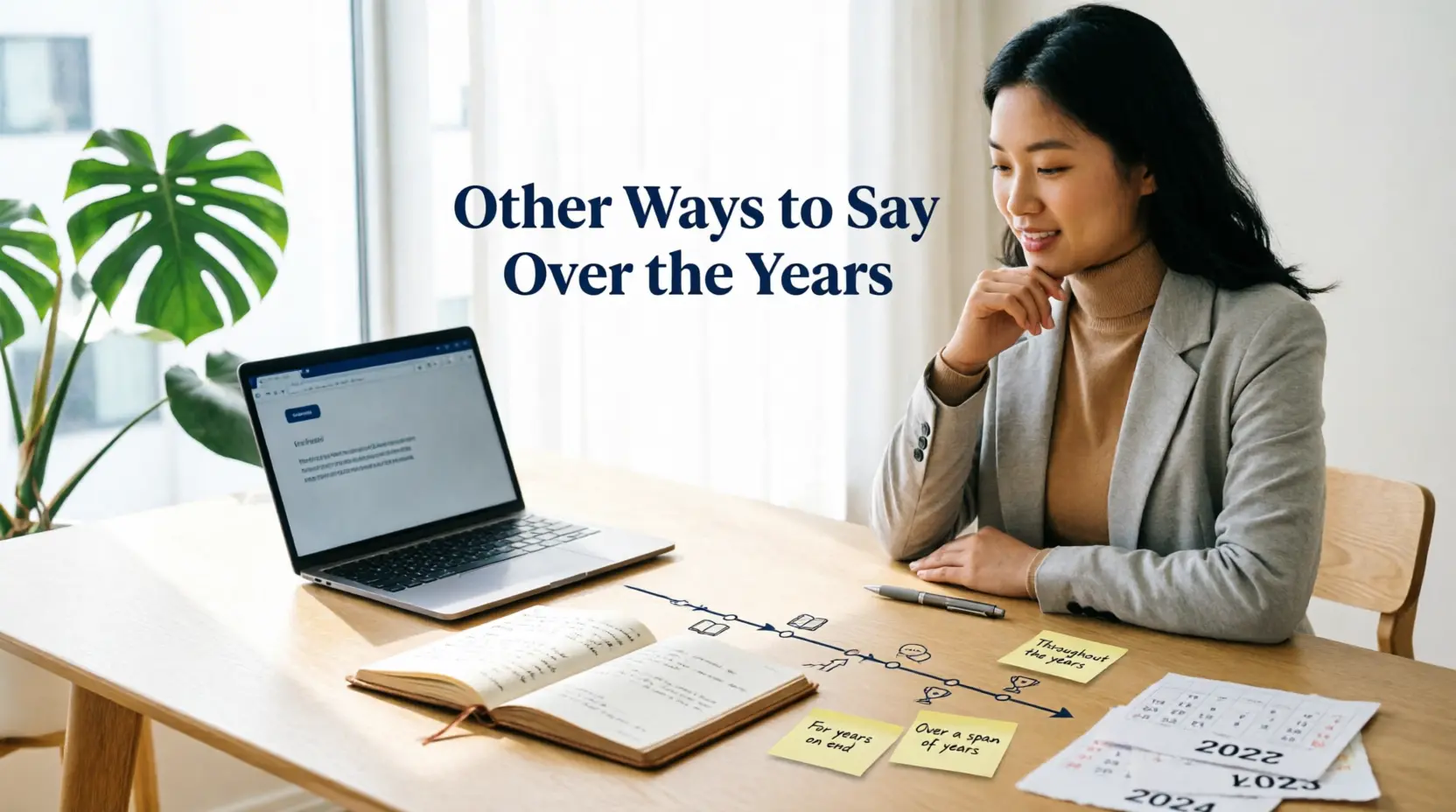
Over the years means “during a period of several years” and is commonly used to describe gradual change, development, experience, or events that happened across time. Useful alternatives include throughout the years, over time, throughout the years, in recent years, and across the years.
Top alternatives: Over time, Throughout the years, Throughout the years, In recent years, Across the years
The phrase over the years is commonly used to describe something that has happened, changed, or developed over several years. It is useful when discussing personal experiences, professional growth, relationships, skills, or social changes. Learning other ways to say over the years can make your English more varied, natural, and precise.
Different alternatives suit different contexts. Over time is flexible, throughout the years emphasizes continuity, and in recent years focuses on recent changes. Understanding these differences can improve your spoken and written English, strengthen professional communication, and help you express excitement in English when talking about progress or achievements.
Quick Categories
Formal alternatives to “other ways to say over the years”
- Throughout the years
- Over the course of the years
- Across the years
- Throughout this period
These expressions are suitable for academic writing, historical discussions, formal reports, and detailed analysis.
Pro Tip: Use throughout this period when the exact time period has already been clearly established.
Casual alternatives
- Over time
- As time went by
- As the years passed
- With time
These alternatives sound natural in everyday conversations and personal writing.
Pro Tip: Over time is the easiest general purpose alternative because it works in both casual and professional contexts.
Professional alternatives
- In recent years
- Over the course of time
- During this period
- In the years since
These expressions work well in business reports, presentations, professional emails, and workplace discussions.
Pro Tip: Choose in recent years when you specifically mean the relatively recent past rather than an unspecified long period.
Informal expressions
- As the years went by
- As time passed
- Year after year
- As the years rolled on
These expressions are more conversational and can add a personal or narrative quality.
Pro Tip: Use informal expressions in English when telling stories or describing personal experiences, but avoid overly conversational wording in formal reports.
“The best time expression depends on whether you are emphasizing duration, change, or a specific period.”
Common Mistakes
1. Using “over the years” for a very short period
Mistake: Using the phrase for days or a few weeks.
Example: “Over the years, I have worked here for three months.”
Better: “Over the past three months, I have worked here.”
2. Confusing “over time” with a specific period
Mistake: Assuming over time always identifies a particular number of years.
Example: “Over time, between 2018 and 2020, sales increased.”
Better: “Between 2018 and 2020, sales increased.”
3. Using “in recent years” for distant history
Mistake: Using in recent years when discussing events from many decades ago.
Example: “In recent years, the Roman Empire expanded.”
Better: “Over the centuries, the Roman Empire changed significantly.”
4. Using “year after year” for a single event
Mistake: Using it when something happened only once.
Example: “Year after year, she attended the conference once in 2024.”
Better: “In 2024, she attended the conference.”
5. Confusing “throughout” with “over”
Mistake: Using throughout the years when you only mean that something happened at some point during the period.
Example: “Throughout the years, I visited London twice.”
Better: “Over the years, I visited London twice.”
Throughout often suggests continuity or repeated presence across the entire period.
What Does “Over the Years” Mean?
Over the years means during a period of several years, usually emphasizing gradual development, change, or accumulated experience.
It is commonly used with the present perfect when discussing something that began in the past and remains relevant.
Example: “She has gained valuable experience over the years.”
The phrase is an adverbial time expression and commonly appears at the beginning or end of a sentence.
When to Use “Over the Years”
Use over the years when:
• Describing gradual changes
• Talking about accumulated experience
• Discussing personal development
• Explaining professional growth
• Describing changes in relationships
• Discussing historical or social developments
• Showing how something has evolved
Spoken vs Written
Spoken English: Very natural and common.
Written English: Suitable for essays, articles, reports, biographies, and personal writing.
Formal vs Informal
Formal: “The organization has expanded significantly over the years.”
Neutral: “The company has changed a lot over the years.”
Casual: “Things have really changed as the years went by.”
“Use ‘over time’ for flexibility and ‘throughout the years’ when continuity matters.”
Is It Professional or Polite to Say “Over the Years”?
Polite? Yes
Professional? Yes
Over the years is a neutral expression and is completely acceptable in professional communication. It is commonly used in reports, presentations, business writing, and workplace conversations.
Business Example:
“Over the years, our company has developed a stronger approach to customer service.”
Pros and Cons of Using “Over the Years”
Pros
• Simple and natural
• Friendly tone
• Common usage
• Easy to understand
Cons
• Can become repetitive
• May be vague about the exact period
• Limited precision in technical writing
• Not always suitable when a specific timeframe matters
Other Ways to Say “Over the Years” With Examples
These alternatives will help you sound more fluent, confident, and natural in different situations.
Use them according to tone, context, and audience to describe development, duration, change, or experience.
1. Phrase: Over Time
Meaning: During the gradual passage of time.
Explanation: It is one of the most flexible alternatives and often describes gradual change.
Example Sentence: “Over time, the team developed a more efficient process.”
Best Use: Gradual change
Worst Use: Exact dates
Tone: Neutral, versatile, professional
Context Variability: Casual: “People change over time.” Professional: “Customer preferences have changed over time.” Spoken: “It gets easier over time.”
2. Phrase: Throughout the Years
Meaning: During the whole or most of a period lasting several years.
Explanation: It emphasizes continuity or repeated activity across the years.
Example Sentence: “Throughout the years, the organization has supported thousands of students.”
Best Use: Long term development
Worst Use: One event
Tone: Formal, reflective, neutral
Context Variability: Casual: Possible. Professional: Excellent. Spoken: Natural.
3. Phrase: Throughout the Years
Meaning: Across a continuing period of years.
Explanation: It is useful when something has remained present or happened repeatedly over a long period.
Example Sentence: “Throughout the years, she remained committed to improving her skills.”
Best Use: Continuous activity
Worst Use: Short period
Tone: Formal, steady, reflective
Context Variability: Casual: Natural. Professional: Suitable. Spoken: Common.
4. Phrase: In Recent Years
Meaning: During the relatively recent past.
Explanation: It is more specific than over the years because it focuses on recent developments.
Example Sentence: “In recent years, remote work has become increasingly common.”
Best Use: Recent trends
Worst Use: Ancient history
Tone: Professional, neutral, precise
Context Variability: Casual: Common. Professional: Excellent. Spoken: Natural.
5. Phrase: Across the Years
Meaning: During different periods over several years.
Explanation: It highlights development or change across time.
Example Sentence: “The company has introduced several successful products across the years.”
Best Use: Long term change
Worst Use: Short duration
Tone: Formal, reflective, descriptive
Context Variability: Casual: Possible. Professional: Suitable. Spoken: Less common.
6. Phrase: As the Years Passed
Meaning: As time moved forward through successive years.
Explanation: It often emphasizes gradual personal or historical change.
Example Sentence: “As the years passed, his confidence grew.”
Best Use: Personal growth
Worst Use: Business statistics
Tone: Reflective, narrative, natural
Context Variability: Casual: Very natural. Professional: Suitable in narratives. Spoken: Common.
7. Phrase: As the Years Went By
Meaning: During the gradual passage of several years.
Explanation: It has a conversational and narrative quality.
Example Sentence: “As the years went by, they became close friends.”
Best Use: Personal stories
Worst Use: Technical reports
Tone: Conversational, warm, narrative
Context Variability: Casual: Excellent. Professional: Limited. Spoken: Very natural.
8. Phrase: As Time Passed
Meaning: During the period in which time gradually moved forward.
Explanation: It is useful for describing gradual changes or developments.
Example Sentence: “As time passed, the situation became easier to manage.”
Best Use: Gradual development
Worst Use: Exact timeframe
Tone: Neutral, reflective, natural
Context Variability: Casual: Natural. Professional: Suitable. Spoken: Common.
9. Phrase: With Time
Meaning: As time progresses.
Explanation: It often suggests that a change happens gradually.
Example Sentence: “With time, employees became more comfortable with the new system.”
Best Use: Gradual improvement
Worst Use: Fixed deadlines
Tone: Neutral, concise, natural
Context Variability: Casual: Common. Professional: Suitable. Spoken: Very natural.
10. Phrase: Over the Course of Time
Meaning: During a period as time progresses.
Explanation: It is a more formal and extended version of over time.
Example Sentence: “The process became more efficient over the course of time.”
Best Use: Formal writing
Worst Use: Casual conversation
Tone: Formal, measured, professional
Context Variability: Casual: Uncommon. Professional: Suitable. Spoken: Formal.
11. Phrase: Over the Course of the Years
Meaning: During a period extending across several years.
Explanation: It explicitly emphasizes the length of the period.
Example Sentence: “The organization expanded over the course of the years.”
Best Use: Historical writing
Worst Use: Short periods
Tone: Formal, descriptive, academic
Context Variability: Casual: Less common. Professional: Useful. Spoken: Formal.
12. Phrase: During the Years
Meaning: At various points within a period of years.
Explanation: It is useful when referring to events that occurred within a defined period.
Example Sentence: “During the years that followed, the company expanded internationally.”
Best Use: Historical sequence
Worst Use: General change
Tone: Neutral, formal, clear
Context Variability: Casual: Possible. Professional: Excellent. Spoken: Natural.
13. Phrase: During This Period
Meaning: Within the specific period currently being discussed.
Explanation: It is especially useful when the timeframe has already been established.
Example Sentence: “During this period, the team introduced several new initiatives.”
Best Use: Defined timeframe
Worst Use: Unspecified time
Tone: Formal, precise, professional
Context Variability: Casual: Possible. Professional: Excellent. Spoken: Suitable.
14. Phrase: In the Years Since
Meaning: From a particular past event until now or another reference point.
Explanation: It connects the present with a clearly identified past event.
Example Sentence: “In the years since the merger, the company has grown significantly.”
Best Use: Since an event
Worst Use: No reference point
Tone: Professional, precise, formal
Context Variability: Casual: Natural. Professional: Excellent. Spoken: Common.
15. Phrase: Since Then
Meaning: From a particular past time until now or another point in time.
Explanation: It works best when the earlier event has already been mentioned.
Example Sentence: “She moved to Canada in 2020 and has worked there since then.”
Best Use: Past reference
Worst Use: First mention
Tone: Neutral, concise, natural
Context Variability: Casual: Very common. Professional: Suitable. Spoken: Excellent.
16. Phrase: Year After Year
Meaning: Repeatedly every year for several years.
Explanation: It emphasizes repetition rather than general passage of time.
Example Sentence: “Year after year, the company has exceeded its sales targets.”
Best Use: Repeated success
Worst Use: One event
Tone: Emphatic, natural, expressive
Context Variability: Casual: Common. Professional: Suitable. Spoken: Natural.
17. Phrase: Year by Year
Meaning: Gradually from one year to the next.
Explanation: It often emphasizes measurable or gradual progress.
Example Sentence: “The number of users increased year by year.”
Best Use: Measured growth
Worst Use: Sudden changes
Tone: Neutral, analytical, clear
Context Variability: Casual: Possible. Professional: Excellent. Spoken: Suitable.
18. Phrase: From Year to Year
Meaning: As one year changes into another.
Explanation: It is often used when comparing annual changes.
Example Sentence: “The company’s revenue has increased from year to year.”
Best Use: Annual comparison
Worst Use: Daily events
Tone: Formal, analytical, precise
Context Variability: Casual: Possible. Professional: Excellent. Spoken: Suitable.
19. Phrase: Over the Past Few Years
Meaning: During the most recent several years.
Explanation: It gives a more specific timeframe than over the years.
Example Sentence: “Over the past few years, demand for online learning has increased.”
Best Use: Recent change
Worst Use: Distant history
Tone: Neutral, professional, clear
Context Variability: Casual: Very natural. Professional: Excellent. Spoken: Common.
20. Phrase: Over the Past Decade
Meaning: During approximately the last ten years.
Explanation: It is useful when a decade provides a meaningful timeframe.
Example Sentence: “Over the past decade, technology has transformed the workplace.”
Best Use: Ten year period
Worst Use: Short periods
Tone: Formal, precise, professional
Context Variability: Casual: Natural. Professional: Excellent. Spoken: Common.
21. Phrase: Across the Decades
Meaning: During multiple decades.
Explanation: It is appropriate for long term historical or social changes.
Example Sentence: “Across the decades, attitudes toward education have changed.”
Best Use: Historical change
Worst Use: Recent events
Tone: Formal, historical, reflective
Context Variability: Casual: Possible. Professional: Useful. Spoken: Formal.
22. Phrase: Over the Decades
Meaning: During a period covering several decades.
Explanation: It emphasizes significant long term development.
Example Sentence: “Over the decades, the city has transformed dramatically.”
Best Use: Long history
Worst Use: Short period
Tone: Formal, descriptive, historical
Context Variability: Casual: Natural. Professional: Excellent. Spoken: Suitable.
23. Phrase: In the Years That Followed
Meaning: During the years after a previously mentioned event.
Explanation: It is particularly useful for chronological narratives.
Example Sentence: “The company launched its first product in 2010. In the years that followed, it expanded globally.”
Best Use: Historical sequence
Worst Use: Present trends
Tone: Formal, narrative, polished
Context Variability: Casual: Possible. Professional: Excellent. Spoken: Formal.
24. Phrase: In the Years Ahead
Meaning: During future years.
Explanation: Unlike over the years, this phrase refers to the future.
Example Sentence: “In the years ahead, we expect demand to increase.”
Best Use: Future planning
Worst Use: Past events
Tone: Professional, optimistic, forward looking
Context Variability: Casual: Natural. Professional: Excellent. Spoken: Common.
25. Phrase: As Time Went On
Meaning: As time gradually progressed.
Explanation: It is a natural narrative expression for gradual changes.
Example Sentence: “As time went on, the team developed greater confidence.”
Best Use: Personal narrative
Worst Use: Technical data
Tone: Conversational, reflective, natural
Context Variability: Casual: Excellent. Professional: Sometimes suitable. Spoken: Very natural.
26. Phrase: In the Course of the Years
Meaning: During the progression of several years.
Explanation: It is a formal expression that works best in literary or historical writing.
Example Sentence: “In the course of the years, the institution developed a strong reputation.”
Best Use: Formal narrative
Worst Use: Casual speech
Tone: Formal, literary, traditional
Context Variability: Casual: Uncommon. Professional: Limited. Spoken: Formal.
27. Phrase: Over an Extended Period
Meaning: During a relatively long period of time.
Explanation: It is useful when the exact number of years is not important.
Example Sentence: “The study examined changes over an extended period.”
Best Use: Research writing
Worst Use: Casual stories
Tone: Formal, academic, precise
Context Variability: Casual: Uncommon. Professional: Excellent. Spoken: Formal.
28. Phrase: Over a Long Period
Meaning: During a lengthy period of time.
Explanation: It emphasizes duration without specifying an exact timeframe.
Example Sentence: “The policy has evolved over a long period.”
Best Use: Long term change
Worst Use: Exact dates
Tone: Neutral, formal, clear
Context Variability: Casual: Natural. Professional: Excellent. Spoken: Common.
29. Phrase: Throughout This Time
Meaning: During the entire period under discussion.
Explanation: It emphasizes continuity during a particular timeframe.
Example Sentence: “Throughout this time, the researchers continued collecting data.”
Best Use: Continuous activity
Worst Use: Isolated events
Tone: Formal, precise, continuous
Context Variability: Casual: Possible. Professional: Excellent. Spoken: Suitable.
30. Phrase: As the Years Rolled On
Meaning: As several years gradually passed.
Explanation: It is a more expressive and informal way to describe the passage of time.
Example Sentence: “As the years rolled on, the small business became a respected local brand.”
Best Use: Storytelling
Worst Use: Formal reports
Tone: Informal, expressive, narrative
Context Variability: Casual: Excellent. Professional: Limited. Spoken: Natural.
“Precision matters: ‘in recent years’ identifies a recent period, while ‘over the years’ leaves the timeframe broader.”
How to Choose the Right Alternative
When discussing gradual change
Use:
• Over time
• As time passed
• With time
• As the years went by
When discussing recent trends
Use:
• In recent years
• Over the past few years
• In the years since
When discussing long historical periods
Use:
• Across the decades
• Over the decades
• Over an extended period
When discussing repeated annual activity
Use:
• Year after year
• Year by year
• From year to year
When writing professionally
Use:
• Over time
• In recent years
• During this period
• Over the past decade
Mini Quiz and Self Check
1. Which phrase is best for a recent trend?
A. Across the decades
B. In recent years
C. In the course of the years
D. As the years rolled on
Answer: B. In recent years
2. Which expression emphasizes repetition every year?
A. Year after year
B. Since then
C. During this period
D. Over time
Answer: A. Year after year
3. Which phrase is most appropriate for a professional report?
A. As the years rolled on
B. Over the past decade
C. As time went on
D. As the years went by
Answer: B. Over the past decade
4. You are describing gradual improvement without specifying a timeframe. Which option works best?
A. Over time
B. In 2019
C. Year after year
D. In the years ahead
Answer: A. Over time
Comparison Table: Top Alternatives
| Phrase | Tone | Best Use |
|---|---|---|
| Over time | Neutral, versatile | Gradual change |
| Throughout the years | Formal, reflective | Long term continuity |
| In recent years | Professional, precise | Recent trends |
| As the years passed | Reflective, natural | Personal development |
| As the years went by | Conversational, warm | Storytelling |
| Over the past few years | Neutral, clear | Recent changes |
| Year after year | Expressive, emphatic | Repeated activity |
| Year by year | Analytical, neutral | Measured progress |
| Over the past decade | Formal, precise | Ten year period |
| During this period | Formal, professional | Defined timeframe |
FAQs
What are the best other ways to say “over the years”?
The most useful alternatives include over time, throughout the years, in recent years, as the years passed, and over the past few years. The best option depends on the timeframe and context.
What is a professional way to say “over the years”?
Over time, in recent years, during this period, and over the past decade are excellent choices for professional English.
Is “over the years” formal or informal?
Over the years is neutral. It can be used naturally in casual conversation as well as professional writing, reports, presentations, and essays.
What is the difference between “over the years” and “over time”?
Over the years usually refers to a period lasting several years, while over time is broader and simply emphasizes gradual change as time passes.
Can I use “throughout the years” instead of “over the years”?
Yes, but there is a slight difference. Throughout the years often emphasizes continuity or repeated activity across the period, while over the years is more general.
Conclusion
Learning other ways to say over the years gives you more flexibility when describing time, progress, experience, and change. Expressions such as over time, in recent years, throughout the years, and over the past decade can make your English more precise and prevent repetitive writing.
Practice these expressions in your daily speaking and writing. Pay attention to whether you are discussing recent events, gradual development, repeated activity, or a long historical period. Choosing the right expression for the context will make your English sound more natural, confident, and professional.
CTA: Which alternative to “over the years” do you use most often? Share your favorite phrase and an example sentence.