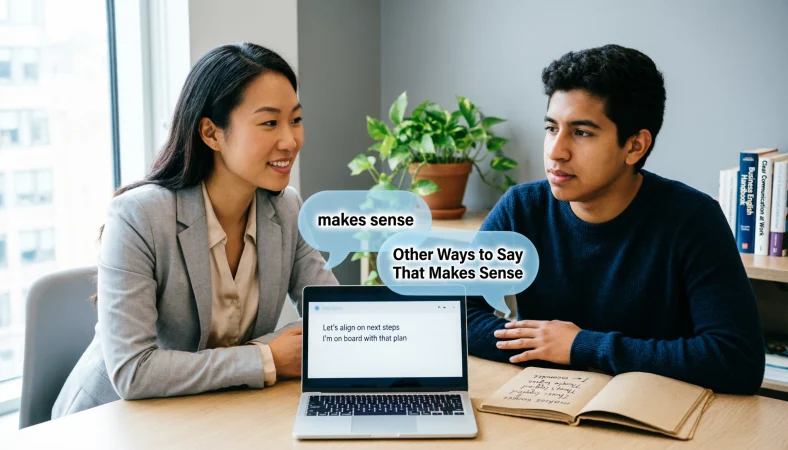
The phrase “that makes sense” means that something is logical, understandable, or reasonable. Useful alternatives include I understand, that is logical, I see your point, that seems reasonable, and I follow your reasoning.
Top alternative: I Understand — the clearest, most versatile, and professional alternative to “that makes sense.”
“That makes sense” is a common English expression used to show that you understand an explanation, agree that an idea is logical, or recognize why something happened. It is especially useful in everyday conversations, meetings, discussions, emails, and professional communication. Learning alternatives to that makes sense can help you respond more naturally and avoid repeating the same phrase.
Knowing other ways to say that makes sense also helps you express understanding, agreement, or approval with greater precision. For example, “I understand” focuses on comprehension, while “That is reasonable” emphasizes logic or practicality. These alternatives are useful for English learners and professionals who want to communicate clearly and express excitement in English when appropriate.
Formal Alternatives to “That Makes Sense”
For formal communication, consider:
- That is logical.
- That is understandable.
- That is reasonable.
- I understand your reasoning.
Pro Tip
In formal writing, choose an alternative that clearly explains whether you mean logical, reasonable, or understandable.
Casual Alternatives
For everyday conversations, try:
- I get it.
- I see what you mean.
- I understand.
- I see your point.
Pro Tip
Use shorter expressions in casual conversations because they sound more natural and conversational.
Professional Alternatives
Useful professional reaction phrases include:
- I understand your reasoning.
- That seems reasonable.
- I see your point.
- That is a logical approach.
Pro Tip
In workplace communication, specify what you understand when possible instead of giving a vague agreement.
Informal Expressions
Common informal expressions in English include:
- I get what you mean.
- I see.
- Got it.
- I follow you.
Pro Tip
Reserve highly informal expressions for familiar colleagues, friends, and relaxed conversations.
“The strongest response does more than agree; it shows exactly what you understood.”
Common Mistakes
1. Using “That Makes Sense” as Complete Agreement
The phrase can show understanding without necessarily meaning that you completely agree.
Example: “That makes sense, although I have a different opinion.”
2. Using “Makes Sense” in Very Formal Writing
The expression is natural but can sound conversational in highly formal documents.
Example: “The proposed approach makes sense.”
Better: “The proposed approach appears reasonable.”
3. Confusing Understanding With Agreement
Understanding someone’s reasoning does not always mean accepting their conclusion.
Example: “I understand your argument, but I disagree with the conclusion.”
4. Repeating the Same Expression
Using “that makes sense” repeatedly can make your responses sound limited.
Example: “That makes sense” after every explanation.
Better: “I understand,” “I see your point,” or “That seems reasonable.”
5. Using an Overly Informal Alternative Professionally
Some expressions may sound too casual with clients or senior professionals.
Example: “I get it now.”
Better: “I understand now.”
“Understanding and agreement are related, but they are not always the same thing.”
What Does “That Makes Sense” Mean?
“That makes sense” means that something seems logical, understandable, reasonable, or consistent with the information available.
It is commonly used as a response after someone explains an idea, decision, situation, or reason.
Example: “You left early because of the traffic? That makes sense.”
Grammatically, “makes sense” is a verb phrase. The subject “that” refers to an idea, explanation, action, or situation.
When to Use “That Makes Sense”
You can use the expression when:
- Someone gives you an explanation
- You understand a decision
- An idea seems logical
- You agree with someone’s reasoning
- A situation becomes clearer
- You are responding during a meeting
- You want to acknowledge another person’s explanation
Spoken vs. Written
“That makes sense” is extremely natural in spoken English. It can also appear in emails and messages, particularly when the communication is conversational.
Formal vs. Informal
The phrase is neutral and conversational rather than highly formal. In formal reports or academic writing, alternatives such as “this is reasonable” or “this is logically consistent” may be more appropriate.
Is It Professional or Polite to Say “That Makes Sense”?
Yes. “That makes sense” is polite and generally professional, particularly in meetings, workplace conversations, emails, and discussions.
However, more formal alternatives may be preferable when writing reports, proposals, or highly formal correspondence.
Business example:
“I understand your reasoning, and that approach makes sense given the current circumstances.”
Polite? Yes
Professional? Yes
Pros and Cons of Using “That Makes Sense”
Pros
- Simple and natural
- Friendly tone
- Common usage
- Easy to understand
Cons
- Can become repetitive
- May sound conversational in formal writing
- Does not always show complete agreement
- Can be vague without additional explanation
Other Ways to Say “That Makes Sense” With Examples
These alternatives will help you sound more fluent, confident, and natural in different situations.
Use them according to tone, context, and audience to express understanding, agreement, approval, or logical reasoning.
1. Phrase: I Understand
Meaning: You understand the information or explanation.
Explanation: This is one of the safest and most versatile alternatives.
Example Sentence: “I understand why you decided to postpone the meeting.”
Best Use: General understanding
Worst Use: Strong agreement
Tone: Neutral, polite, professional
Context Variability: Casual: “I understand.” Professional: “I understand your concerns.” Spoken: Very natural.
2. Phrase: I See Your Point
Meaning: You understand the reasoning behind someone’s argument.
Explanation: This acknowledges another person’s perspective without necessarily agreeing.
Example Sentence: “I see your point, and I think we should consider that option.”
Best Use: Discussions
Worst Use: Complete agreement
Tone: Respectful, thoughtful, diplomatic
Context Variability: Casual: Natural. Professional: Excellent. Spoken: Very common.
3. Phrase: That Is Logical
Meaning: Something follows a sensible line of reasoning.
Explanation: This is a more formal way to express that an idea makes sense.
Example Sentence: “That is logical given the results of the analysis.”
Best Use: Formal discussions
Worst Use: Casual chats
Tone: Formal, precise, analytical
Context Variability: Casual: Somewhat formal. Professional: Excellent. Spoken: Appropriate.
4. Phrase: That Seems Reasonable
Meaning: Something appears sensible or acceptable.
Explanation: This expression often communicates agreement with a proposed action or decision.
Example Sentence: “That seems reasonable, so we can proceed with the revised schedule.”
Best Use: Workplace decisions
Worst Use: Emotional reactions
Tone: Professional, neutral, measured
Context Variability: Casual: Natural. Professional: Excellent. Spoken: Very useful.
5. Phrase: I See What You Mean
Meaning: You understand what someone is trying to communicate.
Explanation: This is friendly and natural in everyday conversation.
Example Sentence: “I see what you mean now about the proposed changes.”
Best Use: Clarifying ideas
Worst Use: Formal reports
Tone: Friendly, conversational, polite
Context Variability: Casual: Excellent. Professional: Suitable. Spoken: Very natural.
6. Phrase: I Follow Your Reasoning
Meaning: You understand how someone reached a conclusion.
Explanation: This is particularly useful during professional or intellectual discussions.
Example Sentence: “I follow your reasoning, and I agree with the proposed approach.”
Best Use: Analytical discussions
Worst Use: Casual greetings
Tone: Professional, thoughtful, respectful
Context Variability: Casual: Slightly formal. Professional: Excellent. Spoken: Natural.
7. Phrase: That Is Understandable
Meaning: Something is easy to understand or accept given the circumstances.
Explanation: It is useful when acknowledging someone’s decision, reaction, or situation.
Example Sentence: “Given the circumstances, your concern is understandable.”
Best Use: Acknowledging concerns
Worst Use: Simple agreement
Tone: Polite, empathetic, formal
Context Variability: Casual: Natural. Professional: Excellent. Spoken: Common.
8. Phrase: I Get What You Mean
Meaning: You understand someone’s intended meaning.
Explanation: This is more casual than “I understand.”
Example Sentence: “I get what you mean about making the process simpler.”
Best Use: Casual discussion
Worst Use: Formal letters
Tone: Casual, friendly, conversational
Context Variability: Casual: Excellent. Professional: Suitable with colleagues. Spoken: Very natural.
9. Phrase: That Adds Up
Meaning: The information appears consistent and logical.
Explanation: This is commonly used when facts or details fit together.
Example Sentence: “The numbers add up, so the explanation seems credible.”
Best Use: Checking logic
Worst Use: Formal reports
Tone: Conversational, confident, informal
Context Variability: Casual: Excellent. Professional: Sometimes suitable. Spoken: Very natural.
10. Phrase: That Is Reasonable
Meaning: Something is sensible or acceptable.
Explanation: This is a strong professional alternative when evaluating a suggestion.
Example Sentence: “That is a reasonable proposal, and I support moving forward.”
Best Use: Professional decisions
Worst Use: Casual excitement
Tone: Formal, neutral, professional
Context Variability: Casual: Natural. Professional: Excellent. Spoken: Very useful.
11. Phrase: I Understand Your Reasoning
Meaning: You understand why someone reached a particular conclusion.
Explanation: This is useful when discussing decisions or differing opinions.
Example Sentence: “I understand your reasoning, even though I recommend another approach.”
Best Use: Professional discussions
Worst Use: Simple explanations
Tone: Respectful, diplomatic, professional
Context Variability: Casual: Formal. Professional: Excellent. Spoken: Natural.
12. Phrase: That Is Clear
Meaning: Something is understandable and no longer confusing.
Explanation: This is useful after someone provides clarification.
Example Sentence: “Thank you for explaining the process. That is clear now.”
Best Use: Clarification
Worst Use: Emotional agreement
Tone: Neutral, professional, concise
Context Variability: Casual: Natural. Professional: Excellent. Spoken: Very natural.
13. Phrase: I Can See Why
Meaning: You understand the reason behind something.
Explanation: This phrase acknowledges another person’s reasoning or reaction.
Example Sentence: “I can see why the team chose that solution.”
Best Use: Understanding reasons
Worst Use: Strong approval
Tone: Empathetic, thoughtful, neutral
Context Variability: Casual: Excellent. Professional: Suitable. Spoken: Very natural.
14. Phrase: That Follows
Meaning: The conclusion logically follows from the information given.
Explanation: This concise phrase is particularly useful in analytical discussions.
Example Sentence: “That follows from the evidence we reviewed.”
Best Use: Logical analysis
Worst Use: Casual conversation
Tone: Formal, analytical, precise
Context Variability: Casual: Uncommon. Professional: Excellent. Spoken: Formal.
15. Phrase: That Is Sound
Meaning: Something is based on reliable reasoning or judgment.
Explanation: This is useful for evaluating strategies, arguments, and decisions.
Example Sentence: “That is a sound strategy for reducing unnecessary costs.”
Best Use: Strategic decisions
Worst Use: Casual reactions
Tone: Professional, confident, formal
Context Variability: Casual: Formal. Professional: Excellent. Spoken: Appropriate.
16. Phrase: That Seems Logical
Meaning: Something appears to follow a sensible pattern of reasoning.
Explanation: This is a clear alternative when evaluating an idea.
Example Sentence: “That seems logical based on the information available.”
Best Use: Evaluating ideas
Worst Use: Emotional responses
Tone: Neutral, analytical, professional
Context Variability: Casual: Natural. Professional: Excellent. Spoken: Common.
17. Phrase: I Can Follow That
Meaning: You can understand the explanation or reasoning.
Explanation: This phrase focuses on comprehension rather than complete agreement.
Example Sentence: “I can follow that, although I have one question.”
Best Use: Discussions
Worst Use: Formal documents
Tone: Conversational, neutral, friendly
Context Variability: Casual: Excellent. Professional: Suitable. Spoken: Very natural.
18. Phrase: That Is Fair
Meaning: Something seems reasonable or justified.
Explanation: This is often used when acknowledging another person’s position.
Example Sentence: “That is fair. We should consider the additional costs.”
Best Use: Negotiations
Worst Use: Technical analysis
Tone: Friendly, diplomatic, neutral
Context Variability: Casual: Excellent. Professional: Very useful. Spoken: Common.
19. Phrase: I Appreciate Your Point
Meaning: You recognize and value someone’s argument.
Explanation: This is a diplomatic professional expression.
Example Sentence: “I appreciate your point, and we will take it into consideration.”
Best Use: Professional discussions
Worst Use: Casual chats
Tone: Polite, diplomatic, professional
Context Variability: Casual: Formal. Professional: Excellent. Spoken: Very appropriate.
20. Phrase: Your Reasoning Is Clear
Meaning: Someone’s thought process is easy to understand.
Explanation: This directly acknowledges the clarity of an explanation.
Example Sentence: “Your reasoning is clear, and the proposed solution is well supported.”
Best Use: Constructive feedback
Worst Use: Casual conversation
Tone: Professional, positive, precise
Context Variability: Casual: Formal. Professional: Excellent. Spoken: Appropriate.
21. Phrase: I Can Understand That
Meaning: You can understand why something happened or why someone feels a certain way.
Explanation: This often communicates empathy as well as comprehension.
Example Sentence: “I can understand that concern given the recent changes.”
Best Use: Showing empathy
Worst Use: Technical approval
Tone: Empathetic, polite, supportive
Context Variability: Casual: Excellent. Professional: Suitable. Spoken: Very natural.
22. Phrase: That Is Coherent
Meaning: Something is logically organized and consistent.
Explanation: This formal expression is useful when evaluating arguments or explanations.
Example Sentence: “The explanation is coherent and supported by the available evidence.”
Best Use: Formal analysis
Worst Use: Casual conversation
Tone: Formal, analytical, academic
Context Variability: Casual: Rare. Professional: Excellent. Spoken: Formal.
23. Phrase: That Holds Up
Meaning: Something remains logical or credible when examined.
Explanation: This conversational expression is useful when evaluating an argument or explanation.
Example Sentence: “Your explanation holds up when we compare it with the available data.”
Best Use: Evaluating claims
Worst Use: Formal reports
Tone: Conversational, confident, analytical
Context Variability: Casual: Excellent. Professional: Suitable. Spoken: Very natural.
24. Phrase: I See the Logic
Meaning: You understand the reasoning behind an idea.
Explanation: This acknowledges logical reasoning without necessarily showing complete agreement.
Example Sentence: “I see the logic behind your recommendation.”
Best Use: Professional debate
Worst Use: Simple greetings
Tone: Thoughtful, professional, diplomatic
Context Variability: Casual: Natural. Professional: Excellent. Spoken: Very useful.
25. Phrase: That Is Plausible
Meaning: Something appears possible and reasonable.
Explanation: This is useful when an explanation seems credible but has not been fully proven.
Example Sentence: “That is a plausible explanation for the unexpected result.”
Best Use: Evaluating possibilities
Worst Use: Complete certainty
Tone: Formal, analytical, cautious
Context Variability: Casual: Somewhat formal. Professional: Excellent. Spoken: Appropriate.
26. Phrase: I See How That Works
Meaning: You understand how something functions or connects.
Explanation: This is useful when someone explains a process or system.
Example Sentence: “I see how that works now. The first step triggers the next stage.”
Best Use: Understanding processes
Worst Use: Formal reports
Tone: Friendly, clear, conversational
Context Variability: Casual: Excellent. Professional: Suitable. Spoken: Very natural.
27. Phrase: That Is Consistent
Meaning: Something agrees with existing information or expectations.
Explanation: This is particularly useful in analytical and professional contexts.
Example Sentence: “That explanation is consistent with the results we observed.”
Best Use: Evidence analysis
Worst Use: Casual reactions
Tone: Formal, analytical, precise
Context Variability: Casual: Formal. Professional: Excellent. Spoken: Appropriate.
28. Phrase: Your Point Is Well Taken
Meaning: You recognize and seriously consider someone’s argument.
Explanation: This is a polite and diplomatic professional response.
Example Sentence: “Your point is well taken, and we will review the proposal again.”
Best Use: Professional disagreement
Worst Use: Casual chats
Tone: Formal, diplomatic, respectful
Context Variability: Casual: Formal. Professional: Excellent. Spoken: Appropriate.
29. Phrase: That Makes Perfect Sense
Meaning: Something is completely logical or understandable.
Explanation: This strengthens “that makes sense” by emphasizing strong agreement or understanding.
Example Sentence: “That makes perfect sense given the circumstances.”
Best Use: Strong agreement
Worst Use: Uncertain situations
Tone: Positive, natural, enthusiastic
Context Variability: Casual: Excellent. Professional: Suitable. Spoken: Very natural.
30. Phrase: I Understand the Rationale
Meaning: You understand the reason or justification behind a decision.
Explanation: This formal expression works especially well in business and academic settings.
Example Sentence: “I understand the rationale behind the proposed changes.”
Best Use: Formal discussions
Worst Use: Casual chats
Tone: Formal, analytical, professional
Context Variability: Casual: Too formal. Professional: Excellent. Spoken: Suitable for business contexts.
“Choose ‘I see your point’ when you want to acknowledge an idea without automatically agreeing with it.”
Mini Quiz and Self Check
1. Which phrase is most appropriate for a formal business discussion?
A. I get it
B. I see the logic
C. Got it
D. I get what you mean
Answer: B
2. Which expression shows understanding without necessarily showing agreement?
A. I see your point
B. Absolutely
C. Definitely
D. I completely agree
Answer: A
3. Which phrase is most casual?
A. That is coherent
B. I understand the rationale
C. I get what you mean
D. That is logical
Answer: C
4. A colleague explains why a deadline was changed. Which response sounds professional?
A. Got it
B. I understand your reasoning
C. Whatever works
D. I get it
Answer: B
Comparison Table: Top Alternatives
| Phrase | Tone | Best Use |
| I Understand | Neutral, professional | General understanding |
| I See Your Point | Diplomatic, respectful | Discussions |
| That Is Logical | Formal, analytical | Logical arguments |
| That Seems Reasonable | Professional, measured | Workplace decisions |
| I See What You Mean | Friendly, conversational | Everyday discussion |
| I Follow Your Reasoning | Professional, thoughtful | Analysis |
| That Is Understandable | Polite, empathetic | Acknowledging concerns |
| I Get What You Mean | Casual, friendly | Informal conversation |
| I Appreciate Your Point | Diplomatic, formal | Professional discussion |
| I Understand the Rationale | Formal, analytical | Business communication |
FAQs
What are the best alternatives to “that makes sense”?
Some of the best alternatives are I understand, I see your point, that is logical, that seems reasonable, and I follow your reasoning.
What is a professional way to say “that makes sense”?
In professional communication, you can say “I understand your reasoning,” “that seems reasonable,” “that is logical,” or “I see the logic behind your approach.”
Is “that makes sense” professional?
Yes. It is polite and acceptable in many workplace situations, especially conversations and emails, although more formal alternatives may suit official documents.
What can I say instead of “that makes sense” in an email?
You can write “I understand,” “that seems reasonable,” “I see your point,” or “I understand the rationale behind this approach.”
Does “that makes sense” mean I agree?
Not necessarily. It can simply mean that you understand the reasoning. If you want to express complete agreement, use a stronger phrase such as “I completely agree.”
Conclusion
Learning other ways to say that makes sense can significantly improve your English fluency by giving you more precise ways to communicate understanding, agreement, logic, and empathy. Instead of relying on one expression, you can choose language that matches the exact meaning you want to convey.
Practice these alternatives in conversations, meetings, emails, and professional discussions. Pay attention to tone because “I get what you mean” sounds casual, while “I understand the rationale” sounds formal. Choosing the right expression for the situation will make your English sound more natural, confident, and effective.
CTA: Which alternative to “that makes sense” do you use most often? Share your favorite phrase and practice it in a sentence.