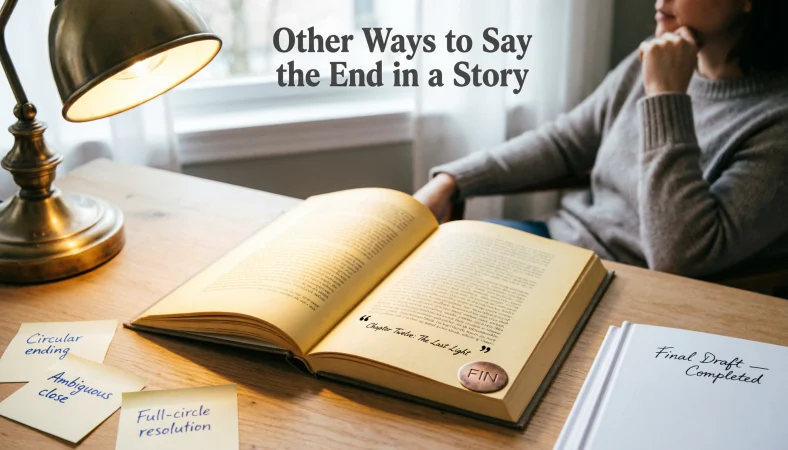
The phrase “the end” in a story refers to the point where the narrative finishes or the main events are concluded. Depending on the genre and tone, you can use alternatives such as the conclusion, the ending, the finale, the resolution, or the story comes to a close.
Top alternatives: The conclusion, the ending, the finale, the resolution, the story comes to a close
Finding other ways to say the end in a story can make your writing more engaging, polished, and expressive. While “the end” clearly shows that a narrative has finished, writers can use more precise expressions to describe different types of conclusions. A mystery may reach a resolution, a dramatic novel may have a finale, while a reflective story may simply come to a close.
Learning alternatives to the end in a story is especially useful for English learners, creative writers, students, reviewers, and anyone discussing books or narratives. The right expression can show whether an ending is satisfying, emotional, unexpected, conclusive, or open-ended, helping you communicate the story’s final moments more naturally and effectively.
“A memorable story deserves an ending that feels as carefully chosen as its opening.”
Formal Alternatives to “The End” in a Story
The Conclusion
A formal term for the final part of a story or written work.
The Resolution
The point where the main conflict or problem is resolved.
The Final Chapter
The last chapter that brings the narrative toward completion.
The Narrative Conclusion
A formal description of how the story’s events are brought to an end.
Pro Tip: Use these expressions in literary analysis, essays, book reviews, and academic writing.
Casual Alternatives
The Ending
A simple and natural way to refer to the final part of a story.
The Story Wraps Up
A conversational way to describe a narrative reaching completion.
The Story Comes to a Close
A natural expression for describing the final moments.
The Story Finishes
A straightforward way to say that the narrative has ended.
Pro Tip: Casual expressions work well when discussing books, movies, television shows, and stories in everyday conversation.
Professional Alternatives
The Narrative Concludes
A polished way to describe the completion of a narrative.
The Story Reaches Its Resolution
A professional expression emphasizing that the central conflict has been settled.
The Final Outcome
The result reached by the story’s characters or events.
The Closing Sequence
A useful phrase for discussing the final section of a film or narrative.
Pro Tip: Use professional reaction phrases and precise literary vocabulary when reviewing stories, preparing presentations, or discussing creative work professionally.
Informal Expressions
That’s How the Story Ends
A conversational way to summarize the conclusion.
And That’s a Wrap
An informal expression indicating that something has finished.
The Story Is Over
A direct and simple expression.
It All Comes to an End
A conversational expression emphasizing completion.
Pro Tip: Informal expressions in English are best for conversations, personal reviews, storytelling, and relaxed discussions.
“The best ending phrase does more than signal completion. It tells readers how the story feels when it finishes.”
Common Mistakes
1. Using “the end” when discussing the resolution
“The end” identifies completion, but it does not necessarily explain how the conflict was resolved.
Example: The resolution explains how the main conflict was settled.
2. Confusing “climax” with “ending”
The climax is usually the story’s highest point of tension, not necessarily its final scene.
Example: The climax occurs before the final chapter.
3. Using “finale” for every type of story
“Finale” often suggests a dramatic or significant concluding section.
Example: The film’s emotional finale left the audience silent.
4. Calling an unresolved story “concluded”
An open ending may intentionally leave questions unanswered.
Example: The novel ends with an unresolved mystery.
5. Using informal expressions in literary analysis
Expressions such as “and that’s a wrap” may sound inappropriate in academic writing.
Example: Academic: The narrative concludes with a symbolic scene.
“Not every ending provides closure. Sometimes an unresolved ending is the writer’s deliberate choice.”
What Does “The End” Mean in a Story?
“The end” refers to the point at which a story or narrative finishes. It can describe the final scene, final chapter, final event, or overall conclusion.
The expression usually functions as a noun phrase.
Example:
“The end of the story reveals why the character left.”
In traditional storytelling, “The End” may also appear as a final phrase or visual signal showing that the narrative is complete.
When to Use “The End” in a Story
Use the expression when:
- Referring generally to the final part of a story
- Talking about how a narrative finishes
- Discussing the last chapter
- Describing a story’s conclusion
- Explaining where a narrative stops
- Talking about traditional story endings
Spoken vs Written
Spoken: “I didn’t expect that at the end of the story.”
Written: “At the end of the story, the protagonist returns home.”
Formal vs Informal
Neutral: The ending, the conclusion
Formal: The narrative conclusion, the resolution
Literary: The finale, the closing passage
Informal: That’s how the story ends, the story wraps up
Is “The End” Professional or Polite?
Yes. The phrase is perfectly understandable and grammatically correct, but it can be too general when discussing stories in professional or academic contexts.
Polite? ✔ Yes
Professional? ✔ Yes, but context dependent
For literary analysis, terms such as conclusion, resolution, and narrative closure often sound more precise.
Business style example:
“The report concludes with recommendations for improving the process.”
“Precision matters: a conclusion, resolution, finale, and closing scene can all describe an ending, but they do not always mean exactly the same thing.”
Pros and Cons of Using “The End”
Pros
- Simple and natural: Everyone understands what it means.
- Friendly tone: It works naturally in everyday storytelling.
- Common usage: It is widely used across different types of narratives.
- Easy to understand: It does not require specialized literary vocabulary.
Cons
- Too general for detailed analysis: It does not explain what happens at the ending.
- Can be repetitive: Writers may want more varied vocabulary.
- Limited emotional range: It does not indicate whether the ending is happy, tragic, surprising, or unresolved.
- Not always suitable for formal writing: Academic discussion often benefits from more precise terminology.
Other Ways to Say “The End” in a Story With Examples
These alternatives will help you sound more fluent, confident, and natural when discussing stories, books, films, and narratives.
Use them according to tone, context, genre, and audience to describe closure, resolution, final events, or emotional impact.
1. Phrase: The Conclusion
Meaning: The final part of a story or written work.
Explanation: It is one of the safest formal alternatives to “the end.”
Example Sentence: The conclusion brings all the major storylines together.
Best Use: Literary analysis
Worst Use: Casual storytelling
Tone: Formal, clear, academic
Context Variability: casual / professional / spoken examples
2. Phrase: The Ending
Meaning: The final part of a story.
Explanation: It is a neutral expression that works in most situations.
Example Sentence: I really enjoyed the ending of the novel.
Best Use: General discussion
Worst Use: Detailed analysis
Tone: Neutral, natural, versatile
Context Variability: casual / professional / spoken examples
3. Phrase: The Resolution
Meaning: The part where the main conflict is resolved.
Explanation: It focuses on how problems or conflicts are settled.
Example Sentence: The resolution explains what happened to the missing character.
Best Use: Literary analysis
Worst Use: Unresolved stories
Tone: Formal, analytical, precise
Context Variability: casual / professional / spoken examples
4. Phrase: The Finale
Meaning: The final and often dramatic part of a story.
Explanation: Finale suggests a significant or memorable conclusion.
Example Sentence: The film has a dramatic finale that audiences will remember.
Best Use: Dramatic stories
Worst Use: Simple endings
Tone: Dramatic, expressive, polished
Context Variability: casual / professional / spoken examples
5. Phrase: The Story Comes to a Close
Meaning: The story gradually reaches its conclusion.
Explanation: This phrase provides a smooth and literary way to describe an ending.
Example Sentence: As the story comes to a close, the characters finally understand each other.
Best Use: Narrative writing
Worst Use: Brief answers
Tone: Literary, smooth, reflective
Context Variability: casual / professional / spoken examples
6. Phrase: The Story Concludes
Meaning: The narrative reaches its final point.
Explanation: This is a formal and concise alternative.
Example Sentence: The story concludes with the protagonist returning home.
Best Use: Literary analysis
Worst Use: Casual chat
Tone: Formal, concise, analytical
Context Variability: casual / professional / spoken examples
7. Phrase: The Final Chapter
Meaning: The last chapter of a book or narrative.
Explanation: It specifically identifies the final section rather than the overall concept of ending.
Example Sentence: The final chapter reveals the truth behind the mystery.
Best Use: Books and novels
Worst Use: Short stories
Tone: Neutral, literary, specific
Context Variability: casual / professional / spoken examples
8. Phrase: The Closing Scene
Meaning: The final scene of a film, play, or story.
Explanation: It focuses specifically on the visual or dramatic ending.
Example Sentence: The closing scene leaves the audience wondering what happens next.
Best Use: Film analysis
Worst Use: General essays
Tone: Cinematic, analytical, descriptive
Context Variability: casual / professional / spoken examples
9. Phrase: The Final Scene
Meaning: The last scene presented in a narrative.
Explanation: It is especially useful when discussing films, television, and plays.
Example Sentence: The final scene changes the meaning of everything that came before it.
Best Use: Film discussion
Worst Use: Academic theory
Tone: Neutral, descriptive, precise
Context Variability: casual / professional / spoken examples
10. Phrase: The Last Chapter
Meaning: The final chapter of a book or longer narrative.
Explanation: It directly identifies the final written section.
Example Sentence: The last chapter provides an emotional conclusion.
Best Use: Book discussions
Worst Use: Films
Tone: Neutral, literary, straightforward
Context Variability: casual / professional / spoken examples
11. Phrase: The Final Act
Meaning: The last major section of a play, film, or dramatic story.
Explanation: It emphasizes dramatic structure rather than simply saying the story ends.
Example Sentence: The final act reveals the consequences of the protagonist’s decision.
Best Use: Dramatic structure
Worst Use: Simple stories
Tone: Dramatic, literary, analytical
Context Variability: casual / professional / spoken examples
12. Phrase: The Story Wraps Up
Meaning: The story finishes or brings its events to a close.
Explanation: This is a casual expression for discussing an ending.
Example Sentence: The story wraps up with everyone returning to their hometown.
Best Use: Casual discussion
Worst Use: Academic writing
Tone: Casual, friendly, conversational
Context Variability: casual / professional / spoken examples
13. Phrase: The Narrative Comes to an End
Meaning: The narrative reaches its final point.
Explanation: This phrase is clear and suitable for literary discussion.
Example Sentence: The narrative comes to an end after the characters reconcile.
Best Use: Literary discussion
Worst Use: Casual dialogue
Tone: Formal, descriptive, neutral
Context Variability: casual / professional / spoken examples
14. Phrase: The Story Is Concluded
Meaning: The story has been brought to a complete ending.
Explanation: It emphasizes that the narrative has reached completion.
Example Sentence: By the final page, the story is fully concluded.
Best Use: Formal writing
Worst Use: Casual speech
Tone: Formal, precise, academic
Context Variability: casual / professional / spoken examples
15. Phrase: The Final Outcome
Meaning: The result reached at the end of the story.
Explanation: This focuses on what ultimately happens rather than simply where the story stops.
Example Sentence: The final outcome surprises both the characters and the reader.
Best Use: Story analysis
Worst Use: Opening scenes
Tone: Analytical, neutral, professional
Context Variability: casual / professional / spoken examples
16. Phrase: The Story Reaches Its Resolution
Meaning: The narrative arrives at the point where its main conflict is settled.
Explanation: It is particularly useful for stories with a clear central conflict.
Example Sentence: The story reaches its resolution when the detective identifies the culprit.
Best Use: Mystery analysis
Worst Use: Open endings
Tone: Formal, analytical, precise
Context Variability: casual / professional / spoken examples
17. Phrase: The Closing Passage
Meaning: The final written section of a story.
Explanation: This expression is useful when analyzing literary writing.
Example Sentence: The closing passage creates a reflective mood.
Best Use: Literary analysis
Worst Use: Casual reviews
Tone: Literary, formal, descriptive
Context Variability: casual / professional / spoken examples
18. Phrase: The Final Moments
Meaning: The events immediately before a story ends.
Explanation: It focuses on the final period rather than the entire ending.
Example Sentence: In the final moments, the hero makes an unexpected choice.
Best Use: Dramatic scenes
Worst Use: General summaries
Tone: Dramatic, descriptive, engaging
Context Variability: casual / professional / spoken examples
19. Phrase: The Last Scene
Meaning: The final scene in a narrative.
Explanation: It is a simple and natural alternative when discussing films or plays.
Example Sentence: The last scene provides a powerful emotional payoff.
Best Use: Film discussion
Worst Use: Formal essays
Tone: Natural, descriptive, neutral
Context Variability: casual / professional / spoken examples
20. Phrase: The Story Ends With
Meaning: A phrase used to introduce the final event or situation.
Explanation: It is useful when explaining exactly how a narrative finishes.
Example Sentence: The story ends with the family moving to a new city.
Best Use: Story summaries
Worst Use: Detailed analysis
Tone: Neutral, direct, natural
Context Variability: casual / professional / spoken examples
21. Phrase: The Narrative Reaches Its Conclusion
Meaning: The narrative arrives at its final stage.
Explanation: This is a polished expression for formal literary discussion.
Example Sentence: The narrative reaches its conclusion without resolving every question.
Best Use: Academic writing
Worst Use: Casual conversation
Tone: Formal, academic, precise
Context Variability: casual / professional / spoken examples
22. Phrase: The Story Draws to a Close
Meaning: The story gradually approaches its ending.
Explanation: This literary expression emphasizes the process of approaching the final point.
Example Sentence: As the story draws to a close, the narrator reflects on the past.
Best Use: Literary writing
Worst Use: Simple summaries
Tone: Literary, reflective, elegant
Context Variability: casual / professional / spoken examples
23. Phrase: The Final Chapter Brings Closure
Meaning: The last chapter provides a sense of completion.
Explanation: It emphasizes emotional or narrative closure.
Example Sentence: The final chapter brings closure to the family’s long conflict.
Best Use: Character stories
Worst Use: Open endings
Tone: Reflective, formal, emotional
Context Variability: casual / professional / spoken examples
24. Phrase: The Story Reaches Its Climax
Meaning: The story reaches its highest point of tension or drama.
Explanation: The climax is not always the actual ending, so it should be used carefully.
Example Sentence: The story reaches its climax when the two rivals finally confront each other.
Best Use: Dramatic analysis
Worst Use: Final scene
Tone: Dramatic, analytical, literary
Context Variability: casual / professional / spoken examples
25. Phrase: The Conflict Is Resolved
Meaning: The main problem or struggle in the story is settled.
Explanation: This phrase describes resolution rather than simply the ending.
Example Sentence: By the final chapter, the central conflict is resolved.
Best Use: Plot analysis
Worst Use: Unresolved plots
Tone: Formal, analytical, clear
Context Variability: casual / professional / spoken examples
26. Phrase: The Narrative Finds Closure
Meaning: The story reaches a satisfying or complete conclusion.
Explanation: Closure can refer to emotional, thematic, or plot related completion.
Example Sentence: The final scene gives the protagonist a sense of closure.
Best Use: Literary analysis
Worst Use: Basic summaries
Tone: Reflective, analytical, sophisticated
Context Variability: casual / professional / spoken examples
27. Phrase: That’s How the Story Ends
Meaning: A conversational way to describe the final outcome.
Explanation: It is especially natural when telling or retelling a story.
Example Sentence: He returns home safely, and that’s how the story ends.
Best Use: Storytelling
Worst Use: Academic essays
Tone: Casual, conversational, friendly
Context Variability: casual / professional / spoken examples
28. Phrase: And That’s a Wrap
Meaning: An informal expression indicating that something is finished.
Explanation: It is more conversational than literary and can be used humorously.
Example Sentence: The final scene is complete, and that’s a wrap.
Best Use: Informal discussion
Worst Use: Literary analysis
Tone: Informal, upbeat, conversational
Context Variability: casual / professional / spoken examples
29. Phrase: It All Comes to an End
Meaning: Everything eventually reaches its final point.
Explanation: This expression emphasizes completion and can have an emotional tone.
Example Sentence: After years of adventure, it all comes to an end.
Best Use: Emotional endings
Worst Use: Technical analysis
Tone: Emotional, reflective, dramatic
Context Variability: casual / professional / spoken examples
30. Phrase: The Story Comes Full Circle
Meaning: The ending connects meaningfully with the beginning.
Explanation: It is ideal when characters, themes, or events return to an earlier idea or situation.
Example Sentence: The story comes full circle when the protagonist returns to the place where everything began.
Best Use: Thematic endings
Worst Use: Unconnected endings
Tone: Literary, reflective, sophisticated
Context Variability: casual / professional / spoken examples
“A strong ending does not always answer every question. Sometimes its purpose is to leave the reader thinking.”
Mini Quiz and Self Check
1. Which phrase is best for a formal literary analysis?
A. And that’s a wrap
B. The narrative reaches its conclusion
C. The story is over
D. That’s how it ends
Answer: B
2. Which term specifically refers to resolving the main conflict?
A. Resolution
B. Opening
C. Climax
D. Introduction
Answer: A
3. A story connects its ending to an important event from its beginning. Which phrase is most suitable?
A. The final scene
B. The last chapter
C. The story comes full circle
D. The story finishes
Answer: C
4. Which phrase is most informal?
A. The narrative concludes
B. The closing passage
C. And that’s a wrap
D. The final outcome
Answer: C
Comparison Table: Top Alternatives
| Phrase | Tone | Best Use |
| The conclusion | Formal | Literary analysis |
| The ending | Neutral | General discussion |
| The resolution | Formal | Conflict analysis |
| The finale | Dramatic | Films and stories |
| The story comes to a close | Literary | Narrative writing |
| The final chapter | Neutral | Books and novels |
| The closing scene | Analytical | Film discussion |
| The final act | Dramatic | Plays and films |
| The story wraps up | Casual | Everyday discussion |
| The story comes full circle | Literary | Thematic analysis |
Frequently Asked Questions
What are the best alternatives to “the end” in a story?
The most useful alternatives include the conclusion, the ending, the resolution, the finale, and the story comes to a close. The best choice depends on the type of ending.
What is a formal way to say “the end” in a story?
The conclusion, the narrative conclusion, the resolution, and the narrative reaches its conclusion are strong formal alternatives.
What is the difference between the climax and the ending?
The climax is the story’s highest point of tension or conflict, while the ending is the final part of the narrative. The climax can happen before the actual ending.
What is a literary way to describe the end of a story?
Expressions such as the story draws to a close, the narrative reaches its conclusion, and the story comes full circle can create a more literary style.
What is an informal way to say a story has ended?
You can say “That’s how the story ends,” “the story wraps up,” “the story is over,” or “and that’s a wrap.”
Conclusion
Learning other ways to say the end in a story gives you greater control over narrative vocabulary. Words such as conclusion, resolution, finale, closing scene, and final chapter allow you to describe different kinds of endings with greater precision.
Practice these expressions by describing the endings of books, films, and short stories you know. Pay attention to whether the ending resolves the conflict, creates emotional closure, leaves questions unanswered, or connects back to the beginning. Choosing the right expression will make your English sound more natural, polished, and confident.
CTA: Choose one alternative from this list and use it to describe the ending of your favorite story.