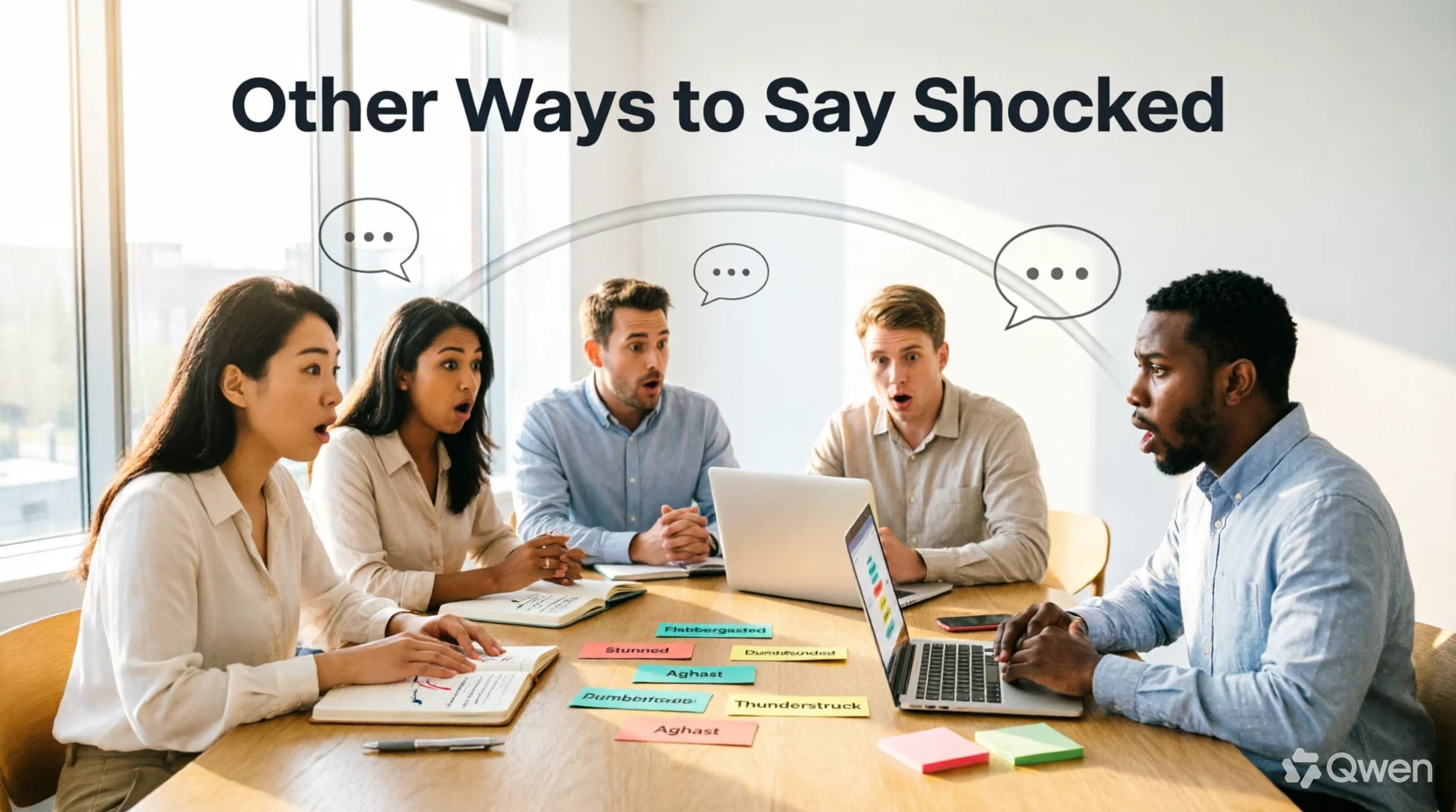
If you want to describe strong surprise, disbelief, or emotional impact, there are many useful alternatives to shocked. Top choices include astonished, stunned, surprised, amazed, and speechless.
Top alternatives to shocked: Astonished, astounded, stunned, surprised, amazed.
Shocked describes a strong feeling of surprise, disbelief, or emotional disturbance caused by something unexpected. It is commonly used in everyday conversations, personal stories, news, workplace discussions, and written communication. Learning alternatives to shocked helps English learners describe different levels of surprise more accurately. For example, surprised sounds neutral, while astonished and astounded express a much stronger reaction
Choosing the right expression can make your spoken and written English more natural, confident, and precise. In professional situations, phrases such as taken aback or deeply concerned may sound more appropriate than simply saying shocked. Learning other ways to say shocked also helps you understand formal, casual, and professional vocabulary, just as learning different expressions can help you express excitement in English. The key is to choose each phrase according to its meaning, tone, and context.
Quick Categories
Formal alternatives to “shocked”
• Astonished
• Astounded
• Stunned
• Taken aback
Pro Tips Box: Use these expressions when describing a strong reaction in formal conversations, reports, articles, or polished writing.
Casual alternatives
• Surprised
• Amazed
• Speechless
• Blown away
Pro Tips Box: These options are natural in everyday conversations. Choose the expression according to how intense your reaction really is.
Professional alternatives
• Deeply concerned
• Taken aback
• Surprised by the development
• Unexpectedly affected
Pro Tips Box: In professional settings, describe the specific reaction when possible instead of using an overly emotional expression.
Informal expressions
• I can’t believe it
• I was not expecting that
• That caught me off guard
• I was completely stunned
Pro Tips Box: Informal expressions are excellent for spoken English but may be unsuitable for formal reports or business correspondence.
“The best synonym is the one that matches the intensity of your reaction.”
Common Mistakes
1. Using “shocked” for every level of surprise
Example: “I was shocked that she arrived five minutes early.”
For a minor surprise, surprised is usually more natural.
2. Confusing “shocked” with “excited”
Shock can be negative, neutral, or positive, while excitement specifically expresses enthusiasm.
Example: “I was shocked to receive the award” may describe surprise, not excitement.
3. Using “astonished” in every situation
Astonished expresses very strong surprise and can sound dramatic in ordinary situations.
Example: “I was astonished when my colleague sent the email” may sound excessive.
4. Using informal expressions in formal writing
Expressions such as I can’t believe it may sound too conversational in reports.
Example: “I can’t believe the results were so poor.”
5. Confusing “stunned” with physical injury
Stunned can describe extreme surprise, but it can also refer to physical impact.
Example: “She was stunned by the announcement” means extremely surprised.
What Does “Shocked” Mean?
Shocked means extremely surprised or emotionally disturbed by something unexpected.
It is the past participle of shock and commonly functions as an adjective after linking verbs such as be, feel, and seem.
Example: “I was shocked by the unexpected news.”
The word can describe positive, negative, or neutral surprise depending on the context.
When to Use “Shocked”
You can use shocked when:
• Something happens unexpectedly
• News is emotionally difficult
• Someone receives surprising information
• An event is much worse than expected
• You want to emphasize a strong reaction
• You are telling a personal story
Spoken vs Written
Spoken: “I was absolutely shocked when I heard the news.”
Written: “The community was shocked by the unexpected announcement.”
Formal vs Informal
Formal: “The organization was deeply concerned by the findings.”
Informal: “I was completely shocked when I heard.”
Is It Professional or Polite to Say “Shocked”?
Shocked is polite and grammatically correct, but it can sound emotionally strong in professional communication. In business settings, a more measured phrase such as surprised by the development or deeply concerned may be preferable.
Polite? ✔️ Yes
Professional? ❌ No, in most cases
Business example: “We were surprised by the unexpected change in the project timeline.”
“In professional English, a measured reaction often sounds more confident than an emotional one.”
Pros and Cons of Using “Shocked”
Pros
• Simple and natural: Easy to use in everyday English
• Friendly tone: Natural in personal conversations
• Common usage: Widely understood by native speakers
• Easy to understand: Suitable for intermediate English learners
Cons
• Too informal for some work contexts: Professional alternatives may sound more appropriate
• Overused: Repeating it can make writing less expressive
• Limited emotional range: It does not always show whether the reaction is positive, negative, or neutral
• Not suitable for some formal writing: More precise wording may be needed
Other Ways to Say “Shocked” With Examples
These alternatives will help you sound more fluent, confident, and natural in different situations.
Use them according to tone, context, and audience to express surprise, disbelief, admiration, or approval.
1. Phrase: Astonished
Meaning: Extremely surprised by something unexpected.
Explanation: This formal adjective expresses a very strong reaction.
Example Sentence: “I was astonished by how quickly the team completed the project.”
Best Use: Strong surprise
Worst Use: Minor surprises
Tone: Formal, strong, expressive
Context Variability: Casual: “I was astonished!” Professional: “We were astonished by the results.” Spoken: “I was absolutely astonished.”
2. Phrase: Astounded
Meaning: Extremely surprised or impressed.
Explanation: This word emphasizes an unusually powerful reaction.
Example Sentence: “The manager was astounded by the company’s rapid growth.”
Best Use: Major surprises
Worst Use: Routine news
Tone: Formal, intense, expressive
Context Variability: Casual: “I was astounded.” Professional: “We were astounded by the results.” Spoken: “I was completely astounded.”
3. Phrase: Stunned
Meaning: So surprised that you temporarily do not know how to react.
Explanation: It strongly emphasizes the immediate impact of unexpected information.
Example Sentence: “She was stunned when she heard that she had won the award.”
Best Use: Sudden news
Worst Use: Minor changes
Tone: Strong, dramatic, natural
Context Variability: Casual: “I was stunned.” Professional: “The announcement left the team stunned.” Spoken: “I was completely stunned.”
4. Phrase: Surprised
Meaning: Feeling unexpected reaction to something you did not anticipate.
Explanation: This is the most neutral and versatile alternative.
Example Sentence: “I was surprised by the positive response.”
Best Use: Everyday situations
Worst Use: Extreme reactions
Tone: Neutral, natural, versatile
Context Variability: Casual: “I was surprised.” Professional: “We were surprised by the outcome.” Spoken: “I was really surprised.”
5. Phrase: Amazed
Meaning: Extremely surprised, often in a positive way.
Explanation: It commonly combines surprise with admiration.
Example Sentence: “I was amazed by her ability to solve the problem so quickly.”
Best Use: Positive surprise
Worst Use: Serious bad news
Tone: Positive, expressive, friendly
Context Variability: Casual: “I’m amazed!” Professional: “We were amazed by the team’s performance.” Spoken: “I was really amazed.”
6. Phrase: Taken Aback
Meaning: Suddenly surprised or confused by something unexpected.
Explanation: This expression often describes a brief, unexpected reaction.
Example Sentence: “I was taken aback by the unexpected criticism.”
Best Use: Unexpected comments
Worst Use: Extreme disasters
Tone: Polished, restrained, professional
Context Variability: Casual: “I was taken aback.” Professional: “The manager was taken aback by the response.” Spoken: “I was a little taken aback.”
7. Phrase: Speechless
Meaning: So surprised or emotional that you cannot immediately speak.
Explanation: It emphasizes the inability to find words.
Example Sentence: “I was speechless when my colleagues organized the surprise celebration.”
Best Use: Emotional moments
Worst Use: Formal reports
Tone: Emotional, expressive, natural
Context Variability: Casual: “I’m speechless.” Professional: “The announcement left everyone speechless.” Spoken: “I was completely speechless.”
8. Phrase: Flabbergasted
Meaning: Extremely surprised and unable to believe what happened.
Explanation: This expressive word is common in informal English.
Example Sentence: “I was flabbergasted when I saw the final result.”
Best Use: Informal reactions
Worst Use: Formal reports
Tone: Informal, dramatic, expressive
Context Variability: Casual: “I was flabbergasted.” Professional: Usually avoid it. Spoken: “I was absolutely flabbergasted.”
9. Phrase: Dumbfounded
Meaning: So surprised that you are temporarily unable to respond.
Explanation: It emphasizes confusion or disbelief caused by something unexpected.
Example Sentence: “The unexpected decision left everyone dumbfounded.”
Best Use: Unexpected decisions
Worst Use: Routine news
Tone: Strong, expressive, polished
Context Variability: Casual: “I was dumbfounded.” Professional: “The decision left the committee dumbfounded.” Spoken: “I was completely dumbfounded.”
10. Phrase: Bewildered
Meaning: Extremely confused or uncertain because something unexpected happened.
Explanation: This focuses more on confusion than pure surprise.
Example Sentence: “I was bewildered by the sudden change in instructions.”
Best Use: Confusing situations
Worst Use: Happy surprises
Tone: Formal, thoughtful, serious
Context Variability: Casual: “I was bewildered.” Professional: “The employees were bewildered by the sudden change.” Spoken: “I was completely bewildered.”
11. Phrase: Overwhelmed
Meaning: Strongly affected emotionally by an experience or event.
Explanation: It can express intense emotion rather than surprise alone.
Example Sentence: “She was overwhelmed by the support she received.”
Best Use: Emotional events
Worst Use: Simple surprises
Tone: Emotional, positive, sincere
Context Variability: Casual: “I’m overwhelmed.” Professional: “The team was overwhelmed by the positive response.” Spoken: “I felt completely overwhelmed.”
12. Phrase: Startled
Meaning: Suddenly surprised by something unexpected.
Explanation: It usually describes an immediate physical or emotional reaction.
Example Sentence: “I was startled by the sudden noise.”
Best Use: Sudden events
Worst Use: Long-term news
Tone: Neutral, immediate, natural
Context Variability: Casual: “You startled me.” Professional: “The sudden announcement startled the team.” Spoken: “I was really startled.”
13. Phrase: Taken by Surprise
Meaning: Unexpectedly affected by something.
Explanation: This natural phrase emphasizes that someone was not prepared for an event.
Example Sentence: “We were taken by surprise by the sudden announcement.”
Best Use: Unexpected events
Worst Use: Predictable outcomes
Tone: Neutral, natural, flexible
Context Variability: Casual: “I was taken by surprise.” Professional: “The organization was taken by surprise.” Spoken: “That really took me by surprise.”
14. Phrase: Caught Off Guard
Meaning: Surprised because you were not prepared.
Explanation: This common expression focuses on a lack of preparation.
Example Sentence: “The difficult question caught me off guard during the interview.”
Best Use: Unexpected questions
Worst Use: Formal reports
Tone: Casual, natural, conversational
Context Variability: Casual: “That caught me off guard.” Professional: “The question caught me off guard.” Spoken: “I was caught off guard.”
15. Phrase: In Disbelief
Meaning: Unable or unwilling to believe what has happened.
Explanation: This phrase emphasizes doubt rather than surprise alone.
Example Sentence: “She stared at the results in disbelief.”
Best Use: Unexpected results
Worst Use: Routine events
Tone: Emotional, serious, natural
Context Variability: Casual: “I was in disbelief.” Professional: “The team reacted with disbelief.” Spoken: “I just couldn’t believe it.”
16. Phrase: At a Loss for Words
Meaning: Unable to think of what to say because of strong emotion or surprise.
Explanation: This expression focuses on the difficulty of responding verbally.
Example Sentence: “I was at a loss for words after hearing the announcement.”
Best Use: Emotional moments
Worst Use: Technical reports
Tone: Polished, emotional, natural
Context Variability: Casual: “I’m at a loss for words.” Professional: “The announcement left her at a loss for words.” Spoken: “I was honestly at a loss for words.”
17. Phrase: Amazed by
Meaning: Extremely impressed or surprised by something.
Explanation: This phrase is particularly useful for positive reactions.
Example Sentence: “We were amazed by the quality of the presentation.”
Best Use: Positive results
Worst Use: Negative events
Tone: Positive, professional, expressive
Context Variability: Casual: “I’m amazed by it.” Professional: “We were amazed by the team’s performance.” Spoken: “I’m amazed by what you did.”
18. Phrase: Surprised by
Meaning: Unexpectedly affected by something.
Explanation: This is a flexible expression for mild to moderate surprise.
Example Sentence: “We were surprised by the increase in customer demand.”
Best Use: Business updates
Worst Use: Extreme events
Tone: Neutral, professional, clear
Context Variability: Casual: “I was surprised by that.” Professional: “We were surprised by the outcome.” Spoken: “I was really surprised by it.”
19. Phrase: Deeply Concerned
Meaning: Very worried or troubled by something.
Explanation: This is a measured professional alternative when the shock is negative.
Example Sentence: “We are deeply concerned by the findings of the investigation.”
Best Use: Serious issues
Worst Use: Happy surprises
Tone: Formal, serious, professional
Context Variability: Casual: “I’m really concerned.” Professional: “We are deeply concerned by the findings.” Spoken: “I’m deeply concerned about this.”
20. Phrase: Disturbed
Meaning: Emotionally troubled or upset by something.
Explanation: It emphasizes discomfort or concern rather than simple surprise.
Example Sentence: “The organization was disturbed by the allegations.”
Best Use: Serious news
Worst Use: Positive surprises
Tone: Serious, formal, emotional
Context Variability: Casual: “I was disturbed by that.” Professional: “We were deeply disturbed by the findings.” Spoken: “I found that very disturbing.”
21. Phrase: Horrified
Meaning: Extremely shocked and upset by something terrible.
Explanation: This is much stronger than ordinary surprise and usually relates to something disturbing.
Example Sentence: “The community was horrified by the incident.”
Best Use: Terrible events
Worst Use: Minor problems
Tone: Strong, emotional, serious
Context Variability: Casual: “I was horrified.” Professional: “The public was horrified by the incident.” Spoken: “I was absolutely horrified.”
22. Phrase: Appalled
Meaning: Extremely shocked and upset by something unacceptable.
Explanation: It often expresses strong disapproval as well as shock.
Example Sentence: “The committee was appalled by the lack of accountability.”
Best Use: Serious misconduct
Worst Use: Positive events
Tone: Formal, critical, strong
Context Variability: Casual: “I was appalled.” Professional: “We were appalled by the findings.” Spoken: “I was absolutely appalled.”
23. Phrase: Taken by Surprise
Meaning: Unexpectedly affected by an event or development.
Explanation: This expression is useful when something happens without warning.
Example Sentence: “The company was taken by surprise by the sudden resignation.”
Best Use: Unexpected changes
Worst Use: Planned events
Tone: Neutral, professional, natural
Context Variability: Casual: “That took me by surprise.” Professional: “The company was taken by surprise.” Spoken: “It really took me by surprise.”
24. Phrase: Blown Away
Meaning: Extremely impressed or surprised.
Explanation: This is an informal expression usually used for a positive reaction.
Example Sentence: “I was blown away by the quality of the presentation.”
Best Use: Positive reactions
Worst Use: Formal writing
Tone: Informal, enthusiastic, expressive
Context Variability: Casual: “I was blown away.” Professional: Use “very impressed” instead. Spoken: “I was totally blown away.”
25. Phrase: Could Hardly Believe It
Meaning: Found something so surprising that it was difficult to accept as true.
Explanation: This natural phrase communicates strong disbelief.
Example Sentence: “I could hardly believe it when I saw the final score.”
Best Use: Personal stories
Worst Use: Formal reports
Tone: Natural, emotional, conversational
Context Variability: Casual: “I could hardly believe it.” Professional: “The results were difficult to believe.” Spoken: “I could hardly believe it.”
26. Phrase: Completely Surprised
Meaning: Extremely unexpected to someone.
Explanation: Adding completely makes the neutral word surprised stronger.
Example Sentence: “I was completely surprised by the generous offer.”
Best Use: Everyday reactions
Worst Use: Formal analysis
Tone: Natural, clear, expressive
Context Variability: Casual: “I was completely surprised.” Professional: “We were completely surprised by the outcome.” Spoken: “I was completely surprised.”
27. Phrase: Taken by Shock
Meaning: Strongly affected by unexpected information or events.
Explanation: This expression is understandable but less natural than shocked or taken aback in standard English.
Example Sentence: “The community was shocked by the unexpected announcement.”
Best Use: Rare contexts
Worst Use: Professional writing
Tone: Unnatural, strong, emotional
Context Variability: Casual: Avoid when possible. Professional: Use “shocked” or “taken aback.” Spoken: Prefer “I was shocked.”
28. Phrase: Surprised and Concerned
Meaning: Feeling both unexpected surprise and worry.
Explanation: This phrase is useful when a situation produces both emotions.
Example Sentence: “We were surprised and concerned by the sudden decline in sales.”
Best Use: Business problems
Worst Use: Happy news
Tone: Professional, measured, clear
Context Variability: Casual: “I was surprised and worried.” Professional: “We were surprised and concerned by the findings.” Spoken: “I was surprised and concerned.”
29. Phrase: Deeply Affected
Meaning: Strongly influenced emotionally by an event.
Explanation: This formal phrase avoids directly stating shock while emphasizing emotional impact.
Example Sentence: “The community was deeply affected by the unexpected tragedy.”
Best Use: Formal writing
Worst Use: Minor surprises
Tone: Formal, sensitive, respectful
Context Variability: Casual: “It really affected me.” Professional: “The team was deeply affected by the news.” Spoken: “I was deeply affected by what happened.”
30. Phrase: Lost for Words
Meaning: Unable to speak because of strong surprise or emotion.
Explanation: This is a natural expression for moments when a reaction is difficult to put into words.
Example Sentence: “I was completely lost for words when I received the award.”
Best Use: Emotional moments
Worst Use: Formal reports
Tone: Natural, emotional, conversational
Context Variability: Casual: “I’m lost for words.” Professional: “The announcement left him speechless.” Spoken: “I was completely lost for words.”
“Use ‘surprised’ for neutral reactions, ‘astonished’ for powerful surprise, and ‘deeply concerned’ when professionalism matters.”
Professional Reaction Phrases Related to Shock
In professional settings, direct emotional language is not always the best choice. These professional reaction phrases can communicate surprise or concern more diplomatically:
• “We were surprised by the development.”
• “The announcement was unexpected.”
• “We were taken aback by the findings.”
• “The results were unexpected.”
• “We were deeply concerned by the situation.”
• “The development came as a surprise.”
• “The findings were particularly concerning.”
For everyday conversations, informal expressions in English such as “I can’t believe it,” “That caught me off guard,” and “I was completely stunned” sound more natural.
Mini Quiz / Self Check
1. Which alternative is most appropriate for a formal business report?
A. Blown away
B. Flabbergasted
C. Deeply concerned
D. I can’t believe it
Answer: C. Deeply concerned
2. Which word describes extremely strong surprise?
A. Astonished
B. Calm
C. Interested
D. Curious
Answer: A. Astonished
3. Your interviewer asks you an unexpected question. Which expression is natural?
A. I was caught off guard.
B. I was horrified.
C. I was appalled.
D. I was deeply disturbed.
Answer: A. I was caught off guard.
4. Which expression is best for a positive emotional reaction?
A. Amazed
B. Appalled
C. Disturbed
D. Horrified
Answer: A. Amazed
Comparison Table: Top Alternatives
| Phrase | Tone | Best Use |
|---|---|---|
| Astonished | Formal, strong | Major surprises |
| Astounded | Formal, intense | Impressive results |
| Stunned | Strong, natural | Sudden news |
| Surprised | Neutral, versatile | Everyday situations |
| Amazed | Positive, expressive | Positive surprises |
| Taken aback | Polished, restrained | Unexpected comments |
| Speechless | Emotional, natural | Emotional moments |
| Dumbfounded | Strong, expressive | Unexpected decisions |
| Caught off guard | Casual, natural | Unexpected questions |
| Deeply concerned | Formal, serious | Professional issues |
FAQs
What are the best alternatives to shocked?
The best alternatives include astonished, astounded, stunned, surprised, amazed, speechless, and taken aback. The ideal choice depends on the intensity and context.
What is a professional way to say shocked?
In professional communication, use phrases such as surprised by the development, taken aback, deeply concerned, or the findings were unexpected.
What is a formal word for shocked?
Astonished, astounded, stunned, and taken aback can work in formal contexts, although each communicates a slightly different type or intensity of reaction.
Is “shocked” a negative word?
Not always. Shocked can describe negative, positive, or neutral surprise. The surrounding context determines the emotional meaning.
What is the difference between shocked and surprised?
Surprised is a general term for an unexpected reaction, while shocked usually suggests a much stronger emotional or psychological impact.
Conclusion
Knowing other ways to say shocked helps you communicate different levels of surprise, disbelief, concern, and emotional impact more accurately. Words such as surprised and amazed work well in everyday English, while astonished, astounded, and taken aback provide stronger or more polished alternatives.
Practice one or two expressions each day and use them in realistic sentences. Most importantly, pay attention to tone. A natural casual expression may be perfect in conversation but inappropriate in a business report. Choosing the right alternative will make your English clearer, more confident, and more professional.
Which alternative to “shocked” do you use most often? Share your favorite phrase and example sentence.