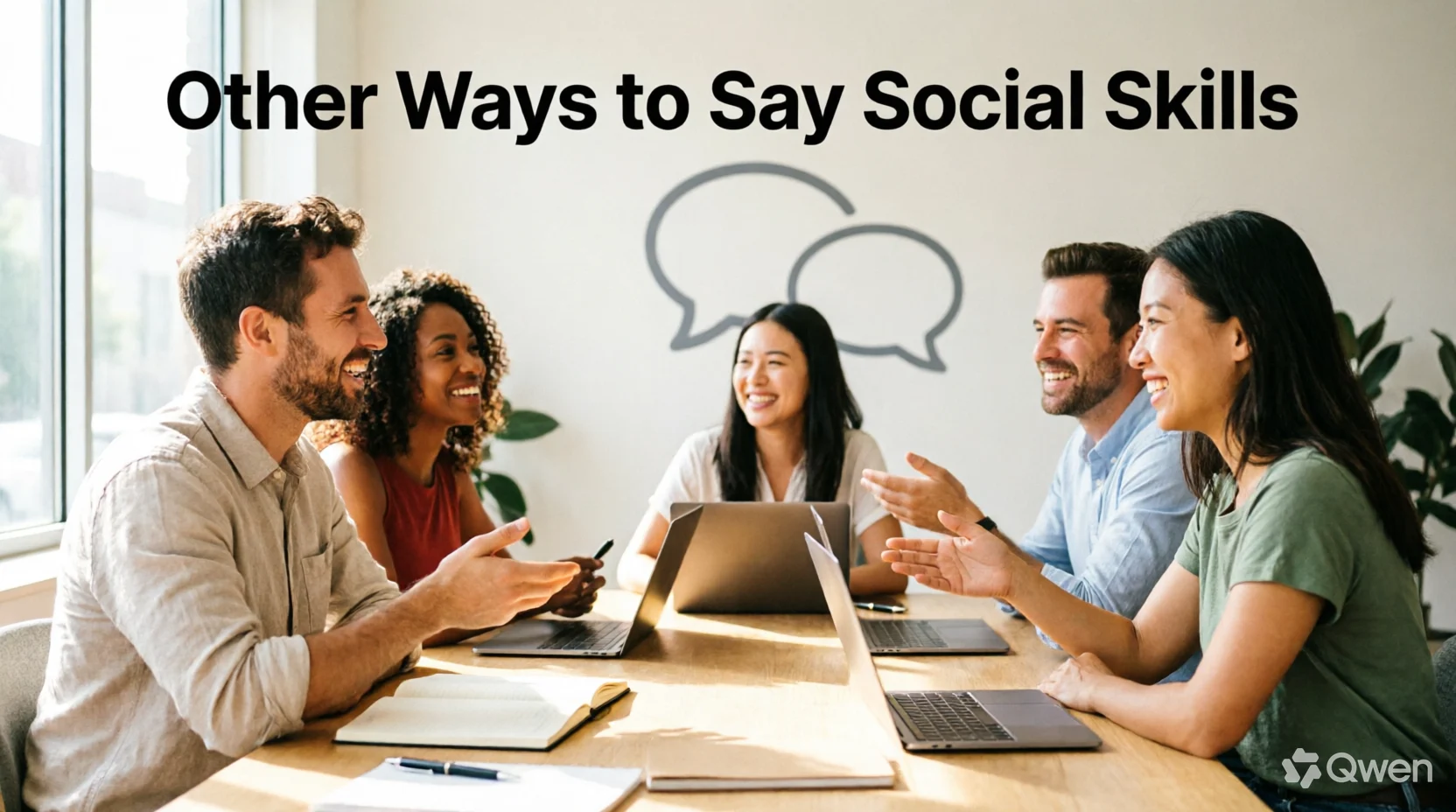
If you need other ways to say social skills, choose a phrase that matches your context, tone, and audience. The best alternatives include interpersonal skills, communication skills, people skills, relationship building skills, and social competence.
Top alternatives to social skills: Interpersonal skills, people skills, communication skills, social competence, relationship building skills.
Social skills are the abilities people use to communicate, interact, cooperate, and build positive relationships with others. The phrase is commonly used in everyday conversations, education, job interviews, resumes, performance reviews, and professional development. For English learners, knowing alternatives to social skills can make communication more precise and flexible. For example, people skills sounds friendly and conversational, while interpersonal skills is more suitable for professional or formal contexts.
Learning other ways to say social skills can help you sound more fluent, confident, and natural in both spoken and written English. Different alternatives allow you to describe communication, teamwork, relationship building, and emotional awareness more accurately depending on the situation. Just as learners explore different ways to express excitement in English, understanding these expressions helps you choose the right words for the right audience, tone, and context. “Fluent English is not only about knowing more words; it is about choosing the right words for the situation.”
Quick Categories
Formal alternatives to “social skills”
• Interpersonal skills
• Social competence
• Interpersonal abilities
• Interpersonal competencies
Pro Tips Box: Use these expressions in academic writing, formal reports, assessments, and professional documents where precision matters.
Casual alternatives
• People skills
• Getting along with others
• Communication abilities
• Being good with people
Pro Tips Box: Casual alternatives work well in conversations, interviews, and friendly discussions, but some are less suitable for formal documents.
Professional alternatives
• Communication skills
• Relationship building skills
• Collaboration skills
• Stakeholder engagement skills
Pro Tips Box: Match the phrase to the specific workplace ability you want to highlight instead of using a broad term unnecessarily.
Informal expressions
• People person skills
• Knowing how to work with people
• Working well with others
• Being comfortable around people
Pro Tips Box: These informal expressions are natural in speech but should usually be replaced with more precise language in resumes and formal reports.
“The more specific your vocabulary, the more accurately you can describe your strengths.”
Common Mistakes
1. Treating every alternative as an exact synonym
Some expressions emphasize communication, while others focus on relationships or teamwork.
Example: “My communication skills are excellent at building friendships.”
2. Using “people skills” in highly formal writing
People skills is understandable, but interpersonal skills usually sounds more professional.
Example: “The report evaluates the employee’s people skills.”
3. Confusing social skills with communication skills
Communication skills can include written communication, while social skills usually emphasize interaction with other people.
Example: “Her social skills include writing detailed technical reports.”
4. Using “social competence” in casual conversation
The phrase is grammatically correct but can sound academic or technical.
Example: “You have excellent social competence” may sound unnatural between friends.
5. Using “social skills” when you mean teamwork
Social skills are broader than teamwork and can include listening, empathy, conversation, and relationship building.
Example: “His social skills helped the project team divide the tasks.”
What Does “Social Skills” Mean?
Social skills are the abilities that help a person communicate and interact effectively with other people.
The phrase is a plural noun phrase. It commonly appears with verbs such as have, develop, improve, demonstrate, and use.
Example: “Strong social skills can help employees build better workplace relationships.”
The term can include listening, speaking, empathy, cooperation, conflict management, emotional awareness, and appropriate social behavior.
When to Use “Social Skills”
You can use social skills when talking about:
• Communicating with friends, colleagues, customers, or strangers
• Building and maintaining relationships
• Listening and responding appropriately
• Cooperating with other people
• Handling disagreements
• Showing empathy and emotional awareness
• Participating effectively in groups
• Discussing personal development or education
Spoken vs Written
Spoken: “She has excellent social skills and gets along with everyone.”
Written: “The training program aims to improve participants’ social skills.”
Formal vs Informal
Formal: “The candidate demonstrates strong interpersonal skills.”
Informal: “He is really good with people.”
Is It Professional or Polite to Say “Social Skills”?
The phrase social skills is polite and widely understood, but it can be somewhat broad in professional communication. In resumes, performance reviews, and business reports, a more specific term often sounds stronger.
Polite? ✔️ Yes
Professional? ❌ No, in most cases when a more precise term is available
Business example: “The candidate demonstrates strong interpersonal skills, particularly in client communication and team collaboration.”
“Professional English becomes stronger when you replace broad labels with specific abilities.”
Pros and Cons of Using “Social Skills”
Pros
• Simple and natural: Easy for most English speakers to understand
• Friendly tone: Does not sound overly technical
• Common usage: Frequently used in education, workplaces, and everyday conversation
• Easy to understand: Suitable for intermediate English learners
Cons
• Too informal for some work contexts: More precise professional terms may be better
• Overused: It can appear vague when describing professional strengths
• Limited emotional range: It does not explain the exact interpersonal ability involved
• Not suitable for some formal writing: Academic or technical contexts may require greater precision
Other Ways to Say “Social Skills” With Examples
These alternatives will help you sound more fluent, confident, and natural in different situations.
Use them according to tone, context, and audience to express excitement, admiration, or approval when discussing someone’s communication and interpersonal strengths.
1. Phrase: Interpersonal Skills
Meaning: Abilities used to communicate and interact effectively with other people.
Explanation: This is one of the strongest professional alternatives to social skills.
Example Sentence: “She has excellent interpersonal skills and works effectively with clients.”
Best Use: Resumes, workplaces
Worst Use: Casual chatting
Tone: Formal, professional, precise
Context Variability: Casual: “He has good interpersonal skills.” Professional: “The role requires strong interpersonal skills.” Spoken: “Her interpersonal skills are impressive.”
2. Phrase: People Skills
Meaning: The ability to interact comfortably and effectively with people.
Explanation: This friendly phrase is common in workplace and conversational English.
Example Sentence: “His people skills make him an excellent customer service representative.”
Best Use: Interviews, conversation
Worst Use: Academic writing
Tone: Friendly, natural, professional
Context Variability: Casual: “She has great people skills.” Professional: “Strong people skills are valuable in sales.” Spoken: “He is known for his people skills.”
3. Phrase: Communication Skills
Meaning: Abilities that help someone communicate information clearly and effectively.
Explanation: This is broader than social skills because it can include written communication.
Example Sentence: “The position requires excellent communication skills.”
Best Use: Resumes, interviews
Worst Use: Social-only contexts
Tone: Professional, broad, clear
Context Variability: Casual: “His communication skills are good.” Professional: “The candidate demonstrates excellent communication skills.” Spoken: “I want to improve my communication skills.”
4. Phrase: Social Competence
Meaning: The ability to behave and communicate effectively in social situations.
Explanation: This term emphasizes effective and appropriate social behavior.
Example Sentence: “The program helps students develop social competence.”
Best Use: Academic, educational
Worst Use: Casual conversation
Tone: Academic, formal, technical
Context Variability: Casual: “She has strong social competence.” Professional: “The assessment measures social competence.” Spoken: “The course focuses on social competence.”
5. Phrase: Relationship Building Skills
Meaning: Abilities used to create and maintain positive relationships.
Explanation: This phrase is particularly useful in professional settings involving clients or teams.
Example Sentence: “Her relationship building skills have helped strengthen client partnerships.”
Best Use: Business, networking
Worst Use: Casual introductions
Tone: Professional, positive, specific
Context Variability: Casual: “He is good at building relationships.” Professional: “Relationship building skills are essential for account managers.” Spoken: “I am confident in my relationship building skills.”
6. Phrase: Collaboration Skills
Meaning: Abilities that help people work successfully with others.
Explanation: This alternative focuses specifically on cooperative work.
Example Sentence: “The candidate demonstrated strong collaboration skills during the project.”
Best Use: Teamwork, resumes
Worst Use: Personal friendships
Tone: Professional, practical, positive
Context Variability: Casual: “She works well with others.” Professional: “Collaboration skills are essential for this role.” Spoken: “I enjoy roles that require collaboration.”
7. Phrase: Interpersonal Abilities
Meaning: Abilities related to interacting and communicating with other people.
Explanation: This formal expression is useful when discussing a person’s overall interaction style.
Example Sentence: “The position requires excellent interpersonal abilities.”
Best Use: Formal reports
Worst Use: Friendly conversation
Tone: Formal, neutral, precise
Context Variability: Casual: “He has strong interpersonal abilities.” Professional: “Her interpersonal abilities support effective leadership.” Spoken: “His interpersonal abilities are impressive.”
8. Phrase: Interpersonal Competencies
Meaning: Specific interpersonal abilities that contribute to effective interaction.
Explanation: This term is especially useful in training, human resources, and competency based assessments.
Example Sentence: “The training focuses on developing interpersonal competencies.”
Best Use: HR, training
Worst Use: Casual speech
Tone: Formal, technical, professional
Context Variability: Casual: “She has strong interpersonal competencies.” Professional: “The framework identifies key interpersonal competencies.” Spoken: “The course develops interpersonal competencies.”
9. Phrase: Social Abilities
Meaning: Abilities that help someone interact appropriately with others.
Explanation: This is a direct and understandable alternative to social skills.
Example Sentence: “Children develop important social abilities through group activities.”
Best Use: Education, general
Worst Use: Business resumes
Tone: Neutral, clear, educational
Context Variability: Casual: “He has good social abilities.” Professional: “The program develops social abilities.” Spoken: “Social abilities improve with practice.”
10. Phrase: Ability to Work With Others
Meaning: The capacity to cooperate and interact effectively with other people.
Explanation: This phrase clearly describes teamwork without using the word skills.
Example Sentence: “The role requires an ability to work effectively with others.”
Best Use: Job applications
Worst Use: Short labels
Tone: Professional, direct, clear
Context Variability: Casual: “She works well with others.” Professional: “The candidate shows an ability to work effectively with others.” Spoken: “I enjoy working with others.”
11. Phrase: Teamwork Skills
Meaning: Abilities that help someone contribute effectively to a team.
Explanation: This focuses on cooperation within groups rather than general social interaction.
Example Sentence: “Strong teamwork skills are essential for this position.”
Best Use: Resumes, interviews
Worst Use: Social relationships
Tone: Professional, practical, positive
Context Variability: Casual: “He is great at teamwork.” Professional: “The candidate demonstrates strong teamwork skills.” Spoken: “I developed my teamwork skills through group projects.”
12. Phrase: Relationship Management Skills
Meaning: Abilities used to maintain productive relationships with people.
Explanation: This phrase works especially well in sales, management, consulting, and client focused roles.
Example Sentence: “Relationship management skills are essential for successful account management.”
Best Use: Business, management
Worst Use: Personal conversations
Tone: Professional, strategic, formal
Context Variability: Casual: “She is good at managing relationships.” Professional: “The role requires strong relationship management skills.” Spoken: “Relationship management is one of my strengths.”
13. Phrase: Communication Abilities
Meaning: The capacity to communicate ideas and information effectively.
Explanation: This is a broad alternative that can include verbal and written communication.
Example Sentence: “The course develops students’ communication abilities.”
Best Use: Education, work
Worst Use: Informal slang
Tone: Neutral, professional, clear
Context Variability: Casual: “His communication abilities are strong.” Professional: “The assessment evaluates communication abilities.” Spoken: “I want to strengthen my communication abilities.”
14. Phrase: Social Interaction Skills
Meaning: Abilities used during interactions with other people.
Explanation: This phrase specifically emphasizes the interaction aspect of social skills.
Example Sentence: “The workshop teaches practical social interaction skills.”
Best Use: Training, education
Worst Use: Business headlines
Tone: Neutral, educational, specific
Context Variability: Casual: “Her social interaction skills are improving.” Professional: “The program develops social interaction skills.” Spoken: “These activities improve social interaction.”
15. Phrase: Networking Skills
Meaning: Abilities used to establish and maintain professional connections.
Explanation: This is a narrower alternative focused on professional relationship building.
Example Sentence: “Strong networking skills can help professionals develop valuable connections.”
Best Use: Careers, business
Worst Use: Family relationships
Tone: Professional, practical, modern
Context Variability: Casual: “He is good at networking.” Professional: “Networking skills are important for business development.” Spoken: “I am working on my networking skills.”
16. Phrase: Client Relationship Skills
Meaning: Abilities used to create and maintain effective relationships with clients.
Explanation: This phrase is particularly relevant to customer facing professional roles.
Example Sentence: “Her client relationship skills have contributed to high customer satisfaction.”
Best Use: Sales, service
Worst Use: General friendship
Tone: Professional, specific, positive
Context Variability: Casual: “She is great with clients.” Professional: “Strong client relationship skills are required.” Spoken: “Client relationships are one of my strengths.”
17. Phrase: Customer Relations Skills
Meaning: Abilities used to communicate effectively with customers.
Explanation: This alternative is useful when social interaction occurs primarily in customer service.
Example Sentence: “The candidate has excellent customer relations skills.”
Best Use: Customer service
Worst Use: Academic writing
Tone: Professional, practical, customer focused
Context Variability: Casual: “He is good with customers.” Professional: “Customer relations skills are essential for this position.” Spoken: “I enjoy working with customers.”
18. Phrase: Emotional Intelligence
Meaning: The ability to understand and manage emotions in oneself and others.
Explanation: Emotional intelligence overlaps with social skills but is not an exact synonym.
Example Sentence: “Her emotional intelligence helps her handle difficult conversations calmly.”
Best Use: Leadership, HR
Worst Use: Basic synonym replacement
Tone: Professional, psychological, positive
Context Variability: Casual: “He has strong emotional intelligence.” Professional: “Emotional intelligence supports effective leadership.” Spoken: “I have been developing my emotional intelligence.”
19. Phrase: Social Awareness
Meaning: The ability to understand other people’s feelings, behavior, and social situations.
Explanation: This focuses on recognizing and responding appropriately to social cues.
Example Sentence: “Social awareness is important when working with diverse teams.”
Best Use: Education, leadership
Worst Use: Simple resume labels
Tone: Neutral, thoughtful, professional
Context Variability: Casual: “She has excellent social awareness.” Professional: “Social awareness supports effective collaboration.” Spoken: “Social awareness helps you understand how others feel.”
20. Phrase: Empathy Skills
Meaning: Abilities that help someone understand and respond to other people’s feelings.
Explanation: Empathy is one component of strong social interaction rather than a complete synonym.
Example Sentence: “Empathy skills can improve communication with customers.”
Best Use: Service, leadership
Worst Use: Technical writing
Tone: Warm, professional, supportive
Context Variability: Casual: “She is very empathetic.” Professional: “Empathy skills are valuable in client service.” Spoken: “Empathy helps me understand different perspectives.”
21. Phrase: Conversational Skills
Meaning: Abilities that help someone participate effectively in conversations.
Explanation: This phrase is useful when the focus is speaking and listening rather than broader relationships.
Example Sentence: “Regular practice can improve conversational skills.”
Best Use: Language learning
Worst Use: Formal HR reports
Tone: Friendly, educational, natural
Context Variability: Casual: “His conversational skills are excellent.” Professional: “Conversational skills are important in client meetings.” Spoken: “I am improving my conversational skills.”
22. Phrase: Listening Skills
Meaning: The ability to understand and respond appropriately to what others say.
Explanation: Listening is a key part of effective social communication.
Example Sentence: “Strong listening skills help employees understand customer concerns.”
Best Use: Workplace, education
Worst Use: Full synonym
Tone: Professional, clear, practical
Context Variability: Casual: “She is a good listener.” Professional: “Strong listening skills improve customer communication.” Spoken: “I am working on my listening skills.”
23. Phrase: Conflict Resolution Skills
Meaning: Abilities used to manage disagreements and reach constructive solutions.
Explanation: This is a specialized aspect of social and interpersonal competence.
Example Sentence: “Managers need strong conflict resolution skills.”
Best Use: Management, HR
Worst Use: Casual introductions
Tone: Professional, practical, authoritative
Context Variability: Casual: “He is good at resolving disagreements.” Professional: “Conflict resolution skills are essential for managers.” Spoken: “I have developed my conflict resolution skills.”
24. Phrase: Rapport Building Skills
Meaning: Abilities used to establish trust and a comfortable connection with others.
Explanation: This phrase is especially useful in sales, interviews, coaching, and client relationships.
Example Sentence: “Her rapport building skills help clients feel comfortable.”
Best Use: Sales, coaching
Worst Use: Academic definitions
Tone: Professional, positive, interpersonal
Context Variability: Casual: “He builds rapport quickly.” Professional: “Rapport building skills are valuable in consulting.” Spoken: “I am good at building rapport.”
25. Phrase: Relationship Skills
Meaning: Abilities that help someone establish and maintain healthy relationships.
Explanation: This is a broad phrase that can apply to personal and professional settings.
Example Sentence: “Strong relationship skills can improve workplace cooperation.”
Best Use: General communication
Worst Use: Highly technical writing
Tone: Neutral, friendly, positive
Context Variability: Casual: “She has great relationship skills.” Professional: “Relationship skills support effective leadership.” Spoken: “Good relationship skills take practice.”
26. Phrase: Cooperation Skills
Meaning: Abilities that help someone cooperate effectively with others.
Explanation: This phrase emphasizes willingness and ability to work toward shared goals.
Example Sentence: “The activity develops cooperation skills among students.”
Best Use: Education, teamwork
Worst Use: Networking contexts
Tone: Neutral, educational, practical
Context Variability: Casual: “The children are learning cooperation skills.” Professional: “Cooperation skills support effective teamwork.” Spoken: “Good cooperation makes projects easier.”
27. Phrase: Social Communication Skills
Meaning: Abilities used to communicate appropriately during social interactions.
Explanation: This phrase combines communication ability with social awareness.
Example Sentence: “The course focuses on developing social communication skills.”
Best Use: Education, training
Worst Use: Short business bios
Tone: Educational, formal, specific
Context Variability: Casual: “He is improving his social communication skills.” Professional: “The program develops social communication skills.” Spoken: “Social communication improves through practice.”
28. Phrase: Stakeholder Engagement Skills
Meaning: Abilities used to communicate with and maintain productive relationships with stakeholders.
Explanation: This is a highly professional alternative for business and organizational contexts.
Example Sentence: “The project manager demonstrated excellent stakeholder engagement skills.”
Best Use: Corporate, project work
Worst Use: Casual conversation
Tone: Corporate, formal, strategic
Context Variability: Casual: “She is good at working with different groups.” Professional: “Stakeholder engagement skills are essential for project success.” Spoken: “I have strong stakeholder engagement skills.”
29. Phrase: People Management Skills
Meaning: Abilities used to guide, communicate with, support, and manage other people.
Explanation: This phrase is more specific than social skills because it implies a leadership or supervisory role.
Example Sentence: “The position requires strong people management skills.”
Best Use: Leadership, management
Worst Use: Personal friendships
Tone: Professional, managerial, confident
Context Variability: Casual: “He is good at managing people.” Professional: “People management skills are essential for team leaders.” Spoken: “I want to strengthen my people management skills.”
30. Phrase: Ability to Connect With Others
Meaning: The ability to establish comfortable and meaningful connections with people.
Explanation: This natural phrase emphasizes warmth, understanding, and relationship building.
Example Sentence: “Her ability to connect with others makes her an effective mentor.”
Best Use: Interviews, profiles
Worst Use: Technical resumes
Tone: Warm, natural, positive
Context Variability: Casual: “He connects easily with others.” Professional: “Her ability to connect with others supports effective leadership.” Spoken: “I have always found it easy to connect with others.”
“Do not choose a synonym because it looks impressive. Choose it because it accurately describes the skill you mean.”
Professional Reaction Phrases Related to Social Skills
When discussing communication strengths at work, specific professional reaction phrases often sound more natural than simply saying someone has good social skills.
Consider:
• “She communicates effectively with colleagues and clients.”
• “He builds rapport quickly with new customers.”
• “She handles difficult conversations professionally.”
• “He collaborates effectively across teams.”
• “She demonstrates strong interpersonal awareness.”
• “He listens carefully and responds thoughtfully.”
• “She builds productive professional relationships.”
For everyday communication, you may also hear informal expressions in English such as “good with people,” “works well with others,” and “gets along with everyone.”
Mini Quiz: Test Your Understanding
1. Which phrase is most appropriate for a formal resume?
A. Good with people
B. People person
C. Interpersonal skills
D. Gets along with everyone
Answer: C. Interpersonal skills
2. Which phrase is most suitable when describing cooperation within a team?
A. Teamwork skills
B. Social awareness
C. Emotional intelligence
D. Conversational skills
Answer: A. Teamwork skills
3. You are speaking casually about a colleague who communicates well with everyone. Which sounds most natural?
A. “She demonstrates interpersonal competencies.”
B. “She has great people skills.”
C. “She demonstrates stakeholder engagement capabilities.”
D. “She possesses social competence.”
Answer: B. She has great people skills.
4. Which phrase specifically emphasizes understanding other people’s feelings?
A. Networking skills
B. Collaboration skills
C. Empathy skills
D. Teamwork skills
Answer: C. Empathy skills
Comparison Table: Top Alternatives
| Phrase | Tone | Best Use |
|---|---|---|
| Interpersonal skills | Formal | Resumes and reports |
| People skills | Friendly | Interviews and conversation |
| Communication skills | Professional | Jobs and education |
| Social competence | Academic | Research and education |
| Relationship building skills | Professional | Business and networking |
| Collaboration skills | Professional | Teamwork |
| Emotional intelligence | Professional | Leadership and HR |
| Networking skills | Professional | Careers and business |
| Conversational skills | Natural | Language learning |
| Ability to work with others | Direct | Job applications |
FAQs
What are the best alternatives to social skills?
The best alternatives depend on context. Interpersonal skills is excellent for formal and professional situations, while people skills sounds more natural in casual conversation.
What is a professional way to say social skills?
Interpersonal skills is usually the strongest professional alternative. You can also use communication skills, collaboration skills, relationship building skills, or stakeholder engagement skills when they describe the specific ability.
Can I use “people skills” on a resume?
Yes, but interpersonal skills usually sounds more polished on a resume. Use “people skills” when a friendly, accessible tone is appropriate.
Are social skills and communication skills the same?
Not exactly. Social skills focus primarily on interacting effectively with people, while communication skills can include speaking, listening, writing, presenting, and other forms of communication.
How can I improve my vocabulary for social skills?
Learn alternatives by context rather than memorizing isolated synonyms. Practice using formal, professional, casual, and informal expressions in complete sentences.
Conclusion
Learning other ways to say social skills gives you more control over your English. Instead of repeatedly using one broad phrase, you can choose interpersonal skills for formal writing, people skills for friendly conversation, or relationship building skills when discussing professional relationships.
The most important step is to practice tone awareness. Choose one new expression each day and use it in a sentence, conversation, email, or professional context. With regular practice, your vocabulary will become more precise, flexible, and confident.
Which alternative do you use most often? Share your favorite phrase and your example sentence to practice with other English learners.