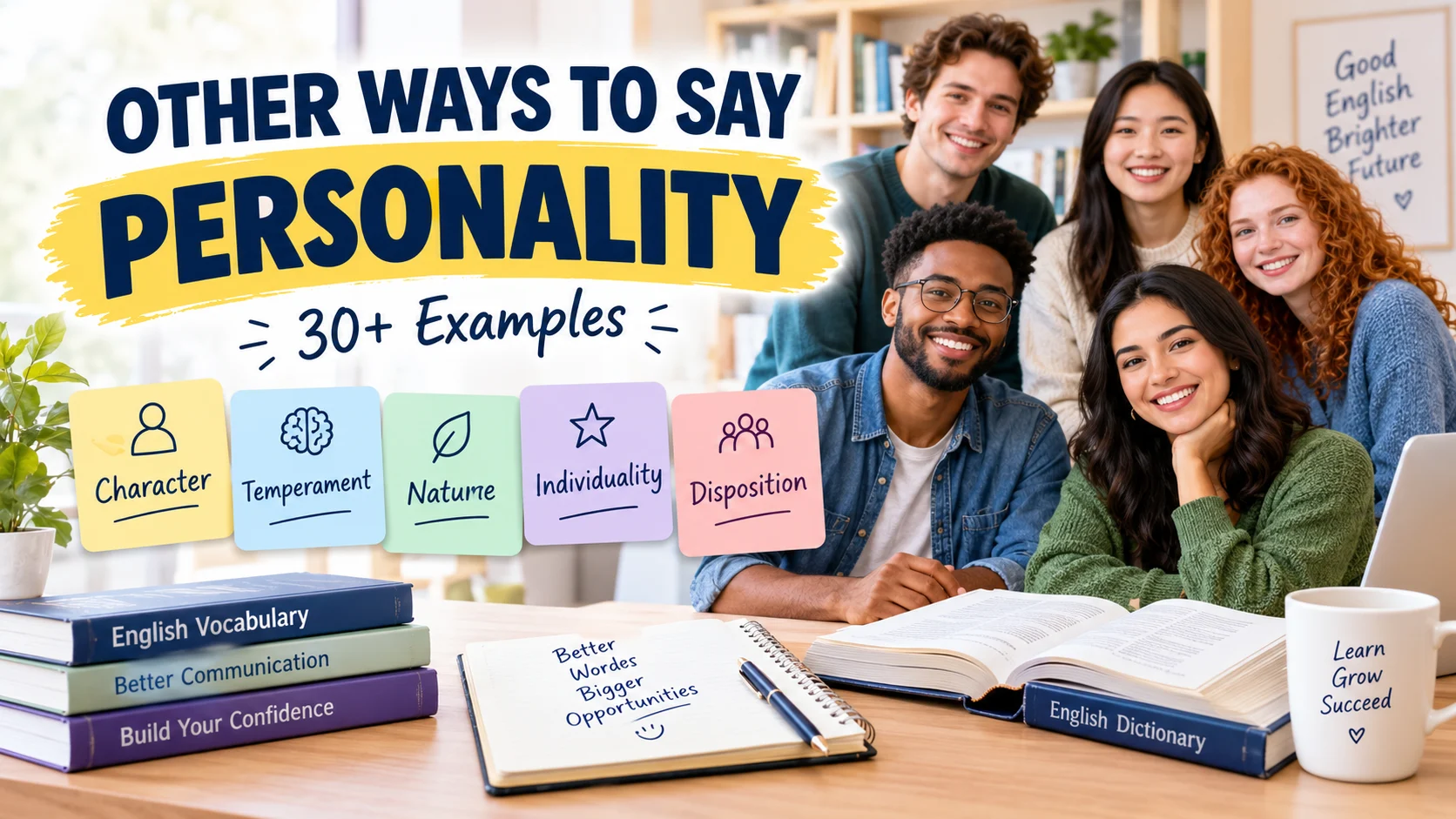
If you want to describe someone’s personality more precisely, you can use alternatives such as character, temperament, nature, disposition, individuality, and personal qualities. These expressions help you communicate more naturally in everyday conversations, professional settings, and descriptive writing.
Top 5 alternatives: Character, temperament, nature, disposition, individuality.
Introduction
Personality describes the combination of qualities, behaviors, attitudes, and characteristics that make someone unique. It helps explain how a person thinks, feels, communicates, and interacts with others. Whether you are describing a friend, introducing a colleague, writing a professional profile, or discussing someone’s behavior, choosing the right vocabulary makes your English more expressive.
Learning other ways to say personality allows you to communicate with greater precision. For example, character often highlights someone’s moral qualities, while temperament describes their natural emotional tendencies. Similarly, disposition focuses on someone’s usual attitude, and individuality emphasizes what makes them different from others.
From an English-learning perspective, understanding these distinctions is more useful than memorizing synonyms without context. This guide explores formal, casual, and professional alternatives, with practical examples and explanations. You will also discover how to choose suitable expressions for different situations, improve your descriptive vocabulary, and develop more natural communication skills. Although these words do not directly express excitement in English, they help you describe the personal qualities that influence how people communicate and respond.
Formal Alternatives to “Personality”
Formal vocabulary is useful when describing someone’s behavior, character, or psychological qualities in academic writing, reports, interviews, and professional discussions.
- Character: Highlights someone’s moral qualities, values, and principles.
- Disposition: Describes a person’s natural attitude or emotional tendencies.
- Temperament: Refers to someone’s typical emotional responses and behavioral patterns.
Pro Tip: Use character when discussing someone’s integrity and disposition when describing their general attitude. These words are not always interchangeable.
Casual Alternatives to “Personality”
These expressions work well in everyday conversations when discussing what someone is like.
- Nature: Describes someone’s natural qualities or usual behavior.
- Way of being: Refers to the distinctive manner in which someone behaves and interacts.
- Personal qualities: Describes the individual characteristics that define someone.
Pro Tip: Use nature in everyday conversations and personal qualities when you want to describe someone’s strengths or characteristics clearly.
Professional Alternatives to “Personality”
In workplaces, interviews, performance reviews, and professional introductions, these expressions can communicate someone’s qualities more precisely.
- Personal attributes: Refers to qualities that influence someone’s behavior and interactions.
- Behavioral traits: Describes recognizable patterns in how someone acts.
- Interpersonal qualities: Highlights characteristics that affect how someone communicates and works with others.
Pro Tip: Use interpersonal qualities when discussing teamwork, collaboration, and communication. Use behavioral traits when describing observable workplace behavior.
Informal Expressions
These alternatives sound natural in relaxed conversations, personal descriptions, and friendly discussions.
- Vibe: Describes the general impression someone creates.
- Individuality: Highlights the distinctive qualities that make someone unique.
- Personal style: Refers to the recognizable way someone expresses themselves.
Pro Tip: Vibe is suitable for informal conversations, but choose individuality or personal style for more polished descriptions.
Common Mistakes When Using “Personality”
Although personality is a familiar English word, learners sometimes use it incorrectly or choose it when a more specific expression would communicate their meaning better.
Here are five common mistakes to avoid.
1. Confusing Personality With Character
Personality describes a broad combination of personal qualities, while character often emphasizes moral principles and values.
Incorrect: Her personality proves that she is always honest.
Better: Her character shows that she values honesty.
2. Using Temperament to Describe Physical Appearance
Temperament refers to emotional and behavioral tendencies, not someone’s physical appearance.
Incorrect: She has a beautiful temperament and attractive eyes.
Better: She has a calm temperament and a confident appearance.
3. Treating Disposition and Mood as Identical
Disposition generally describes a person’s usual attitude, whereas mood often refers to a temporary emotional state.
Incorrect: His disposition changed after receiving bad news.
Better: His mood changed after receiving bad news.
4. Using Informal Expressions in Formal Writing
Words such as vibe can sound too casual in academic or professional communication.
Incorrect: The candidate has a positive vibe during interviews.
Better: The candidate demonstrates a positive disposition during interviews.
5. Using Personality When a Specific Trait Is Needed
Personality is a broad term. Sometimes a more precise word communicates the intended quality better.
Incorrect: Her personality is very patient.
Better: She demonstrates remarkable patience.
What Does “Personality” Mean?
Personality refers to the combination of psychological characteristics, behavioral patterns, emotional tendencies, attitudes, and qualities that distinguish one individual from another.
It influences how people:
- Think and make decisions.
- Express emotions.
- Communicate with others.
- Respond to challenges.
- Build relationships.
- Behave in different situations.
Grammar Explanation
Personality is a noun. It is generally an uncountable noun when discussing the concept of personality as a whole.
However, it can also be used as a countable noun when referring to an individual’s distinctive personality.
Examples:
- She has a friendly personality.
- Their personalities are completely different.
- His personality makes him a natural leader.
Common grammatical combinations include:
- Positive personality
- Strong personality
- Unique personality
- Outgoing personality
- Introverted personality
- Pleasant personality
When to Use “Personality”
The word personality is appropriate in several everyday, academic, and professional situations.
1. Describing Someone’s Character
Use it when explaining what makes someone distinctive.
Example: Her personality makes everyone feel comfortable around her.
2. Discussing Relationships
It helps explain compatibility between friends, colleagues, and partners.
Example: Their personalities complement each other.
3. Writing Professional Profiles
Use it when discussing someone’s communication style, workplace behavior, or personal characteristics.
Example: His personality makes him an effective team leader.
4. Academic and Psychological Discussions
Personality is frequently used when discussing individual differences, behavior, and psychological characteristics.
Example: Researchers examined how personality influences decision-making.
5. Everyday Conversations
It is useful when talking about someone’s general nature or attitude.
Example: I really like her personality because she is kind and approachable.
Spoken vs. Written Usage
| Situation | Recommended Expression | Example |
|---|---|---|
| Everyday speaking | Nature | I like her nature. |
| Professional writing | Personal attributes | Her personal attributes support effective teamwork. |
| Academic writing | Personality traits | Personality traits influence individual behavior. |
| Friendly conversation | Vibe | He has a positive vibe. |
| Formal discussion | Disposition | She has a cooperative disposition. |
Formal vs. Informal Usage
| Formal | Informal |
|---|---|
| Character | Nature |
| Disposition | Vibe |
| Temperament | Way of being |
| Personal attributes | Personal style |
| Behavioral traits | Individuality |
Is It Professional or Polite to Say “Personality”?
Yes. Personality is both polite and professionally acceptable. It is a neutral word that can be used in workplace conversations, interviews, academic discussions, and professional documents.
However, the word itself is broad. More specific alternatives can make professional communication clearer.
Business-style example:
“Her interpersonal qualities and collaborative approach make her a valuable member of the team.”
- Polite? Yes.
- Professional? Yes.
- Best approach: Choose a more specific alternative when discussing a particular quality or behavior.
Pros and Cons of Using “Personality”
Understanding the strengths and limitations of this word can help you decide when to use it and when another expression would be more effective.
Pros
- Simple and natural: Easy to understand and use in everyday English.
- Friendly tone: Suitable for positive personal descriptions.
- Common usage: Widely understood in professional and informal communication.
- Broad meaning: Can describe several aspects of someone’s behavior and character.
Cons
- Can be vague: Does not always explain which particular quality you mean.
- Overused: Repeating it can make descriptions less interesting.
- Limited precision: May not communicate specific emotional or behavioral characteristics.
- Context matters: Some situations require more precise vocabulary, such as temperament or interpersonal qualities.
Other Ways to Say Personality (With Examples)
Learning alternatives to personality helps you describe people with greater accuracy and confidence. Each expression carries a slightly different meaning, making it important to understand its appropriate context.
These alternatives will help you sound more fluent, confident, and natural in different situations.
Use them according to tone, context, and audience to describe someone’s character, qualities, behavior, or individuality.
1. Character
Meaning: The combination of moral qualities and personal principles that define someone.
Explanation: Character emphasizes honesty, integrity, responsibility, and values rather than someone’s general social behavior.
Example Sentence: Her strong character helped her overcome several difficult situations.
Best Use: Moral qualities
Worst Use: Physical appearance
Tone: Formal, positive, descriptive
Context Variability:
- Casual: I really admire his character.
- Professional: Her character reflects integrity and responsibility.
- Spoken: He has an excellent character.
2. Temperament
Meaning: A person’s natural emotional tendencies and usual reactions.
Explanation: This word is especially useful when describing whether someone is naturally calm, energetic, sensitive, or impatient.
Example Sentence: His calm temperament makes him an excellent mediator.
Best Use: Emotional tendencies
Worst Use: Personal appearance
Tone: Formal, descriptive, psychological
Context Variability:
- Casual: She has a relaxed temperament.
- Professional: His temperament supports effective conflict management.
- Spoken: I like her calm temperament.
3. Nature
Meaning: The basic qualities or natural characteristics of an individual.
Explanation: Nature is a flexible alternative that works particularly well in everyday conversations.
Example Sentence: Her generous nature makes her popular among her friends.
Best Use: Everyday descriptions
Worst Use: Technical analysis
Tone: Natural, friendly, neutral
Context Variability:
- Casual: He has a helpful nature.
- Professional: Her thoughtful nature supports positive relationships.
- Spoken: That’s just his nature.
4. Disposition
Meaning: A person’s usual attitude, mood, or emotional tendency.
Explanation: Disposition is useful when describing whether someone is naturally optimistic, cheerful, cooperative, or reserved.
Example Sentence: She has a cheerful disposition that encourages everyone around her.
Best Use: General attitude
Worst Use: Physical features
Tone: Formal, polished, descriptive
Context Variability:
- Casual: He has a friendly disposition.
- Professional: The employee demonstrates a cooperative disposition.
- Spoken: I appreciate her positive disposition.
5. Individuality
Meaning: The distinctive qualities that make someone different from other people.
Explanation: Use individuality when emphasizing originality, independence, and personal identity.
Example Sentence: Her individuality makes her stand out in a crowd.
Best Use: Personal uniqueness
Worst Use: Group behavior
Tone: Positive, expressive, neutral
Context Variability:
- Casual: I love her individuality.
- Professional: The organization values creativity and individuality.
- Spoken: He has a strong sense of individuality.
6. Personal Qualities
Meaning: The characteristics and attributes that describe an individual’s behavior and identity.
Explanation: This expression is useful when discussing someone’s strengths, attitudes, and positive characteristics.
Example Sentence: Her personal qualities make her an excellent friend and colleague.
Best Use: General descriptions
Worst Use: Precise psychology
Tone: Neutral, professional, descriptive
Context Variability:
- Casual: I admire his personal qualities.
- Professional: Her personal qualities contribute to effective leadership.
- Spoken: Those are wonderful personal qualities.
7. Behavioral Traits
Meaning: The recognizable patterns in how someone acts or responds.
Explanation: This expression is particularly suitable for describing observable habits and behaviors.
Example Sentence: His behavioral traits demonstrate patience and self-discipline.
Best Use: Behavior analysis
Worst Use: Casual compliments
Tone: Analytical, formal, objective
Context Variability:
- Casual: I’ve noticed some interesting behavioral traits.
- Professional: The assessment examines relevant behavioral traits.
- Spoken: These behavioral traits are worth discussing.
8. Personal Attributes
Meaning: The individual characteristics or qualities that describe someone.
Explanation: Personal attributes is a professional expression for discussing someone’s abilities, attitudes, and characteristics.
Example Sentence: Communication and adaptability are important personal attributes.
Best Use: Professional profiles
Worst Use: Relaxed conversation
Tone: Formal, professional, neutral
Context Variability:
- Casual: Those are some great personal attributes.
- Professional: Her personal attributes make her suitable for leadership.
- Spoken: Adaptability is one of his strongest personal attributes.
9. Interpersonal Qualities
Meaning: Characteristics that influence how someone interacts and communicates with others.
Explanation: This phrase is especially useful when discussing teamwork, relationships, empathy, and communication.
Example Sentence: Her interpersonal qualities make collaboration easier.
Best Use: Workplace communication
Worst Use: Physical descriptions
Tone: Professional, positive, polished
Context Variability:
- Casual: He has excellent interpersonal qualities.
- Professional: The position requires strong interpersonal qualities.
- Spoken: Her interpersonal qualities are impressive.
10. Personal Characteristics
Meaning: The distinctive features or qualities that describe an individual.
Explanation: This is a broad expression that can refer to someone’s behavior, attitudes, and individual traits.
Example Sentence: Patience and curiosity are two of her strongest personal characteristics.
Best Use: General descriptions
Worst Use: Specific moral judgments
Tone: Neutral, descriptive, formal
Context Variability:
- Casual: We have different personal characteristics.
- Professional: The assessment considers relevant personal characteristics.
- Spoken: Everyone has different personal characteristics.
11. Persona
Meaning: The particular identity or image someone presents to others.
Explanation: Persona often refers to the public image or outward personality someone displays in social or professional situations.
Example Sentence: His confident public persona makes him an engaging speaker.
Best Use: Public image
Worst Use: Private emotions
Tone: Sophisticated, formal, descriptive
Context Variability:
- Casual: She has an interesting online persona.
- Professional: The speaker maintains a confident professional persona.
- Spoken: His public persona is quite different from his private self.
12. Demeanor
Meaning: The way someone appears or behaves, particularly in social situations.
Explanation: Demeanor emphasizes outward behavior, including someone’s manner, attitude, and presentation.
Example Sentence: Her calm demeanor helped everyone remain focused.
Best Use: Observed behavior
Worst Use: Deep character analysis
Tone: Formal, professional, neutral
Context Variability:
- Casual: I like his relaxed demeanor.
- Professional: The candidate maintained a confident demeanor.
- Spoken: She has a pleasant demeanor.
13. Attitude
Meaning: A person’s way of thinking or feeling about something.
Explanation: Attitude is a useful alternative when you want to discuss someone’s outlook, mindset, or approach rather than their entire personality.
Example Sentence: Her positive attitude helps her handle challenges.
Best Use: Mindset descriptions
Worst Use: Complete identity
Tone: Neutral, direct, conversational
Context Variability:
- Casual: I love your attitude.
- Professional: His proactive attitude supports team success.
- Spoken: She has a wonderful attitude toward learning.
14. Character Traits
Meaning: Specific qualities that describe someone’s character.
Explanation: This phrase is useful when identifying individual characteristics such as honesty, kindness, patience, or courage.
Example Sentence: Honesty and determination are admirable character traits.
Best Use: Individual qualities
Worst Use: Physical appearance
Tone: Educational, descriptive, formal
Context Variability:
- Casual: Kindness is one of her best character traits.
- Professional: Integrity is among the essential character traits of an effective leader.
- Spoken: We all have different character traits.
15. Distinctive Qualities
Meaning: The special characteristics that make someone recognizable or different.
Explanation: Use this expression when highlighting what makes an individual memorable or unique.
Example Sentence: Her distinctive qualities make her an exceptional teacher.
Best Use: Unique features
Worst Use: Temporary emotions
Tone: Positive, polished, descriptive
Context Variability:
- Casual: I love his distinctive qualities.
- Professional: Her distinctive qualities strengthen the team.
- Spoken: Those distinctive qualities make her special.
16. Personal Disposition
Meaning: A person’s natural tendency to behave or respond in particular ways.
Explanation: This phrase emphasizes someone’s general emotional attitude and approach to everyday situations.
Example Sentence: His friendly personal disposition makes him approachable.
Best Use: General temperament
Worst Use: Physical appearance
Tone: Formal, thoughtful, descriptive
Context Variability:
- Casual: She has a friendly disposition.
- Professional: His personal disposition supports positive workplace relationships.
- Spoken: I appreciate his pleasant disposition.
17. Way of Being
Meaning: The distinctive manner in which someone thinks, behaves, and interacts.
Explanation: This expression offers a natural way to describe someone’s overall manner without using technical vocabulary.
Example Sentence: I appreciate her gentle way of being.
Best Use: Personal descriptions
Worst Use: Technical reports
Tone: Warm, conversational, reflective
Context Variability:
- Casual: I love her way of being.
- Professional: His thoughtful way of being supports strong relationships.
- Spoken: That’s simply her way of being.
18. Personal Style
Meaning: The individual manner in which someone expresses themselves.
Explanation: Personal style can describe communication, behavior, preferences, and self-expression.
Example Sentence: Her personal style reflects confidence and creativity.
Best Use: Self-expression
Worst Use: Moral qualities
Tone: Friendly, descriptive, modern
Context Variability:
- Casual: I like your personal style.
- Professional: Her personal style encourages creative thinking.
- Spoken: Everyone has their own personal style.
19. Manner
Meaning: The way someone behaves, speaks, or interacts with others.
Explanation: Manner is useful when describing someone’s conduct or the way they present themselves.
Example Sentence: He has a polite and respectful manner.
Best Use: Social behavior
Worst Use: Deep psychology
Tone: Neutral, polite, descriptive
Context Variability:
- Casual: I like her friendly manner.
- Professional: The manager addressed the issue in a respectful manner.
- Spoken: She has a lovely manner.
20. Individual Traits
Meaning: The specific characteristics that distinguish one person from another.
Explanation: This expression helps identify particular qualities without referring to someone’s overall personality.
Example Sentence: Creativity and patience are valuable individual traits.
Best Use: Specific characteristics
Worst Use: General compliments
Tone: Analytical, neutral, educational
Context Variability:
- Casual: We all have different individual traits.
- Professional: The assessment identifies important individual traits.
- Spoken: Patience is one of his strongest individual traits.
21. Social Style
Meaning: The way someone behaves and communicates in social situations.
Explanation: Social style is especially relevant when discussing communication preferences and interactions with other people.
Example Sentence: Her outgoing social style helps her build friendships easily.
Best Use: Social interactions
Worst Use: Private identity
Tone: Conversational, descriptive, neutral
Context Variability:
- Casual: I like his social style.
- Professional: Her social style encourages team engagement.
- Spoken: We have very different social styles.
22. Psychological Makeup
Meaning: The combination of mental and emotional characteristics that influence someone’s behavior.
Explanation: This expression is generally used in discussions involving psychology, emotions, and individual differences.
Example Sentence: Stress can affect different aspects of a person’s psychological makeup.
Best Use: Psychological discussions
Worst Use: Casual compliments
Tone: Technical, academic, formal
Context Variability:
- Casual: Everyone has a different psychological makeup.
- Professional: The research examines individual psychological makeup.
- Spoken: Our psychological makeup influences how we respond to challenges.
23. Behavioral Pattern
Meaning: A recurring way in which someone acts or responds.
Explanation: Use this expression when focusing on repeated actions rather than someone’s entire identity.
Example Sentence: Her behavioral patterns suggest that she prefers working independently.
Best Use: Repeated behavior
Worst Use: One-time reactions
Tone: Analytical, professional, neutral
Context Variability:
- Casual: I’ve noticed his behavioral patterns.
- Professional: The report identifies recurring behavioral patterns.
- Spoken: That’s an interesting behavioral pattern.
24. Inner Character
Meaning: The deeper moral and personal qualities that define someone.
Explanation: Inner character emphasizes qualities that may not be immediately visible, such as courage, honesty, and compassion.
Example Sentence: Difficult situations often reveal someone’s inner character.
Best Use: Deep qualities
Worst Use: Surface appearance
Tone: Reflective, positive, meaningful
Context Variability:
- Casual: I admire her inner character.
- Professional: Strong inner character supports ethical decision-making.
- Spoken: His actions reveal his inner character.
25. Individual Identity
Meaning: The characteristics and qualities that make someone a distinct individual.
Explanation: Individual identity is broader than personality because it can also include personal experiences, beliefs, and self-understanding.
Example Sentence: Her individual identity is reflected in her choices and creative work.
Best Use: Personal identity
Worst Use: Temporary behavior
Tone: Formal, reflective, descriptive
Context Variability:
- Casual: Everyone deserves to express their individual identity.
- Professional: The organization respects individual identity.
- Spoken: Your individual identity makes you unique.
26. Emotional Makeup
Meaning: The emotional characteristics that influence how someone feels and reacts.
Explanation: This expression is useful when describing someone’s emotional sensitivity, resilience, or general emotional tendencies.
Example Sentence: Her emotional makeup allows her to remain composed during difficult conversations.
Best Use: Emotional tendencies
Worst Use: Physical appearance
Tone: Descriptive, psychological, neutral
Context Variability:
- Casual: We have different emotional makeup.
- Professional: Emotional makeup can influence workplace responses.
- Spoken: His emotional makeup is quite different from mine.
27. Personal Nature
Meaning: The natural characteristics and tendencies that influence someone’s behavior.
Explanation: Personal nature is commonly used to describe whether someone is naturally kind, generous, patient, or independent.
Example Sentence: Her personal nature makes her easy to approach.
Best Use: Natural qualities
Worst Use: Technical assessments
Tone: Friendly, neutral, descriptive
Context Variability:
- Casual: He has a kind personal nature.
- Professional: Her personal nature supports positive interactions.
- Spoken: That’s part of her personal nature.
28. Character and Disposition
Meaning: A combination of someone’s moral qualities and general emotional attitude.
Explanation: This expression is useful when you want to discuss both a person’s principles and their usual behavior.
Example Sentence: Her character and disposition make her a trustworthy colleague.
Best Use: Complete descriptions
Worst Use: Brief introductions
Tone: Formal, thoughtful, descriptive
Context Variability:
- Casual: I admire his character and disposition.
- Professional: The role requires strong character and a cooperative disposition.
- Spoken: Her character and disposition are admirable.
29. Distinctive Personality Traits
Meaning: The specific characteristics that make someone’s personality recognizable.
Explanation: This phrase is useful when identifying the individual qualities that distinguish someone from others.
Example Sentence: Her curiosity and determination are distinctive personality traits.
Best Use: Specific traits
Worst Use: Simple conversation
Tone: Educational, descriptive, formal
Context Variability:
- Casual: Confidence is one of his distinctive personality traits.
- Professional: The assessment highlights several distinctive personality traits.
- Spoken: Those are some of her most noticeable personality traits.
30. Personal Essence
Meaning: The fundamental qualities that express who someone is as an individual.
Explanation: Personal essence is a more expressive and reflective alternative that emphasizes someone’s underlying identity and defining qualities.
Example Sentence: Her kindness and creativity are central to her personal essence.
Best Use: Deep descriptions
Worst Use: Technical reports
Tone: Reflective, expressive, sophisticated
Context Variability:
- Casual: I love her genuine personal essence.
- Professional: Authenticity is central to her professional identity.
- Spoken: His personal essence makes him memorable.
Scroll-Stopping Highlights: Choosing the Right Alternative
“Character reveals what someone stands for, while temperament reveals how someone naturally responds.”
“The best description is not always the most complicated word. It is the word that communicates your meaning accurately.”
“Use individuality to celebrate uniqueness and disposition to describe someone’s usual attitude.”
“Professional English becomes more effective when broad descriptions are replaced with specific qualities.”
Mini Quiz: Test Your Understanding
Choose the most appropriate alternative for each situation.
Question 1: Which word best describes someone’s moral values and integrity?
A. Vibe
B. Character
C. Demeanor
D. Personal style
Correct Answer: B. Character
Explanation: Character focuses on moral qualities, values, and principles.
Question 2: You want to describe a colleague who remains calm under pressure. Which expression is most appropriate?
A. Temperament
B. Individuality
C. Persona
D. Personal style
Correct Answer: A. Temperament
Explanation: Temperament describes someone’s natural emotional tendencies and reactions.
Question 3: Which expression is most appropriate in a professional discussion about teamwork and communication?
A. Vibe
B. Way of being
C. Interpersonal qualities
D. Personal essence
Correct Answer: C. Interpersonal qualities
Explanation: Interpersonal qualities describe characteristics that influence communication and relationships.
Question 4: Which expression is best for an informal conversation about someone’s general impression?
A. Psychological makeup
B. Behavioral traits
C. Personal attributes
D. Vibe
Correct Answer: D. Vibe
Explanation: Vibe is an informal expression for the general impression someone creates.
Comparison Table: Top 10 Alternatives to Personality
The following comparison makes it easier to select an expression based on your intended meaning and communication style.
| Phrase | Tone | Best Use |
|---|---|---|
| Character | Formal, positive | Moral values and integrity |
| Temperament | Formal, analytical | Emotional tendencies |
| Nature | Friendly, neutral | Everyday descriptions |
| Disposition | Polished, formal | General attitude |
| Individuality | Positive, expressive | Uniqueness |
| Personal qualities | Neutral, professional | General characteristics |
| Behavioral traits | Analytical, formal | Observable behavior |
| Personal attributes | Professional, neutral | Workplace descriptions |
| Interpersonal qualities | Professional, positive | Communication and teamwork |
| Demeanor | Formal, descriptive | Outward behavior |
Frequently Asked Questions
1. What are the best alternatives to personality?
Some of the best alternatives include character, temperament, nature, disposition, individuality, personal qualities, and personal attributes. The best choice depends on the specific quality you want to describe.
2. What is a more professional word for personality?
Personal attributes, interpersonal qualities, behavioral traits, and personal characteristics are useful professional alternatives. They provide more specific descriptions in workplace communication.
3. What is the difference between personality and character?
Personality describes someone’s overall psychological and behavioral qualities, while character focuses more specifically on moral values, principles, and integrity.
4. What is another way to describe someone’s personality positively?
You can describe someone as kind-hearted, approachable, confident, thoughtful, outgoing, considerate, or warm. These expressions identify specific positive qualities rather than using a broad term.
5. What is the difference between temperament and disposition?
Temperament refers to natural emotional tendencies and reactions, while disposition describes someone’s general attitude or usual emotional outlook.
Conclusion
Learning other ways to say personality helps you move beyond basic vocabulary and communicate more accurately. Words such as character, temperament, disposition, individuality, and interpersonal qualities each describe a different aspect of what makes someone unique. Understanding these differences allows you to select expressions that match your intended meaning.
Make vocabulary practice part of your daily English routine. Try using one or two new alternatives in conversations, professional emails, and personal descriptions. Pay attention to tone, audience, and context because choosing the right word is just as important as knowing its meaning. With regular practice, you can develop a richer vocabulary and express your ideas more naturally and confidently.